
By April 2026, the global market for AI security reached a staggering $30.8 billion, yet the density of marketing noise makes it harder than ever to distinguish legitimate ai security companies from those offering a thin layer of buzzwords. With venture capital firms funneling over $1.3 billion into the sector in Q1 2026 alone, you're likely facing an overwhelming influx of "AI-native" pitches. It's frustrating to realize that while technology evolves at breakneck speed, your ability to quantify the ROI of these tools often remains stagnant. You aren't just looking for another tool; you're seeking strategic mastery over a digital battlefield where adversarial AI attacks are now a daily reality.
We agree that the current vendor landscape feels more like a chaotic bazaar than a structured security tier. This article provides a definitive methodology for vetting these vendors, helping you move beyond the marketing veneer to achieve genuine strategic resilience at the intersection of AI and cybersecurity. You'll master a repeatable framework for vendor evaluation that aligns with the August 2, 2026 EU AI Act compliance deadlines. We'll break down the essential market categories and provide the specific criteria you need to present to your board for confident budget approval.
Key Takeaways
- Identify the signs of "AI-washing" by distinguishing between legacy security tools and true AI-native architectures designed for the 2026 threat landscape.
- Navigate the evolving taxonomy of ai security companies by categorizing vendors into specialized pillars like NDR, XDR, and AI-Security Posture Management (AI-SPM).
- Deploy a five-point executive checklist to verify model transparency and ensure your vendors possess the adversarial resilience required to withstand model manipulation.
- Execute a strategic risk assessment by inventorying your organization's "Shadow AI" footprint and mapping defensive capabilities against the MITRE ATLAS framework.
- Shift your focus from pure software acquisition to a comprehensive risk management framework where strategic leadership bridges the gap between technical tools and business value.
The AI Security Crisis: Moving Beyond "AI-Washing" in 2026
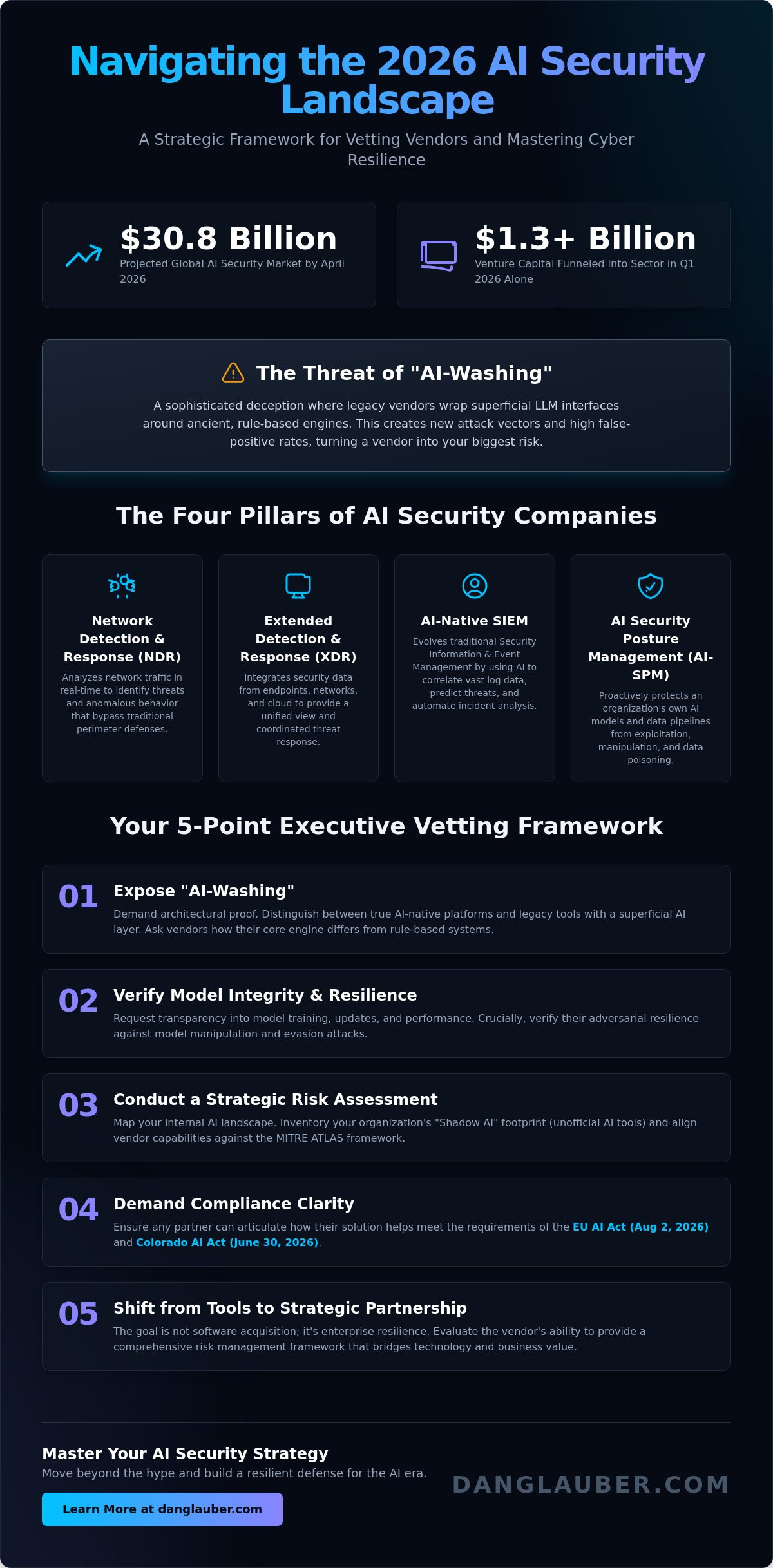
The current cybersecurity landscape is saturated with noise. In 2026, the term "AI-washing" has evolved into a sophisticated deception where legacy vendors wrap superficial Large Language Model (LLM) interfaces around ancient, rule-based engines. These ai security companies claim to offer revolutionary protection, yet they often fail to address the underlying structural shifts required to combat modern attack vectors. Identifying legitimate partners requires a move beyond these marketing veneers toward a deeper understanding of the intersection of AI and cybersecurity. As the global market for AI security is projected to reach $30.8 billion in 2026, the pressure to deploy is immense. This is no longer a simple procurement exercise; it's a strategic battlefield where the survival of the enterprise depends on mastery over autonomous threats.
Traditional signature-based defenses are effectively obsolete. In a world where attackers use generative models to create polymorphic malware that changes its code with every iteration, a static database of known threats offers zero protection. We must shift our focus toward strategic resilience. This approach prioritizes a cohesive risk management framework over the fragmented procurement of point solutions that don't communicate with one another. True resilience in the age of artificial intelligence demands systems that can reason, adapt, and neutralize threats before they manifest as full-scale breaches.
The Evolution of AI-Native Security
The transition from basic machine learning to self-healing security architectures defines the current era. While predictive AI focuses on identifying anomalies based on historical data, generative AI in a defensive posture allows systems to synthesize countermeasures in real-time. 2026 represents a critical tipping point because of the convergence of massive venture capital investment and the implementation of the EU AI Act on August 2, 2026. The Colorado AI Act also takes effect on June 30, 2026, forcing a mandatory shift toward transparency and impact assessments. Organizations can't afford to wait; they need architectures that learn and adapt as quickly as the adversaries they face.
Why Your Legacy Vendor Might Be Your Biggest Risk
Many established ai security companies are struggling with the "bolt-on" problem. By layering AI on top of legacy codebases, they inadvertently create new attack vectors through insecure API integrations and poorly sandboxed model environments. These hybrid systems often suffer from high false-positive rates, leading to alert fatigue and missed critical domains. Understanding these macro-level shifts is essential for any leader analyzing the Strategic Frontier in 2026. Relying on a vendor that treats AI as an afterthought is no longer just a technical oversight; it's a fundamental risk to organizational integrity.
Categorizing the Market: The Four Pillars of AI Security Companies
To master the digital battlefield, leaders must first map the terrain. By 2026, the taxonomy of ai security companies has crystallized into four primary defensive pillars: Network Detection and Response (NDR), Extended Detection and Response (XDR), AI-native SIEM, and the rapidly ascending AI Security Posture Management (AI-SPM). This classification is essential for IT leaders who must distinguish between generalist giants and pure-play innovators. While platform heavyweights like Microsoft and Palo Alto leverage immense data gravity to refine their neural networks, pure-play firms such as Vectra and Darktrace offer deeper algorithmic specialization in specific attack vectors. The strategic choice often hinges on whether your organization requires a broad, unified stack or the surgical precision of an adversarial defense specialist.
We're also witnessing the rise of "AI-Security-for-AI" companies. These vendors don't just use AI to protect your network; they protect the enterprise's internal LLM pipelines and data repositories from exploitation. This shift is underscored by Cyera's $300 million Series D funding in February 2026, which valued the AI data security firm at $5 billion. Additionally, the industry has moved beyond the rigid playbooks of traditional Security Orchestration, Automation, and Response (SOAR). The 2026 standard is the autonomous agent, a system capable of executing complex countermeasures and multi-step reasoning without constant human intervention. Understanding these distinctions is the first step toward building a resilient architecture.
Platform-Native XDR and SIEM Leaders
Consolidation is the defining trend for the top companies in cyber security as they seek to own the entire telemetry stream. These giants capitalize on data gravity, the principle that the company with the most diverse datasets typically produces the most accurate AI models. In 2026, this manifests as "Purple AI" and autonomous SOC assistants that handle 85% of Tier 1 and Tier 2 alerts. If you're looking to streamline your operations, a Board-Level Cybersecurity Briefing can help you evaluate if a consolidated platform aligns with your long-term risk appetite.
Niche Innovators and Adversarial Defense
Specialized ai security companies are now indispensable for organizations running proprietary models. These niche players focus on "Zero-Trust for AI," ensuring that every prompt and data input is verified before it touches a neural network. These AI cybersecurity companies provide the technical depth required to defend against prompt injection and data poisoning, threats that generalist platforms often miss. As NIST released its updated AI RMF Profile for Trustworthy AI in Critical Infrastructure on April 7, 2026, the demand for these adversarial specialists has reached an all-time high.
The Executive Checklist: 5 Metrics for Vetting AI Vendors
Moving from a high-level market taxonomy to the granular vetting process requires a shift in perspective. You aren't just purchasing software; you're integrating an autonomous intelligence into your defensive perimeter. When evaluating ai security companies, the first metric must be model transparency and explainability. It's no longer sufficient for a tool to flag a threat; the system must be able to articulate the logic behind its decision. This is critical for board-level reporting and for meeting the transparency requirements of the EU AI Act by the August 2, 2026 deadline. Without this clarity, your security team remains tethered to a "black box" that could harbor hidden biases or catastrophic logic failures.
The second metric is adversarial resilience. You must demand proof of how the vendor protects its own neural networks from being manipulated by attackers. In 2026, data poisoning and prompt injection are standard tactics on the digital battlefield. Beyond resilience, consider these three critical domains:
- Data Privacy and Provenance: Verify the origins of the training data and ensure your proprietary enterprise data isn't being leaked into the vendor's global models. This is a mandatory safety framework under California's S.B. 53, effective as of January 1, 2026.
- Latency vs. Accuracy: High-performance AI requires massive compute. Evaluate the trade-off between real-time threat prevention and the depth of the model's reasoning capabilities.
- Integration Depth: Avoid "rip and replace" scenarios. Legitimate ai security companies provide API-first architectures that play well with your existing Zero-Trust framework and cloud-native stack.
The "Black Box" Audit
Explainable AI (XAI) is the mandatory standard for 2026 security procurement, requiring that every automated defensive action remains auditable and logically sound. During the audit, push vendors on their model drift monitoring and retraining schedules. Ask specifically if they support Local LLM options; this is essential for highly regulated industries like healthcare or finance that cannot risk sending sensitive telemetry to a public cloud. A vendor that cannot explain its model’s evolution is a vendor that cannot be trusted with your strategic defense.
Quantifying the "AI ROI"
Ditch "Alert Volume" as a metric. In 2026, the primary KPI is Mean Time to Containment (MTTC). Effective AI tools reduce the "Analyst Tax" by automating Tier-1 triage, allowing your human experts to focus on complex threat hunting. However, you must evaluate the Total Cost of Ownership (TCO). Modern AI tools are compute-heavy, and you don't want to be blindsided by hidden infrastructure costs that erode the value of your security investment.
How to Conduct a Strategic AI Security Risk Assessment
Executing a successful procurement strategy in the current market requires more than a simple feature comparison. The selection of ai security companies must be approached as a tactical maneuver within your broader defensive posture. To move from vulnerability to mastery, you need a structured assessment process that validates a vendor’s claims against the reality of your specific environment. This begins with an internal audit before you ever engage with a sales representative. If you don't understand your own "Shadow AI" footprint, even the most sophisticated tool will leave critical gaps in your perimeter.
A comprehensive risk assessment in 2026 follows a precise, five-step progression:
- Step 1: Inventory Shadow AI: Identify every instance where employees are using unsanctioned LLMs or localized models. You can't protect an attack surface you haven't mapped.
- Step 2: Map to MITRE ATLAS: Evaluate prospective ai security companies based on their ability to mitigate specific tactics within the Adversarial Threat Landscape for AI Systems (ATLAS) framework.
- Step 3: Proof of Value (PoV): Reject canned vendor demos. Instead, run a PoV using your organization’s sanitized historical attack data to see how the model performs against real-world threats you've already faced.
- Step 4: Audit the AI Supply Chain: Investigate how the vendor secures its own training pipelines and model weights. A security tool with a compromised supply chain is a Trojan horse.
- Step 5: Strategic Alignment: Ensure the solution integrates into your long-term cybersecurity strategic framework rather than acting as a disconnected silo.
Phase 1: Internal Alignment and Scoping
The CISO can no longer operate in isolation. In 2026, successful vendor selection requires a deep partnership with the Chief Data Officer (CDO) to ensure that security controls don't stifle data utility. You must define which "Critical Assets" require high-latency, high-accuracy AI protection versus those that can rely on standard automated blocks. Establishing your "Risk Appetite" for autonomous response is also vital; deciding where the machine is allowed to act and where it must wait for human intervention is a board-level decision. To refine this alignment, consider scheduling an Executive AI Strategy Workshop to synchronize your leadership team.
Phase 2: The Vendor Deep-Dive
Once you've narrowed the field, conduct a "Red Team" exercise against the prospective vendor’s model. Test for prompt injection and see if the system's "Human-in-the-Loop" (HITL) overrides actually function as advertised during a simulated crisis. It's also essential to check for vendor lock-in. Ensure you can export your learned patterns and model refinements if you decide to switch providers. In the age of artificial intelligence, your learned defensive logic is one of your most valuable intellectual properties; don't let a vendor hold it hostage.
Beyond the Tool: Why Strategy Trumps Software
Purchasing the most advanced telemetry from leading ai security companies is a tactical start, but it's never a complete solution. Even the most sophisticated neural network cannot repair a fragmented organizational culture or a misaligned risk management framework. In the 2026 digital battlefield, tools are force multipliers; however, a multiplier applied to zero remains zero. True mastery requires a shift from reactive procurement to a unified strategy that treats AI risk as a fundamental business risk. Without this high-level orchestration, your organization will likely possess an expensive collection of disconnected silos that fail to communicate when an adversarial attack strikes your critical domains.
Bridging this gap between technical capability and business value is the primary role of an AI cybersecurity consultant. These experts ensure that your investment in autonomous defense aligns with your overarching corporate objectives. A strategic advisor provides the necessary friction to slow down "hype-driven" buying cycles, focusing instead on building a cyber-resilient board. As the global AI security market is expected to surge toward $96.0 billion by 2035, the leaders who thrive will be those who prioritize architectural integrity over the latest "black box" features. The future of security isn't found in a single piece of software; it's a hybrid ecosystem where elite human intelligence directs autonomous machine defense.
The Human Element in the Age of AI
Upskilling your existing workforce is now more critical than upgrading your software stack. An elite team that understands adversarial AI tactics can extract 40% more value from their tools than an untrained team with "superior" technology. To facilitate this cultural transformation, many organizations utilize executive workshops and keynote speaking engagements to demystify the intersection of AI and cybersecurity. These sessions move the conversation beyond technical jargon, empowering every leader to act as a defender within the enterprise’s safety framework.
Building Your 2026 Security Roadmap
Navigating the complex landscape of ai security companies requires unbiased oversight. A Virtual CISO provides this essential perspective, guiding your transition from reactive defense to proactive, AI-driven threat hunting. This roadmap must account for the August 2, 2026 EU AI Act compliance deadline while simultaneously preparing for the next generation of polymorphic threats. By establishing a definitive strategy today, you ensure that your organization doesn't just survive the age of artificial intelligence but masters it through prepared, strategic resilience.
Mastering the Strategic Frontier of AI Defense
The transition from legacy defensive tools to autonomous, self-healing architectures is no longer a luxury for the future. By August 2, 2026, the EU AI Act will mandate a level of transparency that many current vendors simply cannot provide. Your ability to navigate the crowded marketplace of ai security companies depends on your adherence to a rigorous, data-driven vetting process that prioritizes Mean Time to Containment (MTTC) over hollow metrics like alert volume. We've established that while software provides the tactics, only a comprehensive strategic framework ensures long-term resilience on the digital battlefield.
As a vCISO with 30+ years of technical leadership and the author of Cybersecurity in the Age of Artificial Intelligence, I've helped global organizations move from vulnerability to mastery. True security is found at the intersection of human expertise and machine speed. Don't let your defense remain a "black box" while adversaries evolve their tactics daily. To begin your transition toward a proactive posture, Download Dr. Glauber’s Actionable Framework for AI Vendor Assessment today. You possess the methodology to turn these complex risks into your organization's greatest defensive advantage.
Frequently Asked Questions
What are the top AI security companies to watch in 2026?
Wiz and Cyera represent the vanguard of the current market. Wiz currently serves 40% of the Fortune 100 companies, while Cyera secured a $300 million Series D funding round in February 2026, reaching a $5 billion valuation. These firms are leading the shift toward data-centric security and cloud-native protection at the intersection of AI and cybersecurity.
How does AI-native security differ from traditional antivirus?
Traditional antivirus relies on static signatures of known threats, which are ineffective against the polymorphic malware prevalent in 2026. AI-native security uses neural networks to perform behavioral reasoning, identifying "intent" rather than just "identity." This allows systems to neutralize autonomous threats that have no prior signature in a global database.
Is it safe to give an AI security vendor access to all my enterprise data?
Safety is contingent on the vendor's adherence to stringent data provenance and privacy laws like California's S.B. 53, which took effect on January 1, 2026. You should prioritize ai security companies that offer localized LLM options or "Zero-Trust for AI" architectures. These configurations ensure that your sensitive telemetry remains within your controlled environment and isn't used to train the vendor's global models.
Can AI security companies protect against zero-day attacks?
Yes, AI-driven platforms are specifically designed to identify zero-day vulnerabilities by analyzing anomalous patterns in real-time. By April 2026, predictive models have become the standard for neutralizing novel attack vectors before they can be weaponized. These systems recognize the underlying logic of an exploit rather than waiting for a specific file hash to be identified.
What is the average cost of implementing an AI-driven security platform?
While licensing costs are proprietary, the global AI security market's $30.8 billion valuation in 2026 reflects the significant infrastructure investment required. You must evaluate the Total Cost of Ownership (TCO), which includes the compute-heavy nature of running these models. Many organizations find that the reduction in the "Analyst Tax" and faster Mean Time to Containment (MTTC) justifies the initial expenditure.
How do I explain the need for AI security tools to my board of directors?
Focus your presentation on business risk and the August 2, 2026 EU AI Act compliance deadline. Explain that traditional tools can't keep pace with the $1.3 billion in venture capital currently fueling AI-powered adversaries. Emphasize how these tools provide strategic resilience by automating Tier-1 triage and protecting the organization's critical domains from catastrophic data poisoning.
What happens if the AI security tool makes a wrong decision and shuts down a critical system?
Sophisticated frameworks utilize "Human-in-the-Loop" (HITL) overrides to prevent autonomous errors from disrupting operations. You can set a specific "Risk Appetite" within the tool that mandates human verification before any action is taken against mission-critical infrastructure. This balance ensures that machine speed doesn't come at the cost of operational availability.
Should I choose a single-vendor platform or a best-of-breed AI security stack?
Single-vendor platforms offer superior "data gravity," allowing for more cohesive model training across your entire telemetry stream. However, best-of-breed stacks are essential if you require niche adversarial defense for proprietary LLM pipelines. Your decision should align with your long-term roadmap and whether your internal team has the bandwidth to manage multiple specialized integrations.