

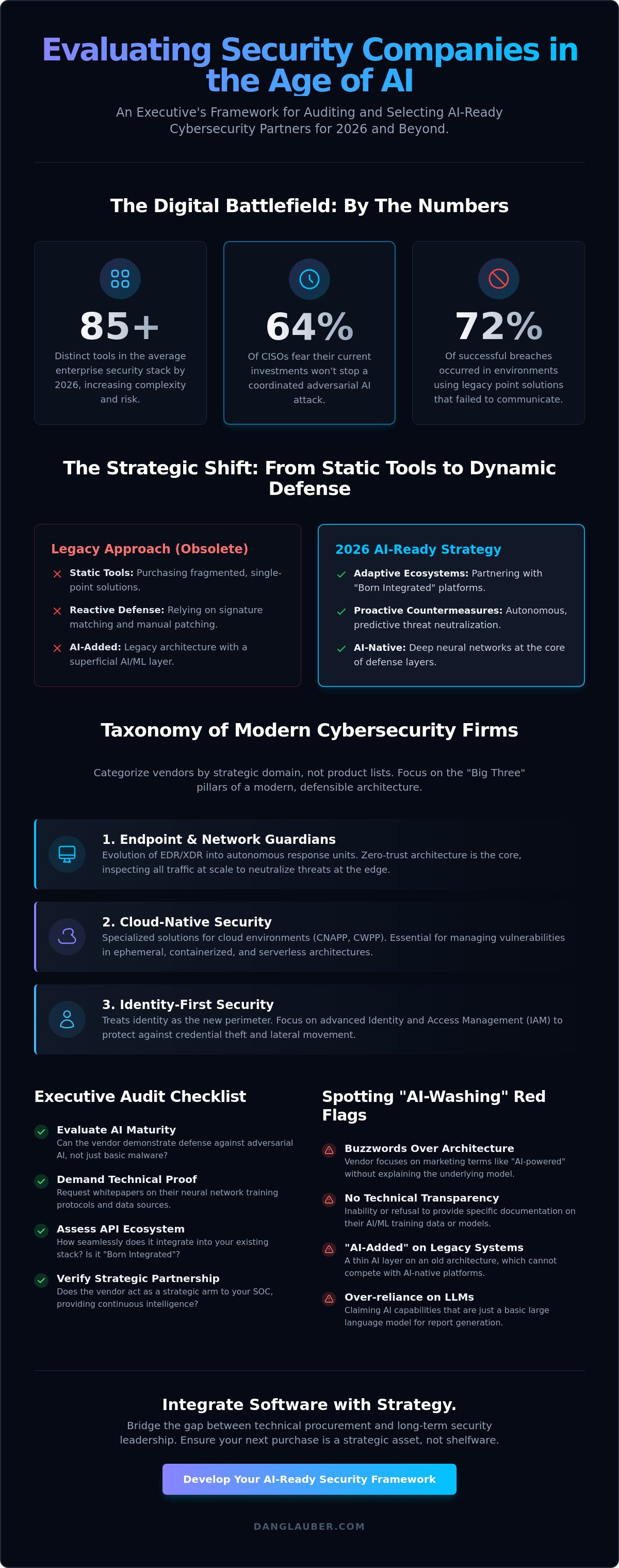
By 2026, the average enterprise security stack will balloon to over 85 distinct tools, yet a 2025 industry survey reveals that 64% of CISOs still fear their current investments won't stop a coordinated adversarial AI attack. You've likely experienced the exhaustion of vetting hundreds of security software companies, only to realize that many innovations are merely marketing buzzwords wrapped around legacy architecture. It's a daunting task to distinguish between a static shield and a dynamic, learning countermeasure on the digital battlefield.
You deserve a strategy that moves beyond the noise of information overload and provides clear, technical mastery. This guide introduces a professional, AI-ready framework designed to help you audit vendors with academic precision and executive clarity. We'll demystify the intersection of AI and cybersecurity, providing a repeatable checklist that ensures your next purchase isn't just shelfware, but a long-term strategic asset. By the end of this briefing, you'll have the data-driven confidence needed to communicate technical risk to your board and secure your organization's future.
Key Takeaways
- Shift your perspective from purchasing static tools to partnering with vendors that provide adaptive, AI-driven countermeasures for the modern digital battlefield.
- Navigate the crowded market by categorizing security software companies into strategic domains like cloud-native and identity-first security rather than simple product lists.
- Deploy a professional seven-domain audit checklist to evaluate a firm's maturity in defending against adversarial AI and its ability to integrate into complex API ecosystems.
- Protect your budget from "AI-washing" by learning to spot red flags, including a vendor's inability to provide specific whitepapers on their neural network training protocols.
- Bridge the gap between technical procurement and long-term strategy by integrating your software selections with an actionable framework for executive security leadership.
Beyond the Vendor List: The Evolution of Security Software Companies
The 2026 security software company is no longer a vendor of static code; it is a provider of adaptive, AI-driven countermeasures. We have moved past the era of simple signature matching into a high-stakes digital battlefield where proactive defense is the only viable strategy. In this environment, reactive patching is a relic of a slower age. Modern threats operate with autonomous speed, requiring a total convergence of networking, security, and machine learning to maintain organizational integrity. While foundational cybersecurity concepts remain relevant, the application of those principles has shifted toward neural-driven resilience.
Traditional security software companies that rely on legacy heuristic models are failing. They cannot keep pace with 2026-era autonomous threats that mutate in real-time. This isn't just a technical gap; it's a strategic failure. According to 2025 industry research, 72% of successful breaches occurred in environments using legacy point solutions that failed to communicate across the stack. The urgency is palpable: if your software isn't learning, it's already obsolete.
The Shift from Tools to Ecosystems
By 2026, the reliance on single-point solutions has become a critical liability. Fragmented toolsets create visibility gaps that sophisticated actors exploit within seconds. Leading organizations now prioritize "Born Integrated" platforms, a concept often championed by a top-tier cyber security company that understands the necessity of architectural cohesion. These software providers function as external strategic arms of your Security Operations Center (SOC). They provide a continuous stream of intelligence and automated response capabilities that act as a force multiplier for lean security teams.
AI as the New Baseline in Security
Mastery in this field requires distinguishing between "AI-added" and "AI-native" architectures. Many security software companies simply layer a basic large language model over a 2015-era database. In contrast, AI-native platforms utilize deep neural networks at the core of their endpoint and network defense layers to identify anomalies that human analysts would miss. These systems don't just react; they predict and neutralize. Adversarial AI serves as the primary driver for software updates in 2026, forcing a constant evolution of defensive algorithms to counter machine-speed exploitation. This shift ensures that your defense is as dynamic as the threats it faces.
A Taxonomy of Modern Cybersecurity Firms
To master the digital battlefield, executives must look past marketing labels and categorize security software companies by their strategic domains rather than product names. This creates a logical map for procurement. The 2026 landscape is defined by the "Big Three" pillars: Endpoint, Cloud-Native, and Identity-First security. Each pillar represents a critical front in organizational defense. Before selecting a partner, many leaders utilize the Cyber Security Evaluation Tool (CSET) to establish a baseline. This data-driven approach ensures that software investments align with documented vulnerabilities rather than vendor hype.
We're seeing a surge in specialized AI-governance firms. By 2026, over 30% of Fortune 500 companies have deployed dedicated AI-governance software to manage model drift and adversarial attacks. There's also a clear divide between managed SaaS solutions, which offer rapid scalability, and on-premise infrastructure required for air-gapped or high-compliance environments. Choosing the right delivery model is as vital as the software's features. If you're struggling to map these domains to your specific risk profile, exploring strategic security frameworks can provide the necessary clarity.
Endpoint and Network Guardians
EDR and XDR providers have evolved into autonomous response units. They don't just alert; they isolate. Zero-trust architecture is now the core of network software, treating every packet as a potential threat vector. You must evaluate these security software companies on their ability to inspect encrypted traffic at scale without creating latency bottlenecks. Modern guardians must process data at the edge to neutralize threats before they reach the core.
Cloud-Native and Application Security
Shift Left security is the standard for 2026. Software companies in this space focus on empowering developers to catch vulnerabilities during the build phase. Cloud Security Posture Management (CSPM) is non-negotiable. It provides the continuous oversight needed to prevent misconfigurations in complex multi-cloud environments. A 2025 industry report suggests that 45% of security budgets are now allocated to these cloud-native platforms. The intersection of DevOps and security requires tools that speak the language of automation and provide real-time feedback loops to engineering teams.
The Executive Audit Checklist: 7 Domains for Evaluation
The digital battlefield requires more than just a cursory list of names; it demands a rigorous, data-driven framework for vetting security software companies. To ensure your organization moves from a state of vulnerability to strategic mastery, you must evaluate potential partners across seven critical domains. This isn't a mere feature comparison. It is a strategic audit of their ability to survive and thrive at the intersection of AI and cybersecurity. By 2026, the gap between a marketing claim and technical reality can be the difference between operational continuity and a total system collapse.
Your evaluation should begin with these five fundamental domains:
- Domain 1: AI Defense Maturity. Does the platform actively defend against adversarial machine learning? By 2026, research indicates that 40% of sophisticated cyberattacks utilize model inversion or data poisoning. You need a vendor that treats their own neural networks as a target that requires protection.
- Domain 2: Integration Friction. Evaluate the API ecosystem's maturity. A 2025 industry audit found that poorly integrated security stacks increase incident response times by an average of 18 minutes. Your software must play well with existing infrastructure without requiring custom middleware.
- Domain 3: Data Sovereignty. Explicitly verify where the training data for their AI models is stored and processed. Compliance with 2026 regional data residency laws is non-negotiable for global enterprises.
- Domain 4: Transparency and Explainable AI. If the software blocks a mission-critical business process, can it provide a logical explanation for the decision? Black-box solutions create operational blindness that executives can't afford.
- Domain 5: Scalability and Performance. Security overhead shouldn't cripple business operations. Performance benchmarks must demonstrate sub-10ms latency even in high-traffic, encrypted environments.
Technical Resilience and Threat Intelligence
A vendor's global threat intelligence feed must provide real-time accuracy to be effective against autonomous threats. You should analyze their historical zero-day response times and patch reliability over the last 24 months to gauge their technical discipline. You must explicitly require a 'Security Software Bill of Materials' (SBOM) to audit the underlying components of their defensive architecture.
Strategic Alignment and Support
Post-sale support is where many security software companies fail to deliver long-term value. It's vital to assess the quality of their strategic advisory services, ensuring they align with the rigorous standards set by leading cyber security firms. A vendor's R&D roadmap should extend at least 36 months into the future, showing a clear commitment to evolving alongside the rapidly shifting landscape of the Age of Artificial Intelligence.
Avoiding 'AI-Wash': Red Flags in Security Software Procurement
Many security software companies are currently engaged in "AI-Washing," a deceptive practice where 2010-era legacy heuristics are rebranded as sophisticated artificial intelligence to capture premium budgets. This isn't just a marketing grievance; it's a strategic vulnerability on the digital battlefield. If your defense relies on static rules rather than genuine neural networks, you're essentially bringing a knife to a machine-speed gunfight. A primary red flag is a vendor's inability to provide specific whitepapers detailing their neural network training sets. Without transparency into the data informing their models, you're investing in a "Black Box" that may be riddled with bias or outdated information.
A 2025 research paper by the Cyber-Resilience Institute found that 58% of security products marketed as "AI-powered" were actually running basic linear regression models. Another warning sign is a high false-positive rate that security software companies attempt to mask through "Automated Remediation" claims. While automation is essential, using it to hide the inefficiency of an underlying algorithm leads to operational chaos. If a system blocks 12% of legitimate traffic but claims it's "protecting" the network, it's failing the business. You must demand proof of a system's ability to distinguish between legitimate anomalies and true malicious intent.
The 'Black Box' Trap
Unexplainable AI represents a significant legal and compliance risk for the board. If an autonomous countermeasure causes a critical operational outage, "the AI did it" is not a valid legal defense under 2026 regulatory frameworks. Executives must demand Proof of Concept (POC) tests that utilize real-world adversarial AI samples rather than curated laboratory data. Every framework must include human-in-the-loop (HITL) overrides to ensure that strategic leadership maintains ultimate control over defensive tactics.
Testing for True Predictive Power
The distinction between simple "Pattern Matching" and "Behavioral Prediction" is where true innovators separate themselves. Pattern matching looks for known signatures; behavioral prediction uses deep learning to anticipate the next move in a complex attack vector. These are the types of critical questions you should prepare for a cybersecurity speaker for executives session to ensure your procurement team isn't swayed by surface-level demos. Historical performance is no longer a guarantee of future defense because the nature of the threat itself has mutated. To ensure your organization is prepared for these shifts, you should book a strategic briefing on AI-native defense frameworks today.
Integrating Software with Strategy: The Role of Expert Advisory
Procuring advanced technology is only the first step toward resilience. Even the most sophisticated tools from leading security software companies will fail to deliver value if they aren't governed by a comprehensive virtual ciso consulting services framework. Technology is a force multiplier, but strategy is the director of that force. Without a clear alignment between software capabilities and organizational risk tolerance, you're merely adding complexity to an already overburdened stack. By 2026, the distinction between a secure organization and a vulnerable one lies in the ability to integrate these countermeasures into a cohesive, learning ecosystem.
Board-level justification for security spend has never been more critical. A 2025 executive survey indicates that 82% of failed security implementations resulted from a lack of strategic oversight rather than technical flaws in the software itself. You must be prepared to translate technical metrics into business outcomes, demonstrating how your software choices reduce the probability of catastrophic downtime. Dr. Daniel Glauber serves as the essential bridge in this process, transforming raw data and software tools into executive mastery. By applying the "Cybersecurity in the Age of Artificial Intelligence" framework, leaders can ensure their investments are both technically sound and strategically defensible.
From Procurement to Security Mastery
True mastery requires a long-term vision. You should develop a 3-year security roadmap that accounts for the rapid evolution of security software companies and their underlying neural networks. Engaging a specialized ai cybersecurity consultant is vital for vetting vendor claims and ensuring that your architecture is resilient against adversarial attacks. This partnership helps manage the cultural shift as your SOC transitions from manual analysis to AI-integrated defense. It's about building a culture that trusts automated countermeasures while maintaining human oversight.
Next Steps for the Strategic Leader
The time for passive observation has passed. To secure your organization's future, you must initiate a project-based strategic advisory for a full software architecture review. This process identifies the "shelfware" in your current stack and reallocates resources toward AI-native platforms that offer true predictive power. For those seeking a deeper dive into actionable frameworks, explore Dr. Glauber's latest research and case studies. You can secure your organization's future by requesting a professional risk assessment today, ensuring your defense is ready for the digital battlefield of 2026 and beyond.
Mastering the Future of Defensive Architecture
The landscape of 2026 demands that executives move beyond simple procurement toward a state of total strategic readiness. You've learned how to look past marketing hype to identify truly adaptive security software companies that utilize deep neural networks for proactive defense. By applying the seven-domain audit framework, you can ensure your stack remains resilient against adversarial machine learning while maintaining the operational transparency your board requires. This shift from reactive tools to an integrated ecosystem is essential for survival on the digital battlefield.
Integrating these technical tools with a board-level strategy is the final step toward digital mastery. As the author of 'Cybersecurity in the Age of Artificial Intelligence' with 30 years of innovation experience serving as a vCISO for global organizations, I provide the expertise needed to align your technical architecture with long-term business goals. Partner with Dr. Daniel Glauber for a Strategic Security Architecture Review to transform your current vulnerabilities into a definitive competitive advantage. You don't have to face the evolving threat landscape alone. Your journey toward a secure, AI-ready future starts with a single, decisive step today.
Frequently Asked Questions
What are the top security software companies for AI defense in 2026?
The top security software companies for AI defense are currently defined by their transition to AI-native architectures. According to the 2025 Gartner Magic Quadrant for Endpoint Protection, leaders like CrowdStrike, Palo Alto Networks, and Microsoft have moved beyond basic automation to offer predictive countermeasures. These firms distinguish themselves by providing neural network-driven response units that neutralize autonomous attack vectors before they can execute within a network.
How do I distinguish between real AI and marketing hype in security software?
You can distinguish real AI from marketing hype by demanding technical documentation on neural network training sets and model drift protocols. A genuine AI-native provider will offer whitepapers detailing how their models defend against data poisoning and adversarial manipulation. If a vendor cannot explain the specific logic behind a blocked threat or relies on static rule-based heuristics, they're likely "AI-washing" legacy technology to justify premium 2026 pricing.
Is it better to use a single vendor platform or a 'best-of-breed' approach?
The 2026 strategic trend favors a "Born Integrated" platform approach over the traditional best-of-breed model. While best-of-breed once offered superior niche protection, the resulting integration friction now creates dangerous visibility gaps. A 2025 industry audit showed that organizations using a unified platform responded to incidents 22% faster than those managing fragmented stacks, as unified data lakes allow for more accurate neural network analysis across the entire environment.
What questions should a Board of Directors ask about security software procurement?
The Board of Directors should focus on liability, strategic resilience, and the long-term ROI of the investment. Critical questions include: "How does this software reduce our financial exposure to autonomous threats?" and "What is the vendor's liability posture if their AI fails to block a known adversarial attack?" Board members must also ask how the procurement aligns with the organization's three-year security roadmap and documented regulatory compliance frameworks.
How much should a mid-sized organization spend on security software annually?
Mid-sized organizations should typically allocate 10% to 15% of their total IT budget to cybersecurity, according to a 2025 Deloitte Cyber Survey. This investment ensures that security software companies act as strategic partners rather than just line-item expenses. For an organization with $500 million in revenue, this budget should prioritize high-impact areas like identity-first security and cloud-native protection to maintain a secure posture on the digital battlefield.
Can AI-driven security software replace the need for a full-time CISO?
AI-driven security software cannot replace a full-time CISO because it lacks the capacity for strategic governance and ethical risk management. While AI excels at machine-speed tactics and anomaly detection, the CISO remains the essential bridge between technical countermeasures and business objectives. A 2026 executive briefing by CISA emphasized that human leadership is indispensable for navigating the complex legal and cultural implications of the Age of Artificial Intelligence.
What is the role of an SBOM in evaluating a security software company?
A Security Software Bill of Materials (SBOM) is critical for auditing the supply chain risk of any software you purchase. It provides a transparent inventory of all third-party components and libraries used by the vendor during development. In 2026, an SBOM allows your security team to identify vulnerabilities in the underlying code before they're exploited, ensuring that your software partners maintain a high standard of developmental hygiene and technical discipline.
How does Zero Trust Architecture integrate with modern security software?
Zero Trust Architecture acts as the foundational operating philosophy that modern security software must enforce. Rather than assuming trust based on network location, software enforcers continuously verify every user and device identity through real-time neural network analysis. By 2026, 75% of enterprise software deployments require full ZTA integration to maintain resilience, ensuring that access is always conditional, context-aware, and restricted to the minimum level necessary for operations.