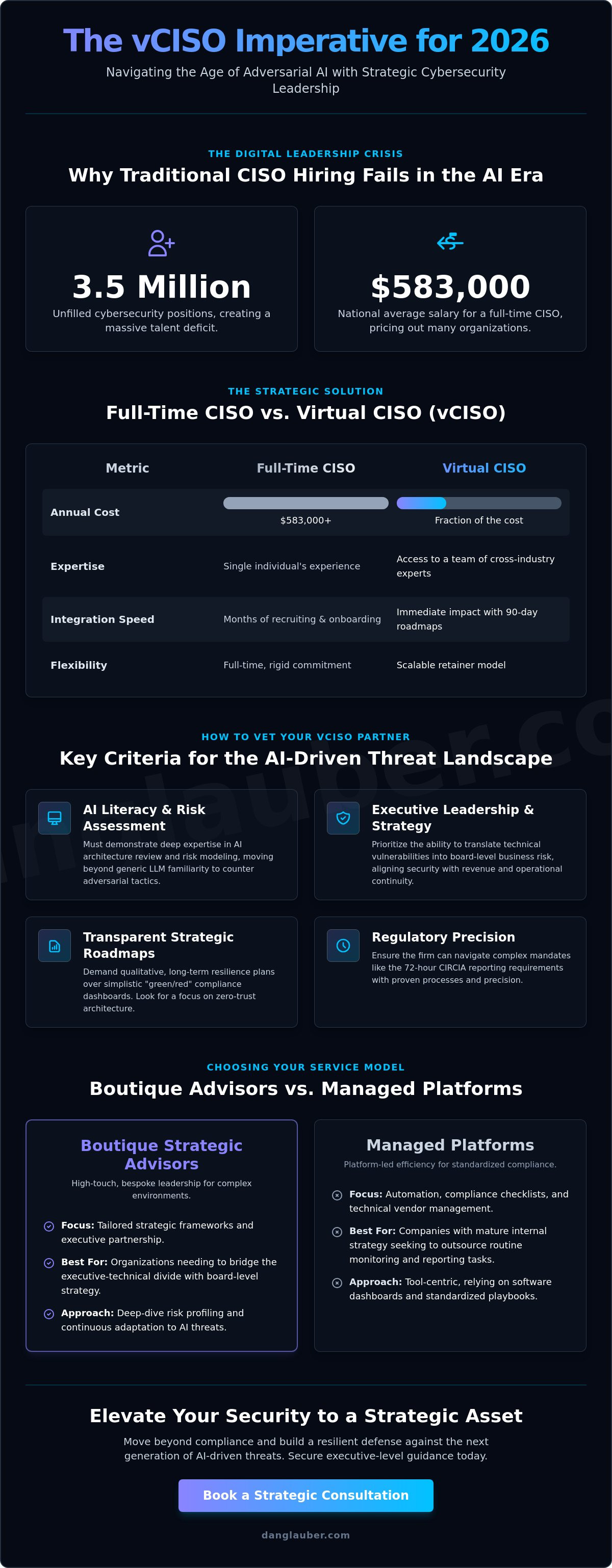
With over 3.5 million cybersecurity positions currently unfilled, the digital battlefield of 2026 demands a faster, more agile approach to leadership than traditional hiring can provide. When the national average salary for a full-time CISO sits at $583,000, many organizations find themselves priced out of the very expertise they need to counter adversarial AI. You likely feel the pressure of justifying security spend to a board that demands both technical depth and strategic foresight. Leading virtual ciso companies have emerged as the primary solution to this talent deficit, offering a bridge between complex neural network threats and business-level risk management.
You deserve a clear path to mastery that avoids the pitfalls of generic service models. This article provides a strategic framework for comparing providers based on their readiness for the age of artificial intelligence. I will break down the tiers of available services, from boutique advisors to managed platforms, while showing you how to secure high-level governance at a fraction of the cost of a full-time executive. We will analyze how to vet for deep technical expertise in zero-trust architecture and ensure your chosen partner can navigate the 72-hour CIRCIA reporting mandates with precision.
Key Takeaways
- Learn why leading virtual ciso companies must now operate as strategic AI defense partners rather than simple technical vendors to combat evolving adversarial tactics.
- Identify the critical criteria for vetting firms, prioritizing executive-level leadership experience and tailored strategic frameworks over generic technical certifications.
- Compare the efficiency of platform-led vCISO models against the high-touch, bespoke risk profiles offered by boutique strategic advisors.
- Master a 90-day integration roadmap that establishes security maturity and aligns your new leadership with existing IT and legal departments.
- Discover how to elevate cybersecurity from a back-office expense to a board-level strategic asset using the Intersection of AI and Cybersecurity framework.
Beyond Compliance: Why vCISO Companies Are Essential for AI Defense
The traditional compliance checklist is no longer a shield; it's a relic. In 2026, the rise of elite virtual ciso companies represents a fundamental pivot from reactive defense to proactive strategic mastery. We've moved past the era where security was a siloed IT function. Today, a Virtual CISO (vCISO) is a strategic leader who provides executive-level security governance on a flexible, retainer basis. This role transcends the technical management of firewalls. It focuses on the high-stakes alignment of digital resilience with long-term business objectives. Organizations that treat security as a mere technical hurdle often find themselves vulnerable when technical defenses fail to account for executive risk levels.
We are witnessing a definitive transition from traditional security management to AI-driven threat mitigation. While technical vendors focus on selling tools, a vCISO partner focuses on the architecture of trust. This distinction is critical as the gap between low-level technical tasks and high-level risk governance continues to widen. You cannot secure a modern enterprise by simply layering software. You secure it through disciplined leadership that understands how to leverage these tools within a broader business context. This requires moving beyond "set and forget" configurations to a model of continuous, AI-aware adaptation.
The 2026 Digital Battlefield: Adversarial AI
The digital battlefield has been permanently altered by the weaponization of generative AI. Attackers now deploy automated exploit discovery and hyper-realistic deepfake phishing campaigns that bypass traditional biometric and psychological defenses. These aren't static threats. They're dynamic, evolving algorithms that learn from every failed attempt. Static security policies, once the gold standard for compliance, are insufficient against such fluid tactics. Strategic advisory is the only viable countermeasure. It provides the human intuition and rapid decision-making necessary to outpace machine-speed threats. Without a leader who understands the intersection of AI and cybersecurity, your defense remains one step behind the adversary.
Bridging the Executive-Technical Divide
A critical failure in many organizations is the "lost in translation" effect between the server room and the boardroom. Technical teams often excel at identifying neural network vulnerabilities but struggle to quantify the financial impact of a breach, which reached an average of $4.45 million according to IBM. Elite virtual ciso companies solve this by translating complex attack vectors into actionable business risk. This requires a deep understanding of cybersecurity in the age of artificial intelligence as a core competency. By framing security through the lens of operational continuity and shareholder value, a vCISO ensures that security spend is viewed as a strategic investment rather than an unavoidable expense. This approach turns defense into a competitive advantage that satisfies both regulators and stakeholders.
Key Criteria: How to Evaluate Modern vCISO Consulting Firms
Selecting a partner from the vast array of virtual ciso companies requires a shift in perspective. You aren't just hiring a technical auditor; you're commissioning a strategic architect for your organization's survival. In 2026, the primary differentiator between a vendor and a visionary is AI literacy. A firm must demonstrate more than a passing familiarity with large language models. They must possess the capability to conduct a rigorous AI architecture review and a comprehensive AI risk assessment. While technical prowess is foundational, the true value lies in the ability to translate these complex vectors into a definitive business roadmap.
Evaluation must move beyond "green/red" compliance dashboards. These simplistic metrics fail to capture the nuance of modern threats like adversarial AI. Instead, demand transparency through qualitative strategic roadmaps that prioritize long-term resilience over temporary fixes. One of the core benefits of a vCISO is the ability to leverage cross-industry insights to build a tailored defense. If a firm presents a generic template, they're providing a false sense of security. You need a framework that quantifies risk in financial terms, especially when the average cost of a data breach remains a staggering $4.45 million.
Executive Credentials vs. Technical Certs
Technical certifications like the CISSP are the baseline, not the ceiling. A true strategic advisor must have sat in the "hot seat" of a full-time executive role, managing real-world crises and board-level expectations. There's a profound difference between a security manager-for-hire and an expert practitioner who understands the weight of a 72-hour CIRCIA reporting deadline. In 2026, look for markers of industry-recognized expertise, such as published research or authorship. This level of mastery ensures your advisor can navigate the high stakes of the digital battlefield with confidence and authority.
Methodology: The Actionable Framework
A structured approach to security is non-negotiable. Leading firms provide virtual ciso consulting services built upon actionable frameworks that evolve with the threat landscape. This methodology should include frequent, high-density board reporting that goes beyond technical jargon to address operational continuity. Aligning your defense with an expert-led security strategy transforms your security posture from a reactive cost center into a proactive business enabler. Success is measured by how effectively your vCISO integrates with your existing legal and IT departments to create a unified front against automated exploits.
Comparing vCISO Service Models: Boutique Advisors vs. Managed Platforms
The landscape of virtual ciso companies in 2026 is categorized by three distinct service archetypes. Each model addresses a specific organizational need, yet they vary significantly in their ability to counter adversarial AI. Choosing the wrong partner often leads to a mismatch between technical output and executive expectations. As the global vCISO market approaches a projected $2.3 billion valuation this year, understanding these structural differences is the first step toward strategic readiness. Different cybersecurity firms prioritize different outcomes, ranging from automated compliance to high-level risk governance.
Platform-Led models emphasize high efficiency and lower entry costs. These providers rely on automated risk assessments and standardized dashboards to manage security posture. While this approach is effective for maintaining basic hygiene, it often produces a generic strategy that fails to account for bespoke business risks. Conversely, the Global Consulting model, typically associated with the "Big Four," offers high prestige and deep resources. These firms carry significant weight with international shareholders but are often slower to pivot when faced with rapidly evolving machine-speed threats. Their high-cost retainers, often exceeding $20,000 per month, may not always translate to the agile leadership required on the digital battlefield.
When to Choose a Platform-Driven Provider
Platform-driven providers are ideal for small to mid-sized businesses (SMBs) where the primary objective is achieving standardized compliance. If your goal is to secure a SOC 2 or HIPAA certification quickly, these automated systems offer a streamlined path. Monthly retainers for these services generally range from $1,500 to $4,000. However, you must weigh this efficiency against the risk of "checkbox security." Automated tools excel at identifying missing patches but struggle to replicate the strategic intuition needed to defend against deepfake phishing or complex neural network vulnerabilities. In an AI-driven threat environment, a purely automated assessment is only a partial defense.
The Case for the Strategic Boutique Advisor
Mid-market and enterprise firms require a more nuanced approach. The Boutique Strategic model focuses on high-touch, expert-driven leadership. These virtual ciso companies provide a single "point of truth" for board-level security questions, ensuring that defense strategies align with specific business innovation goals. Boutique firms typically conduct tailored AI strategy workshops that go beyond technical audits to address the core of your operational resilience. With retainers for mid-market companies often falling between $5,000 and $9,000, this model offers a path to cost-effective, high-level governance. It ensures that your security posture is a bespoke framework designed for your unique risk profile rather than a generic template.
Strategic Integration: Implementing vCISO Leadership Without Friction
Successful integration of a virtual executive requires more than granting access to your network. It demands a fundamental alignment of security objectives with your organizational culture. The first 90 days of engagement with elite virtual ciso companies are the most critical. During this period, the focus shifts from observation to the establishment of a rigorous baseline for security maturity and AI readiness. This initial phase ensures that the vCISO is not operating in a vacuum but is instead deeply embedded within the operational fabric of the firm. Transitioning from a technical-only focus to a strategic-first security posture involves mapping every server-side control to a specific business risk objective, followed by the establishment of executive-level oversight, and culminating in the institutionalization of risk-based decision making across all departments.
Friction often arises when security is viewed as a bottleneck rather than an enabler. To mitigate this, the vCISO must act as a diplomatic bridge between IT and legal departments. In 2026, the legal implications of cybersecurity have never been higher, with CIRCIA requiring incident reporting within 72 hours and the SEC mandating material breach disclosures on Form 8-K within four business days. A disciplined communication cadence is essential. This includes monthly strategic briefings for stakeholders and quarterly deep dives for the board of directors. These sessions move beyond technical jargon to focus on how security investments protect shareholder value and ensure operational continuity.
The AI Risk Assessment: A Critical First Step
The immediate priority for any new vCISO is the identification of "Shadow AI." This involves uncovering unauthorized neural network usage and unsanctioned LLM deployments that may be leaking proprietary data or creating new attack vectors. Evaluating the security of third-party AI integrations is equally vital; you are only as secure as the weakest link in your algorithmic supply chain. These assessments provide the necessary data to set the foundation for a cyber-resilient culture. By addressing these vulnerabilities early, virtual ciso companies prevent small technical gaps from becoming catastrophic strategic failures.
Continuous Governance and Reporting
Governance in the age of artificial intelligence cannot be a quarterly event. It must be a continuous process of strategic alignment. Expert vCISO leadership uses data-driven insights to drive tangible business outcomes, such as negotiating better cyber insurance rates by demonstrating a superior risk profile. Beyond insurance, a robust security posture builds vendor trust, which is a critical currency in the 2026 digital economy. The vCISO also takes command during incident response, providing the leadership necessary for rapid containment and thorough post-mortem analysis. To ensure your organization is prepared for the next evolution of digital threats, you should partner with a strategic security advisor who understands the high stakes of the modern battlefield.
The Glauber Advantage: Elevating vCISO Services to Board-Level Strategy
Dr. Daniel Glauber stands at the primary intersection of AI and cybersecurity, serving as the definitive bridge between groundbreaking technological innovation and executive defense. While many virtual ciso companies provide technical oversight, the Glauber Advantage lies in elevating security to a board-level strategic asset. This isn't just about managing attack vectors; it's about mastering the dynamic relationship between business risk and algorithmic evolution. Regional and global firms seeking a competitive edge benefit from specialized vCISO services in Orlando, where strategic AI-driven leadership meets real-world application. By integrating 18 comprehensive chapters of structured research into every engagement, we ensure that your leadership is prepared for the high stakes of the 2026 digital landscape.
The personality of this brand is that of an expert practitioner who values data-driven insights over hype. We don't just point out risks; we actively seek to master them alongside your team. This creates a trustworthy advisory relationship that stays ahead of the curve. In a year where the vCISO market is projected to reach $2.3 billion, the value of a provider is measured by their ability to translate adversarial AI threats into actionable business strategy. Choosing a partner who understands the "foundation-to-application" model ensures that your security spend is always aligned with your most critical domains.
Tailored Executive AI Strategy Workshops
Dr. Glauber’s Tailored Executive AI Strategy Workshops prepare your leadership for the next generation of threats. These sessions discard abstract technical theories in favor of Actionable Frameworks grounded in over 50 real-world case studies. We empower the C-suite to make data-driven decisions on AI security investments by translating the complexities of neural networks into clear financial and operational terms. This moves the organization from a reactive defensive posture to one of proactive mastery. You don't just learn about the threat; you learn how to weaponize your defense as a competitive advantage. Leaders who undergo these workshops gain the foresight to navigate the age of artificial intelligence while keeping a firm grip on foundational security principles.
Securing Your Organization’s Future
Securing your organization’s future requires more than sporadic project-based consulting. The 2026 digital battlefield moves too fast for a "set and forget" mentality. A long-term retainer with a visionary expert ensures that your security posture evolves alongside the tactics of adversarial AI. Having a world-class ai cybersecurity consultant on call provides the peace of mind necessary to innovate with confidence. It's time to transition from a state of potential vulnerability to one of strategic readiness. Partnering with elite virtual ciso companies that prioritize executive governance is the only way to safeguard shareholder value in a world of machine-speed threats. This strategic alignment turns your security department from a cost center into a definitive source of truth for the entire enterprise. Finalizing your defense strategy today is the only way to ensure your organization remains resilient against the automated countermeasures of tomorrow.
Mastering the Strategic Frontier of 2026
The digital battlefield of 2026 leaves no room for hesitation. Selecting from the top virtual ciso companies is no longer a matter of administrative convenience; it's a critical decision for long-term operational resilience. You've learned that effective leadership must transcend basic compliance to address the nuances of adversarial AI and neural network vulnerabilities. By prioritizing executive-level experience and actionable frameworks, you can bridge the divide between technical server rooms and the boardroom. This strategic alignment ensures your organization meets the 72-hour CIRCIA reporting requirements while maintaining a definitive competitive edge.
As the author of "Cybersecurity in the Age of Artificial Intelligence" with over 30 years of technology and innovation experience, Dr. Daniel Glauber specializes in bridging this technical-executive gap. You don't have to navigate these complex attack vectors alone. Secure your board-level AI strategy with Dr. Daniel Glauber and transform your security posture into a proactive business advantage. Mastery of the current threat landscape is not just a goal; it's a state of preparedness you can achieve today. Your organization's future depends on the strategic leadership you choose now.
Frequently Asked Questions
What is the average cost of a vCISO company retainer in 2026?
Monthly retainers for mid-market organizations with 100 to 500 employees typically range from $5,000 to $9,000 as of January 2026. Smaller firms with fewer than 50 employees generally see costs between $1,500 and $4,000 per month. Leading virtual ciso companies also provide specialized hourly consulting, with rates often falling between $200 and $400 depending on the complexity of the engagement.
Can a virtual CISO handle AI-specific security risks?
A modern vCISO is specifically trained to manage risks at the intersection of AI and cybersecurity. They conduct rigorous architecture reviews of neural networks and identify "Shadow AI" usage that threatens proprietary data. By implementing actionable frameworks, they transform abstract technical threats into definitive business strategies that counter adversarial AI tactics like automated exploit discovery.
How does a vCISO company differ from a Managed Security Service Provider (MSSP)?
A vCISO provides executive-level strategic governance, whereas an MSSP focuses on technical operational monitoring and tool management. While an MSSP handles your firewall and SOC alerts, virtual ciso companies define the risk appetite and security roadmap for the entire enterprise. The vCISO acts as the strategic architect, while the MSSP functions as the technical crew executing specific tasks.
What qualifications should I look for in a virtual CISO for my board of directors?
Prioritize candidates with executive-level experience who've managed high-stakes crises in full-time roles. Industry-recognized expertise, such as authorship of definitive security texts or 30+ years of innovation experience, is critical for establishing board-level credibility. They must possess the unique ability to translate complex attack vectors into financial risk and operational continuity statements.
Is a vCISO effective for companies with strict regulatory compliance needs like SOC 2?
vCISOs are highly effective for managing rigorous regulatory frameworks such as SOC 2, HIPAA, and the 2026 CIRCIA mandates. They don't just provide a compliance checklist; they build the underlying governance structures required for successful audits. This preparation ensures your organization is ready for the mandatory cybersecurity audits and certifications required throughout 2026 and 2027.
What is the typical length of a virtual CISO engagement?
Initial transformation engagements typically span 12 to 24 months to establish a baseline of security maturity. However, many organizations transition into long-term retainers for continuous strategic alignment and quarterly board reporting. This ongoing partnership provides stable leadership in the 2026 threat landscape without the burden of a $583,000 full-time executive compensation package.
How much time per week does a virtual CISO typically spend with an organization?
A vCISO typically spends between 4 and 10 hours per week engaged with a mid-market organization. This time is concentrated on high-impact activities like stakeholder briefings, risk assessments, and incident response leadership. The model is highly scalable, allowing you to adjust the level of engagement as your internal security maturity and business needs evolve.
Can a vCISO help with cyber insurance applications and renewals?
A vCISO is instrumental in navigating the complex cyber insurance landscape by validating security controls for underwriters. They use data-driven insights to demonstrate a superior risk profile, which often leads to more favorable premium rates and coverage terms. By fostering a cyber-resilient culture, they turn security investments into tangible financial advantages during the renewal process.