
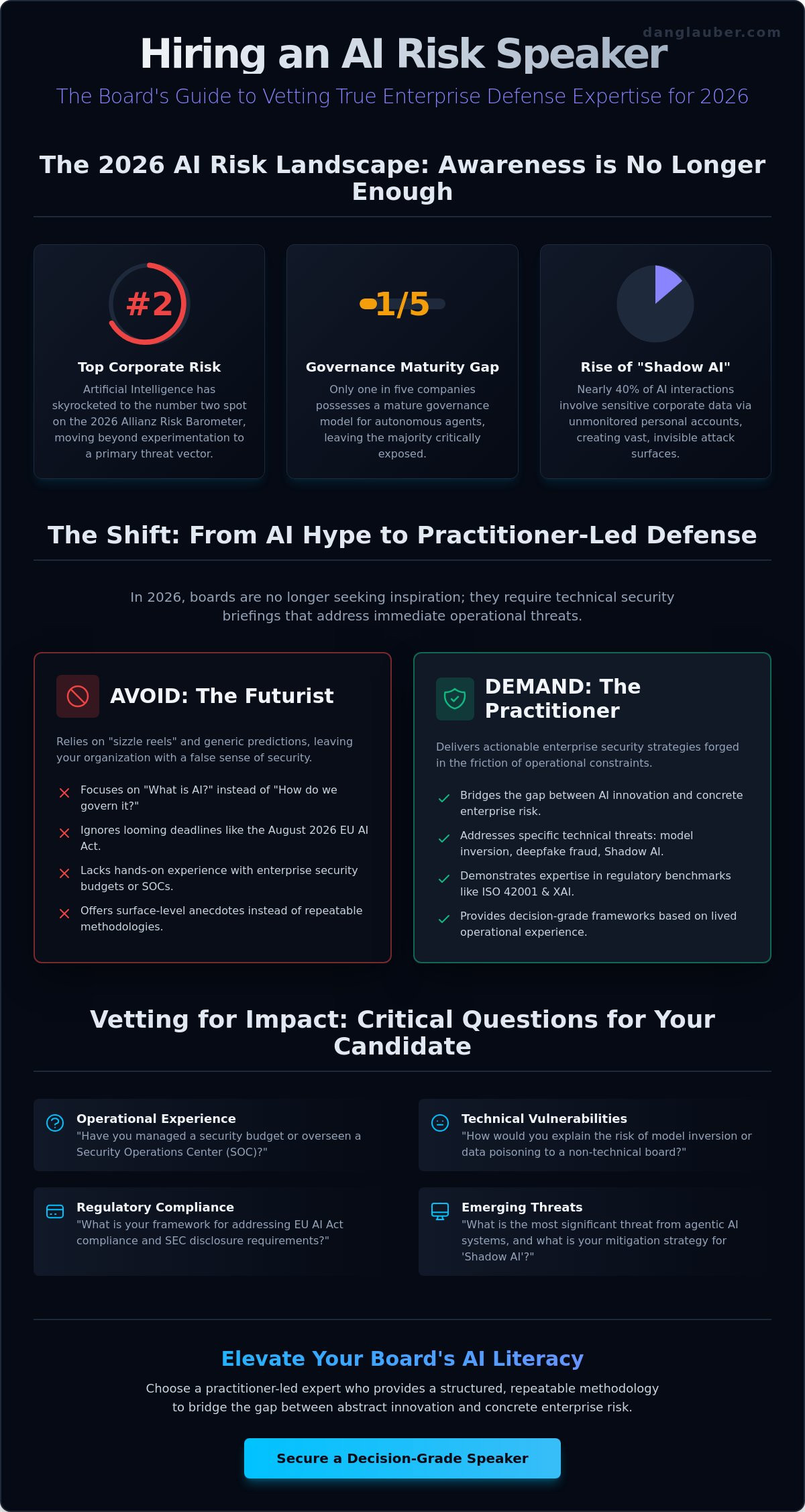
Artificial intelligence skyrocketed to the number two spot on the Allianz Risk Barometer in 2026, yet only one in five companies possesses a mature governance model for autonomous agents. When hiring a speaker on AI and corporate risk, most boards accidentally prioritize "futurist" inspiration over technical defense. You've likely felt the frustration of watching a keynote that relies on flashy demos while ignoring the looming August 2026 EU AI Act deadlines or the rise of deepfake-enabled wire fraud. It's a waste of budget that leaves your organization vulnerable to the very threats you're trying to mitigate.
This guide provides a definitive framework for identifying practitioner-led experts who move beyond the hype to deliver actionable enterprise security strategies. We'll explore the shift toward operational AI expertise, the critical regulatory benchmarks like ISO 42001, and how to select a speaker who elevates board-level literacy through decision-grade frameworks. By the end, you'll know how to secure a voice that commands respect and bridges the gap between innovation and security.
Key Takeaways
- Identify the critical transition from generative AI experimentation to production-level risks that demand a shift in board-level governance.
- Learn the essential criteria for hiring a speaker on AI and corporate risk who can address technical vulnerabilities like model inversion and shadow AI.
- Distinguish between the three primary speaker archetypes to ensure your event candidate aligns with your specific needs for either inspiration or defensive strategy.
- Utilize a 15-question vetting framework designed to expose the difference between generic futurist hype and practitioner-led expertise.
- Discover how foundational security experience serves as the primary bridge between abstract AI innovation and concrete enterprise risk mitigation.
The 2026 Shift: Why "AI Awareness" is No Longer Enough for Corporate Boards
By mid-2026, the era of casual artificial intelligence experimentation has officially concluded. Organizations have transitioned from isolated pilot programs to enterprise-wide production environments, yet governance frameworks frequently lag behind deployment speeds. This disconnect has propelled AI to the number two spot on the 2026 Allianz Risk Barometer. When boards prioritize hiring a speaker on AI and corporate risk, they often seek a bridge between technical innovation and defensive governance. The challenge is no longer realizing that AI exists; it's mastering the strategic readiness required to defend against it.
Shadow AI has emerged as the leading corporate risk of the year. According to 2026 data from Cyberhaven Labs, nearly 40% of all AI interactions involve sensitive corporate data, much of it occurring through unmonitored personal accounts. This "invisible" adoption is compounded by the rise of agentic AI systems. These autonomous agents create expansive new attack surfaces that traditional security perimeters aren't equipped to handle. Hiring a speaker on AI and corporate risk who fails to address these specific, autonomous vulnerabilities leaves the board with a false sense of security in a high-stakes environment.
The Death of the "AI Sizzle Reel"
Executive audiences are fatigued by basic ChatGPT demos and generic predictions about the future of work. In 2026, the demand has shifted toward "current-quarter relevance." Directors don't need an inspirational talk; they require a technical security briefing that addresses immediate operational threats. A practitioner must move the conversation from "What is AI?" to "How do we govern the autonomous agents already running on our network?" This shift requires a speaker who understands the reality of enterprise architecture rather than one who simply recycles headlines.
AI as a Fiduciary Risk Factor
Fiduciary duty now dictates that boards maintain rigorous oversight of AI governance. With the August 2, 2026, deadline for EU AI Act compliance approaching, legal liability is no longer theoretical. Transparency is a regulatory mandate, not a luxury. A credible speaker should demonstrate expertise in Explainable AI (XAI) to help directors understand how model decisions impact corporate liability and SEC cybersecurity disclosure requirements. Many organizations leverage virtual ciso consulting services to establish these governance foundations, ensuring the board is prepared for the technical depth of a professional keynote engagement.
Evaluating Practitioner Credibility: Moving Beyond the AI Futurist Hype
Practitioner Credibility represents the tangible evidence of current, hands-on experience in defending enterprise systems. When hiring a speaker on AI and corporate risk, boards must verify whether a candidate has actually managed a security budget or overseen a Security Operations Center (SOC). True expertise is forged in the friction of operational constraints, not in the vacuum of a stage. In an era where AI adoption is accelerating at six times the average rate for leading organizations, the ability to cite lived operational experience is the only metric that guarantees a speaker can provide decision-grade insights.
Foundational technology experience remains the most reliable filter in an AI-first world. This "30-Year Rule" suggests that a speaker's ability to navigate current neural network vulnerabilities depends on their understanding of the legacy systems AI is now integrated with. A baseline for authority in 2026 is published, peer-reviewed work such as Cybersecurity in the Age of Artificial Intelligence. This ensures the speaker possesses a structured, repeatable methodology rather than just a collection of anecdotes. Without this depth, a presentation risks becoming a surface-level overview that fails to address the unique complexities of your organization's specific risk profile.
The Red Flags of "Surface-Level" Experts
Surface-level experts often reveal themselves through an over-reliance on buzzwords like "Singularity" or "Disruption" while ignoring technical mechanics. If a candidate cannot explain the risks inherent in RAG pipelines or the mechanics of a prompt injection attack to a non-technical board, they aren't an expert; they're a storyteller. These speakers frequently lack specific, recent case studies involving AI-enabled cyber threats. They rely instead on hypothetical scenarios that don't reflect the high-stakes reality of 2026, where AI-generated phishing attacks now show a 54% click-through rate.
The Value of "Dual-Domain Depth"
The most effective speakers possess dual-domain depth. They must understand enterprise risk management and neural network vulnerabilities simultaneously. This requires a deep familiarity with standards like the NIST AI Risk Management Framework, which provides a structured methodology for identifying and mitigating AI-specific threats. Bridging this gap allows them to translate technical complexity into executive business value. For organizations seeking this level of strategic clarity, exploring executive keynote services can ensure the board receives actionable intelligence rather than mere entertainment. This dual perspective is essential for hiring a speaker on AI and corporate risk who can pivot seamlessly from the boardroom to technical workshops.
The Three Archetypes of AI Risk Speakers (and Which Your Event Needs)
Selecting the right authority for an executive event requires more than checking a box for "AI expertise." It demands an alignment between the event's strategic objective and the speaker's core methodology. In 2026, as AI maintains its position as a top-tier business risk, organizations must distinguish between those who can describe the future and those who can defend it. Hiring a speaker on AI and corporate risk involves navigating three distinct archetypes, each serving a specific audience and desired outcome. Leaders must decide if they need to inspire the workforce, educate the researchers, or fortify the board.
| Archetype | Focus Area | Primary Value | Common Weakness |
|---|---|---|---|
| The Futurist | Long-term trends | Visionary inspiration | Lacks technical depth |
| The Academic | Theoretical research | Deep-dive evidence | Detached from business ROI |
| The Strategic Practitioner | Governance & Defense | Risk mitigation | Highly specialized focus |
Comparing Speaker Archetypes
The Futurist is ideal for opening keynotes where the goal is to spark curiosity and reduce employee anxiety regarding automation. However, for boards and C-suite executives, this approach often feels hollow. Leading organizations now recognize that board-level AI expertise is a non-negotiable asset for fiduciary oversight. While the Academic provides rigorous data, the Strategic Practitioner represents the "middle ground of usable strategy." They translate neural network vulnerabilities into executive business value. If your organization requires a hands-on roadmap rather than a speech, you might consider hiring an ai cybersecurity consultant to lead a targeted workshop instead of a general tech speaker.
When to Choose the Strategic Practitioner
The Strategic Practitioner is the logical choice for board offsites where "Corporate Risk" is the primary agenda item. These speakers are uniquely equipped to handle "hostile" or skeptical Q&A sessions because their insights are grounded in operational reality, not hypothetical models. They don't just talk about threats; they provide an actionable ai and cybersecurity framework that directors can implement immediately. This archetype is essential when hiring a speaker on AI and corporate risk for an audience that values data-driven insights over hype. They bridge the gap between innovation and security, ensuring the organization moves from a state of vulnerability to one of mastery.
Vetting for Impact: 15 Critical Questions for Your AI Security Keynote Candidate
The selection process for an executive event must penetrate beyond a polished speaker reel or a high-profile social media presence. When hiring a speaker on AI and corporate risk, the interview phase serves as a primary defense against generic content. You aren't just looking for a presenter; you're vetting a strategic advisor who can withstand the scrutiny of a skeptical board. This vetting should occur in three distinct phases, moving from technical mechanics to audience alignment and final practical utility. A candidate's inability to answer specific architectural questions often signals a lack of the "operating experience" discussed earlier in this framework.
Technical depth represents the first barrier to entry. Ask the candidate to define the risk of model inversion or membership inference attacks in plain English. If they rely on vague metaphors without explaining the underlying data vulnerability, they won't be able to provide the "decision-grade" insights your directors require. Utility is the final metric. Every keynote should leave the audience with a concrete takeaway, such as a localized governance checklist or a specific risk-scoring matrix. The "Customization Depth" test is equally vital. Inquire how much of their presentation is built specifically for your industry's regulatory landscape versus a recycled deck used for general audiences. For organizations seeking this level of rigorous vetting and practitioner-led insight, booking a keynote speaking engagement ensures your event delivers more than just temporary inspiration.
The "Boardroom Stress Test" Questions
A speaker's performance during the vetting process mirrors their ability to handle a live boardroom environment. Use these three questions to test their strategic agility. First, ask: "How do you explain the ROI of AI security to a CFO?" This tests their ability to link defensive spending to enterprise value. Second, inquire: "What three developments in the last 90 days changed the AI risk landscape?" This verifies their commitment to current-quarter relevance. Finally, ask: "How do you handle the ‘AI is just a fad’ objection from senior directors?" Their response will reveal their capability to manage cultural resistance without alienating key stakeholders.
Logistics and Engagement Criteria
Operational flexibility often dictates the long-term impact of the engagement. Evaluate whether the speaker can pivot between a high-energy keynote, a moderated fireside chat, or a closed-door executive workshop. This adaptability is crucial for hiring a speaker on AI and corporate risk who can serve multiple organizational tiers. Always request a "Reference Check" from recent high-stakes engagements, specifically asking former clients about the speaker's "Foundation-to-Application" narrative flow. You need to ensure they don't just point out vulnerabilities but actively guide the audience toward a state of strategic readiness.
Why a Practitioner-Led Keynote is the Logical Choice for 2026 Governance
By the time the final slide of a presentation fades, the true work of corporate governance begins. In 2026, the distinction between a professional orator and a defensive practitioner has become a matter of fiduciary survival. Boards have moved beyond the passive phase of watching the future unfold; they're now tasked with managing the present reality of autonomous agents and production-level vulnerabilities. When hiring a speaker on AI and corporate risk, the goal isn't just to fill a slot on an agenda. It's to initiate a strategic shift that moves the organization from a state of reactive anxiety to one of controlled mastery.
The stage serves as a high-leverage entry point for broader organizational change. While generalists provide a survey of what's possible, a practitioner provides a blueprint for what's necessary. This is where the role of specialized cyber security firms becomes central to the conversation. A keynote shouldn't exist in a vacuum. It should act as a catalyst for ongoing advisory, ensuring that the insights shared during a 60-minute briefing translate into long-term risk management roadmaps. Dr. Daniel Glauber represents this bridge, bringing 30 years of security innovation to every engagement. His value proposition is simple: he defends the systems he describes.
Strategic Advisory Beyond the Stage
Dr. Glauber’s background as a Virtual CISO (vCISO) informs every aspect of his speaking content. He doesn't just present theories; he shares the friction and successes of actual enterprise deployments. This operational depth allows him to pivot seamlessly from a high-energy keynote to intensive Executive AI Strategy Workshops. These post-keynote sessions are vital for converting inspiration into application, helping leadership teams stress-test their specific governance models. This integrated approach ensures that the board doesn't just leave with notes, but with a functional framework for oversight.
Booking Your 2026 AI Risk Keynote
High-demand practitioner-speakers who possess both technical depth and boardroom presence are a rare commodity in the current market. Early booking is essential to ensure your event aligns with a speaker who can tailor their content to your organization’s unique security posture and regulatory requirements. The process involves more than a logistics check; it's a collaborative alignment of strategic goals. If you're ready to move beyond the sizzle reel and provide your board with decision-grade intelligence, you can secure Dr. Daniel Glauber for your next executive event or board briefing. Mastery of the AI era starts with the right voice on the stage.
Securing Your Strategic AI Future
The transition from speculative AI awareness to operational risk management is the defining challenge for 2026 leadership. You've identified that "sizzle reels" provide no defense against the complex regulatory and technical threats facing your organization. By prioritizing practitioner-led depth over futurist hype, you ensure your board receives the decision-grade intelligence required for modern fiduciary oversight. Success in hiring a speaker on AI and corporate risk depends on finding an authority who translates neural network vulnerabilities into actionable governance frameworks.
Dr. Daniel Glauber offers this rare bridge between high-level strategy and technical reality. As the author of "Cybersecurity in the Age of Artificial Intelligence" and an active vCISO for global organizations, he brings over 30 years of technology innovation to the stage. His sessions don't just describe the landscape; they provide the defensive architecture your organization needs to thrive. Book Dr. Daniel Glauber for your next Executive Keynote or Board Briefing to move your team from potential vulnerability to strategic mastery. You have the tools to lead your organization through this era of transformation with confidence.
Frequently Asked Questions
What is the average fee for a high-level AI cybersecurity speaker in 2026?
Fees vary significantly based on the speaker's operational background, published research, and the level of customization required for the event. Organizations should expect a tiered structure where emerging experts provide foundational workshops while globally recognized authorities with active C-suite roles command higher premiums for high-stakes executive engagements. Factors such as audience size and travel requirements also influence the final investment for a professional keynote.
How do I know if an AI speaker actually has technical depth?
Technical depth is verified through a candidate's ability to explain complex vulnerabilities like model inversion or adversarial attacks in a boardroom context. You should look for practitioners who cite specific, hands-on experience in defending enterprise architectures rather than those who rely on high-level trends. A speaker with true depth will move beyond generative AI demos to discuss the mechanics of secure model deployment.
Can an AI risk speaker also conduct a private board briefing?
Yes, many top-tier practitioners offer specialized board-level cybersecurity briefings designed to elevate director literacy and satisfy fiduciary oversight requirements. These sessions are typically more confidential and interactive than a standard keynote. They focus on the specific legal and operational liabilities of the organization, providing a secure environment for directors to ask sensitive questions about corporate risk posture.
What is the difference between an AI futurist and an AI security practitioner?
An AI futurist focuses on visionary trends and the transformative potential of technology, while an AI security practitioner prioritizes defensive governance and risk mitigation. When hiring a speaker on AI and corporate risk, the practitioner is essential for organizations that need actionable roadmaps rather than general inspiration. The practitioner's insights are grounded in the friction of real-world enterprise defense and regulatory compliance.
Should I hire a speaker who focuses on AI offense or AI defense?
The most effective speakers address both sides of the coin to provide a comprehensive view of the threat landscape. Understanding AI-enabled offensive tactics, such as deepfake-enabled fraud, is necessary to build a robust defensive strategy. This dual perspective ensures the board understands how adversaries use the technology, which is critical for implementing frameworks like the NIST AI Risk Management Framework.
How far in advance should I book a speaker for a corporate AI summit?
High-demand practitioner-speakers are typically booked three to six months in advance, especially for events aligned with major regulatory deadlines. This lead time is crucial for hiring a speaker on AI and corporate risk who can conduct the necessary research to customize their content. Early engagement allows the speaker to align their presentation with your organization's specific security posture and strategic goals.
What materials should a speaker provide after the keynote?
A credible speaker should provide actionable resources such as governance checklists, risk-scoring matrices, or executive strategy frameworks. These materials ensure that the insights shared on stage translate into a permanent risk management roadmap for the leadership team. Post-event materials are a hallmark of a practitioner who values long-term organizational mastery over temporary entertainment on the stage.
How can I measure the ROI of hiring a speaker on corporate AI risk?
ROI is measured through improved board-level AI literacy, the implementation of formal governance policies, and a reduction in unmonitored "Shadow AI" adoption. Success is reflected in the organization's ability to demonstrate regulatory readiness and a proactive stance against AI-driven security breaches. When a keynote leads to a concrete update in the corporate risk register, the value of the engagement is clearly established.