

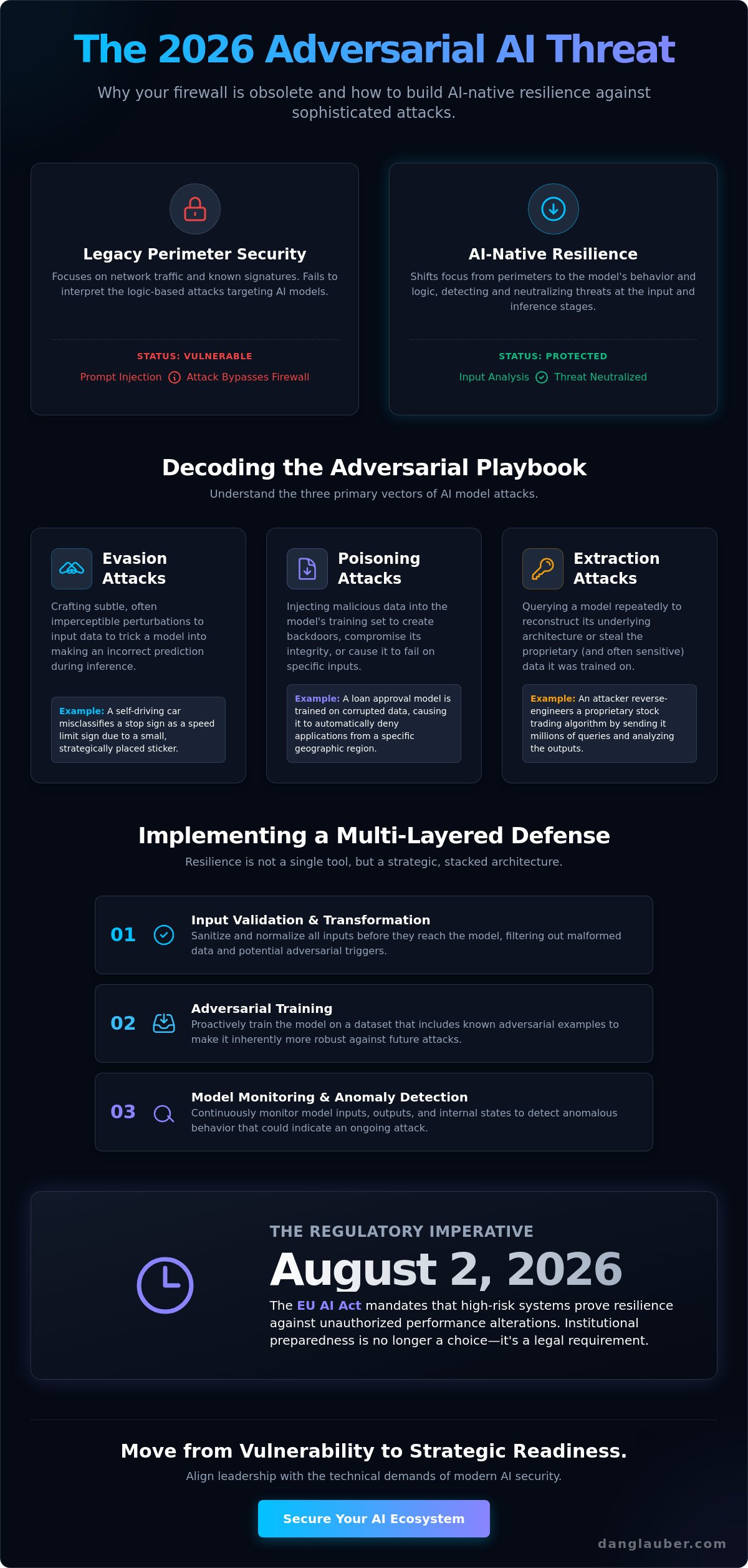
Your enterprise firewall is functionally invisible to a prompt injection attack. While traditional security focuses on the perimeter, defending against adversarial AI attacks requires addressing threats that target the very logic of your models. As we enter 2026, you likely recognize that the rapid deployment of agentic AI has outpaced the legacy protocols meant to protect them. The stakes are no longer theoretical. With the EU AI Act requiring high-risk systems to prove resilience against unauthorized performance alterations by August 2, 2026, institutional preparedness is now a mandate rather than a choice.
Success in this landscape requires a fundamental shift from reactive patching to a strategy of AI-native resilience. You'll learn how to implement a layered defense that addresses the 80+ techniques currently cataloged in the MITRE ATLAS framework. We'll provide the specific criteria for evaluating specialized security advisors and a comprehensive framework for AI red teaming. This guide ensures your organization moves from a state of vulnerability to one of strategic readiness, securing your systems against the sophisticated threats of the current technological era.
Key Takeaways
- Analyze the 2026 regulatory landscape and the specific mandates, such as the EU AI Act, that redefine AI resilience from a technical option to a legal requirement.
- Identify why traditional perimeter security fails to protect neural networks and why your organization must pivot to behavior-based, AI-native defense architectures.
- Master the mechanics of evasion and data poisoning to develop a proactive stance when defending against adversarial AI attacks targeting your core models.
- Implement a multi-layered defense-in-depth strategy that incorporates adversarial training and input transformation to neutralize sophisticated manipulation attempts.
- Evaluate the role of strategic advisory and executive workshops in aligning leadership with the technical demands of the modern AI security lifecycle.
The Strategic Imperative of Defending Against Adversarial AI Attacks
Defending against adversarial AI attacks represents the ultimate frontier of corporate resilience in the current technological era. This discipline involves securing the integrity, availability, and confidentiality of machine learning models against deliberate, malicious manipulation. We have moved past the phase of theoretical research; 2026 has emerged as the 'Year of the Adversary' for enterprise AI deployments. As organizations transition from experimental sandboxes to mission-critical applications, the surface area for potential exploitation has expanded exponentially. Your models are no longer just software components; they're the primary engines of your strategic advantage.
The business impact of a successful breach is staggering. It involves more than just a temporary system failure. A compromised model leads to a total erosion of stakeholder trust, massive regulatory penalties under the EU AI Act, and fundamentally flawed decision-making. When an adversary successfully manipulates a model's output, they aren't just stealing data; they're hijacking the logic of your organization. This shift requires a move toward visionary leadership that treats AI security as a foundational pillar of the modern enterprise.
The Reality of AI Vulnerability in 2026
AI models are inherently open by design. Their mathematical architectures, while sophisticated, provide unique attack surfaces that traditional security protocols fail to recognize. Research into Adversarial machine learning demonstrates that even minor, imperceptible perturbations in input data can trigger catastrophic failures in model classification. In 2026, the proliferation of automated agentic AI has accelerated this threat. These malicious agents can probe for model blind spots at machine speed, evolving adversarial examples from simple digital noise into sophisticated semantic triggers. These triggers are designed to bypass standard filters, allowing attackers to exploit vulnerabilities that human analysts might never detect.
Bridging the Gap: Technical Risk to Business Value
Security is no longer a localized IT concern; it's a board-level governance mandate. Leaders must quantify the cost of inaction, particularly as new laws like the Colorado AI Act take effect on June 30, 2026. A single model extraction attack can result in the loss of proprietary intellectual property that took years to develop. Organizations that fail to prepare face a future of vulnerability and reactive crisis management. Moving toward mastery requires a structured approach to risk that aligns technical defense with long-term business value. Adversarial defense serves as the comprehensive immune system for corporate intelligence.
- Integrity: Ensuring model outputs remain accurate and unmanipulated.
- Availability: Protecting against denial-of-service attacks targeting inference APIs.
- Confidentiality: Preventing model inversion or extraction of sensitive training data.
Decoding the Adversarial Playbook: Evasion, Poisoning, and Extraction
Effectively defending against adversarial AI attacks requires a granular understanding of how adversaries exploit the inherent mathematical openness of neural networks. These maneuvers are not accidental glitches. They are calculated exploitations of a model's decision boundaries. To build a resilient framework, we must categorize these threats using NIST's taxonomy of adversarial attacks, which provides a standardized language for describing the lifecycle of a breach from training to inference. Mastery over these concepts allows an organization to move beyond reactive patching and toward a proactive, visionary security posture.
A critical, often overlooked gap in current security discourse is the intersection of Explainable AI (XAI) and model vulnerability. While XAI tools are essential for transparency and compliance, they can inadvertently serve as a reconnaissance tool for attackers. By analyzing feature attribution maps, an adversary can identify exactly which inputs have the most significant impact on a model's prediction, effectively mapping out the most efficient path for an evasion attack. Balancing transparency with security is now a fundamental requirement for executive-level governance.
Evasion and Prompt Injection in the LLM Era
Evasion attacks represent the most immediate threat to deployed models. In these scenarios, an attacker manipulates input data to force a model into making an incorrect classification. In the context of Large Language Models, this frequently manifests as prompt injection. Attackers use "jailbreaking" techniques to bypass safety guardrails, or indirect prompt injection to hide malicious instructions within trusted data sources. In industrial settings, "adversarial noise" can be applied to physical objects to fool computer vision systems, causing them to misidentify hazards or ignore safety protocols. Defending against these semantic manipulations requires a deep understanding of natural language processing and signal processing.
Data Integrity and the Supply Chain of Intelligence
Data poisoning is the strategic "long-game" of modern industrial espionage. By subtly compromising the training set, an adversary can create dormant backdoors that only trigger when a specific, rare input is presented. This risk is particularly acute when organizations utilize pre-trained models from unverified or third-party repositories. Maintaining a secure supply chain of intelligence requires:
- Data Sanitization: Implementing rigorous filtering to identify and remove anomalous or malicious data points before training.
- Provenance Tracking: Maintaining a detailed, immutable record of every data source used in the model's lifecycle.
- Differential Privacy: Applying mathematical noise to the training process to prevent inference attacks from leaking sensitive data.
Reverse-engineering proprietary algorithms through model extraction is another rising threat. By probing an API with thousands of queries, an attacker can reconstruct a "shadow model" that mimics your proprietary logic, effectively stealing your intellectual property. Understanding these technical risks is a prerequisite for effective leadership. Many organizations find that a Board-Level Cybersecurity Briefing is the most effective way to align these complex technical challenges with broader corporate risk management goals.
Beyond Traditional Infosec: Why Your Current Perimeter Fails
The conventional security perimeter is a relic in the face of modern neural architectures. Traditional firewalls and intrusion detection systems are designed to intercept malicious code or unauthorized access requests, yet they remain fundamentally blind to the mathematical logic of a machine learning model. This is the "Black Box" problem in a security context. A firewall can inspect a packet for a known malware signature, but it cannot evaluate the semantic intent of a prompt or the subtle mathematical drift within a tensor. When defending against adversarial AI attacks, relying on legacy infrastructure is akin to guarding a vault with a lock that doesn't recognize the key has been duplicated through logic rather than force.
Many organizations fall into the trap of the "SOC Fallacy," believing that a standard Security Operations Center provides sufficient coverage. It doesn't. Traditional SOCs prioritize deterministic threats. AI threats, however, are often imperceptible to signature-based tools because they exploit the model's intended functionality. A data poisoning attack doesn't look like a breach; it looks like a routine training update. Legacy DevSecOps pipelines also struggle here, as they aren't built to account for the stochastic nature of AI outputs. You can't secure a probabilistic system with a binary mindset.
The Stochastic Challenge: Security in a Probabilistic World
Deterministic security rules fail because AI doesn't operate on "if-then" logic. It operates on weights and probabilities. An adversary doesn't need to break your code if they can subtly shift the probability of a specific outcome. This shift from static defense to dynamic resilience is the hallmark of sophisticated 2026 strategies. Integrating AI and cybersecurity requires a move toward behavior-based monitoring that can detect anomalies in model confidence scores rather than just network traffic. This ensures that your defensive posture evolves at the same rate as the generative threats targeting your enterprise.
Governance as a Defensive Asset
Effective defense is as much about structural governance as it is about technical controls. Establishing a "Human-in-the-loop" protocol serves as a critical security check, preventing automated agents from making catastrophic decisions based on manipulated inputs. Strategic leadership involves auditing the very logic your AI uses to function. Utilizing virtual ciso consulting services allows organizations to bridge the gap between high-level risk management and the granular requirements of the NIST AI Risk Management Framework (RMF). This alignment ensures that your AI security is not a siloed IT ticket but a core component of your enterprise compliance and defensive architecture. Mastery in this field requires a visionary approach that treats governance as a proactive defensive asset rather than a bureaucratic bottleneck.
Implementing a Robust Defense-in-Depth Strategy for AI
Securing an enterprise model requires moving beyond singular technical patches toward a comprehensive, multi-layered defensive architecture. Defending against adversarial AI attacks is a continuous lifecycle that begins in the training environment and extends through real-time inference. A robust strategy acknowledges that no single control is infallible; instead, it relies on overlapping safeguards that increase the cost and complexity for an adversary. This systematic approach ensures that even if one layer is bypassed, the integrity of the corporate intelligence remains intact. Mastery of this framework is what distinguishes a visionary organization from one that is merely compliant.
The implementation of this defense-in-depth strategy follows five critical steps:
- Step 1: Adversarial Training. Proactively incorporating known attack vectors and perturbed data into the training set to harden the model's decision boundaries.
- Step 2: Input Transformation. Sanitizing and pre-processing data through techniques like feature squeezing or bit-depth reduction before it reaches the model.
- Step 3: Model Robustness Audits. Utilizing rigorous stress-testing to identify latent vulnerabilities in the model's logic.
- Step 4: Output Filtering. Monitoring and blocking responses that exhibit signs of extraction attempts or anomalous semantic patterns.
- Step 5: Continuous Monitoring. Implementing AI-specific telemetry that tracks model confidence scores and detects distribution shifts in real time.
AI Red Teaming: The Proactive Defense
Proactive defense requires a shift in perspective. AI Red Teaming is a continuous exercise in adversarial empathy. Unlike traditional penetration testing, this process involves simulating sophisticated manipulation attempts to uncover how a model might fail when presented with "out-of-distribution" inputs. Organizations should utilize 'Challenger Models' to shadow production systems, identifying when the primary model's outputs begin to drift or align with known adversarial patterns. This allows for the identification of blind spots without disrupting live production environments, ensuring that defending against adversarial AI attacks remains a dynamic rather than static process.
Technological Safeguards: Differential Privacy and XAI
Advanced safeguards like Differential Privacy provide a mathematical guarantee against inference-related data leakage, ensuring that individual training records cannot be reconstructed by an adversary. This is often paired with Explainable AI (XAI) to detect when a model is "reasoning" incorrectly, providing a window into the black box. However, leadership must navigate the inherent trade-off between model performance and defensive robustness. Increasing a model's resilience often requires a slight sacrifice in raw accuracy or latency. Striking the right balance is a strategic decision that requires expert guidance. To align your technical defense with executive-level risk management, consider engaging in an Executive AI Strategy Workshop to build a customized roadmap for your organization.
Navigating the AI Security Frontier with Strategic Advisory
Transitioning from a state of vulnerability to one of strategic mastery requires more than just technical adjustments; it demands a fundamental realignment of corporate governance. While internal teams often possess deep technical talent, they frequently lack the specialized bridge between high-level risk management and the unique vulnerabilities of neural architectures. This is where an ai cybersecurity consultant becomes an essential strategic partner. By providing the external perspective and deep research required to navigate this landscape, a consultant ensures that your AI initiatives are built on a foundation of resilience rather than technical debt.
Dr. Glauber's comprehensive framework, detailed in Cybersecurity in the Age of Artificial Intelligence, provides the definitive roadmap for 2026. This work moves past the hype, offering a structured methodology for defending against adversarial AI attacks while maintaining the velocity of innovation. Transforming into a resilient, AI-first organization isn't a one-time event. It's a commitment to continuous adaptation and strategic foresight. Executive workshops play a critical role in this transformation, aligning leadership with the reality of the threat landscape and ensuring that security is viewed as a catalyst for trust rather than a barrier to deployment.
Leadership in the Age of Adversarial AI
Rushed implementations often result in "Security Debt," a liability that grows as AI systems become more integrated into core business processes. Leadership must foster a culture of security awareness that extends beyond the IT department to every developer and end-user interacting with agentic systems. Preparing for board-level briefings on AI resilience is no longer an optional task. Boards now require documented evidence of risk posture and defensive maturity to satisfy both insurers and regulators. This shift ensures that the organization views AI security as a core component of its strategic advantage.
Strategic Next Steps for Global Organizations
The path forward begins with a comprehensive AI Risk Assessment to identify which models are high-value and high-risk. Following this initial audit, setting up a monthly vCISO advisory ensures that your organization stays ahead of the evolving threat landscape. To catalyze this change across the entire leadership team, engaging a cybersecurity speaker for executives can provide the necessary vision and urgency. These steps ensure that your organization isn't just reacting to threats but actively shaping its own secure future. Mastery in this era depends on the ability to lead through complexity with confidence and preparedness.
- Audit: Conduct model-level risk assessments for all production-grade AI.
- Advise: Implement a recurring vCISO schedule to manage logic-based threats.
- Align: Host executive workshops to bridge the gap between technical risk and business value.
Mastering the AI Security Lifecycle
The journey toward 2026 requires a definitive departure from legacy security mindsets. You've seen how traditional firewalls fail to recognize semantic manipulation and why a layered defense-in-depth strategy is the only viable path forward. Securing your enterprise models involves a continuous cycle of adversarial training, robust input transformation, and proactive red teaming. This isn't just about technical patches; it's about building an organizational immune system that can withstand the stochastic nature of modern threats.
As the author of 'Cybersecurity in the Age of Artificial Intelligence', Dr. Daniel Glauber brings over 30 years of technology and security innovation to every engagement. Based in Florida, he serves as a vCISO for global enterprise clients, bridging the gap between technical risk and board-level strategy. Mastery in defending against adversarial AI attacks is within your reach when you align your technical controls with visionary leadership. Secure your organization's future with Dr. Daniel Glauber's strategic AI advisory services. You're now equipped to lead your organization into a resilient, AI-first future with confidence and preparedness.
Frequently Asked Questions
What is the most common type of adversarial AI attack in 2026?
Evasion attacks remain the most prevalent threat in 2026. These maneuvers involve manipulating inputs to force a model into making incorrect classifications or bypassing safety guardrails. In the current era of autonomous agents, indirect prompt injection has surged as adversaries hide malicious instructions within trusted data sources. This allows attackers to hijack model logic without direct access to the system, making it a primary concern for enterprise security teams.
Can traditional firewalls and antivirus software detect adversarial AI attacks?
Traditional perimeter defenses are fundamentally incapable of detecting these threats. Firewalls inspect network packets for known malware signatures; however, they cannot evaluate the mathematical perturbations or semantic intent behind a malicious prompt. Defending against adversarial AI attacks requires AI-native security tools that monitor model behavior and confidence scores rather than just binary code or traffic patterns. Relying on legacy infrastructure leaves the internal logic of your models entirely exposed.
How does adversarial training improve the robustness of a machine learning model?
Adversarial training hardens a model's decision boundaries by proactively incorporating known attack vectors into the training dataset. By exposing the network to perturbed examples during its learning phase, the model learns to recognize and neutralize these manipulations. This process creates a more resilient architecture that maintains accuracy even when presented with "out-of-distribution" inputs. It's a foundational step in building an AI system that's prepared for real-world adversarial conditions.
What is the difference between prompt injection and data poisoning?
The primary distinction lies in the attack's timing and target. Prompt injection is an inference-time attack where malicious instructions are fed into a deployed model to override its original programming. Data poisoning is a long-term strategy that occurs during the training phase. It involves corrupting the training set to create hidden backdoors that can be triggered later. While prompt injection targets the input, data poisoning compromises the model's fundamental integrity from the start.
Is it possible to fully secure an AI model against all adversarial attacks?
Complete security is a mathematical impossibility in a probabilistic world. Adversarial AI is a continuous arms race where new exploitation techniques emerge as quickly as defensive measures are developed. Organizations should focus on dynamic resilience rather than absolute prevention. This involves implementing a layered defense-in-depth strategy that minimizes the impact of a breach while maximizing the cost for the adversary. Preparedness and rapid detection are more realistic goals than total invulnerability.
What role does a Virtual CISO (vCISO) play in defending against AI threats?
A Virtual CISO provides the strategic governance necessary to align AI security with broader corporate risk management. They bridge the knowledge gap between technical developers and executive leadership, ensuring that AI resilience is treated as a board-level priority. By auditing model logic and implementing the NIST AI Risk Management Framework, a vCISO transforms AI security from a siloed IT task into a core defensive asset. This leadership is essential for navigating the complex 2026 regulatory landscape.
How does Explainable AI (XAI) help in identifying adversarial manipulation?
Explainable AI provides the transparency required to detect when a model's reasoning has been compromised. By analyzing feature attribution maps, security teams can identify if a model is making decisions based on irrelevant or adversarial noise. While XAI can inadvertently aid attackers in reconnaissance, its primary value lies in serving as a diagnostic tool. It allows practitioners to uncover hidden logic failures before they manifest as catastrophic errors in a production environment.
What are the first steps an organization should take to audit their AI security?
Organizations should begin with a comprehensive AI Risk Assessment to inventory all production-grade models and identify high-value targets. Once the attack surface is mapped, the next step is to implement rigorous AI Red Teaming to stress-test these systems under simulated adversarial conditions. Establishing a baseline for model telemetry and confidence scores allows for the detection of subtle drifts. These initial steps are critical for defending against adversarial AI attacks and ensuring long-term model integrity.