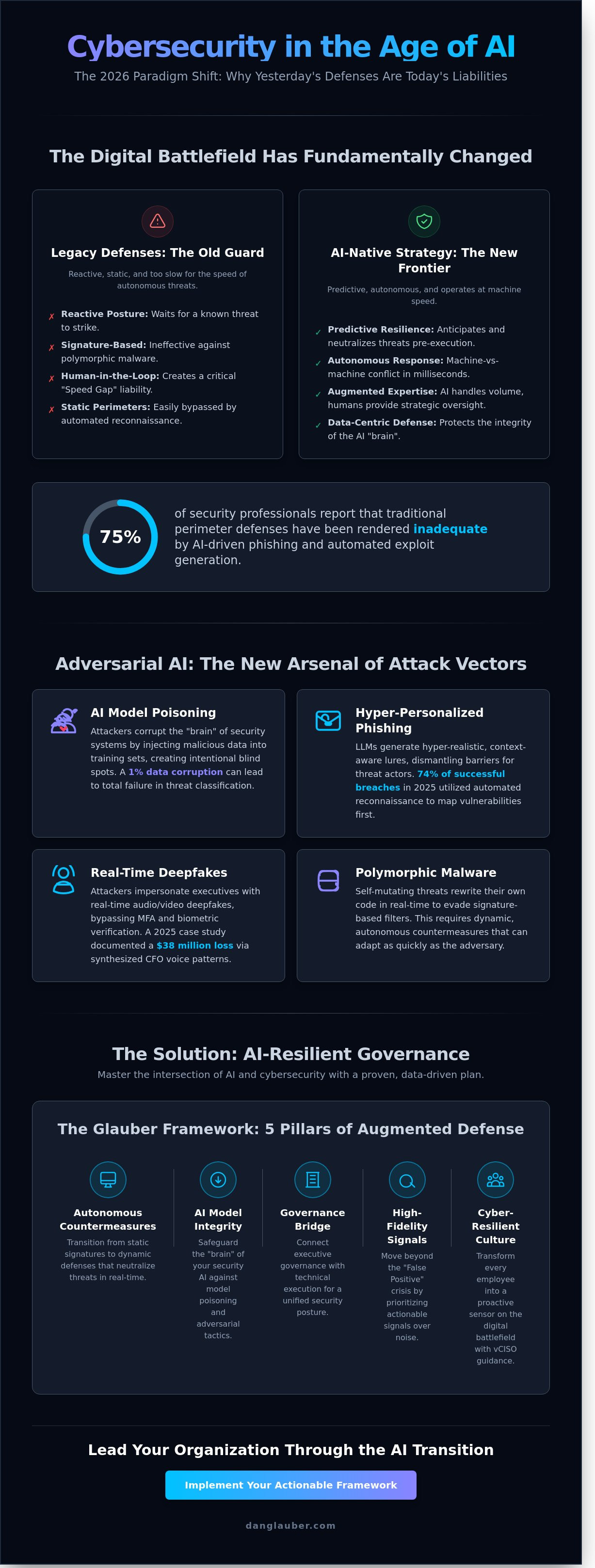
What if the security infrastructure your organization finalized in 2023 is already a liability rather than a shield? As we approach 2026, the digital battlefield has shifted; cybersecurity in the age of artificial intelligence is no longer about patching known vulnerabilities but about out-pacing autonomous neural networks. You likely feel the mounting pressure as 75% of security professionals report that AI-driven phishing and automated exploit generation have rendered traditional perimeter defenses inadequate. It's exhausting to explain to a board of directors why yesterday's gold standard tools can't stop today's polymorphic malware.
You deserve a strategy that moves beyond reactive firefighting. This article promises to help you master the intersection of AI and cybersecurity with actionable frameworks designed to defend against next-generation threats. We'll provide a clear breakdown of Adversarial AI and a comprehensive roadmap for AI security governance. By the end of this briefing, you'll have the confidence to lead your organization through this transition with a definitive, data-driven plan.
Key Takeaways
- Discover how to transition from static, signature-based defenses to dynamic, autonomous countermeasures capable of neutralizing polymorphic malware in real-time.
- Learn to safeguard the "brain" of your security systems by identifying and mitigating model poisoning and adversarial machine learning tactics.
- Master the implementation of the five-pillar Glauber Framework to bridge the gap between executive governance and technical execution for cybersecurity in the age of artificial intelligence.
- Optimize security operations by moving beyond the "False Positive" crisis and adopting AI-native architectures that prioritize high-fidelity signals over noise.
- Cultivate a cyber-resilient culture led by vCISO strategic guidance, transforming every employee into a proactive sensor on the modern digital battlefield.
The Paradigm Shift: Why Traditional Security Fails in 2026
The digital battlefield has fundamentally changed. We've moved past the era of static firewalls and signature-based detection. Today, cybersecurity in the age of artificial intelligence represents a dynamic, autonomous conflict where software agents engage in high-speed combat. Traditional models fail because they're reactive. They wait for a known threat to appear before initiating a response. In 2026, threats are never truly known because they're constantly mutating. This shift requires a move from the "detect and respond" mindset to one of predictive resilience.
The "Speed Gap" is our greatest vulnerability. When an AI-driven attack vector identifies a zero-day exploit, it executes the breach in milliseconds. Relying on human-in-the-loop triage isn't just inefficient; it's a liability that creates a window of opportunity for total system compromise. Static defenses can't keep pace with polymorphic malware that rewrites its own code to evade specific filters. We're now at the intersection of AI and cybersecurity, where the only effective countermeasure is a system that learns and adapts as quickly as the adversary.
The Democratization of Cybercrime
Large Language Models (LLMs) have effectively dismantled the barriers to entry for global threat actors. Sophisticated coding is no longer a requirement for high-level intrusions. We've seen the rise of Phishing-as-a-Service, where hyper-personalized AI generation creates lures that are indistinguishable from legitimate corporate communications. Adversarial AI is the use of machine learning to bypass security controls. By mid-2025, reports indicated that 74% of successful breaches utilized some form of automated reconnaissance to map network vulnerabilities without human intervention. To track these evolving market dynamics, CyberDB provides comprehensive analysis and database resources for the global cybersecurity and AI industries.
The Erosion of Human Trust via Deepfakes
Business Email Compromise (BEC) has evolved into a multi-sensory threat. Static identity markers are obsolete. Real-time audio and video deepfakes now allow attackers to impersonate executives during live virtual meetings with startling accuracy. Zero Trust principles must now extend to biological identity verification to counter these synthetic threats. A landmark 2025 case study documented how a global logistics firm suffered a $38 million loss after an AI-driven social engineering attack successfully bypassed traditional multi-factor authentication (MFA) by synthesizing the CFO's biometric voice patterns during a high-priority wire transfer authorization.
- Autonomous Conflict: Security is now a machine-vs-machine engagement.
- Polymorphic Threats: Malware that adapts its signature in real-time.
- Predictive Resilience: Shifting from recovery to proactive anticipation.
The Dual Battlefield: Adversarial AI vs. Augmented Defense
The digital battlefield has shifted into a high-stakes competition between competing machine learning models. This relentless cat and mouse game defines cybersecurity in the age of artificial intelligence; it's a conflict where the speed of silicon replaces the speed of human thought. Traditional perimeters have dissolved. In their place, data integrity has emerged as the new defensive boundary. If an adversary compromises the data used to train your security models, your defenses become your greatest vulnerability.
Model poisoning is the most sophisticated expression of this threat. Attackers no longer just seek to bypass a firewall; they aim to "corrupt the brain" of the security system itself. By injecting subtle, adversarial perturbations into training sets, hackers can create intentional blind spots. A 2023 report from the Berryville Institute of Machine Learning identified over 70 distinct attack vectors against ML systems, highlighting that even a 1% corruption of training data can lead to a total failure in threat classification. Security leaders must treat their data pipelines with the same level of scrutiny once reserved for kernel-level access.
Augmented defense provides the necessary counterweight. This approach doesn't seek to replace the human analyst but rather to liberate them from the cognitive fatigue of triaging 10,000 daily alerts. AI handles the high-volume pattern recognition, while the human expert provides the strategic nuance. Transitioning to these actionable frameworks allows organizations to move from reactive patching to proactive resilience.
Offensive AI: The New Attack Vectors
Adversaries are leveraging neural networks to automate vulnerability discovery at a scale previously unimaginable. Evasive AI represents a significant leap in malware sophistication. These programs use reinforcement learning to "test" themselves against specific EDR vendors in isolated environments, evolving their code until they're invisible to signature-based and even some heuristic detections. Beyond malware, attackers are deploying neural networks to target cryptographic targets. By identifying non-random patterns in entropy, these models can shorten the time required to crack complex targets by 25% compared to traditional brute-force methods.
Defensive AI: Predictive Threat Hunting
Modern defense relies on behavioral analytics to catch "living-off-the-land" attacks. These techniques involve adversaries using legitimate system tools, such as PowerShell or administrative scripts, to move laterally. AI models trained on baseline user behavior can detect these anomalies in milliseconds, triggering automated incident response protocols that contain the threat before it executes. This moves the SOC from detection to autonomous containment.
The future of infrastructure lies in resilience through automation. In the context of 2026 infrastructure, self-healing networks are defined as autonomous systems that utilize real-time telemetry to detect exploitation and instantly re-provision compromised nodes into a verified "known-good" state without human intervention.
Evaluating Strategy: Legacy SOC vs. AI-Enhanced Architectures
The traditional Security Operations Center (SOC) is buckling under the weight of its own architecture. Legacy models rely on a linear scaling of human analysts to manage incoming alerts, which is economically unsustainable. A 2023 study by Ponemon Institute found that 54% of security professionals feel their SOC is ineffective due to the sheer volume of alerts. In contrast, AI-native security operations leverage machine learning to automate the triage process. This transition isn't just about speed; it's about shifting from a "Perimeter Defense" mindset to a "Data-Centric Security" model where protection follows the data across cloud environments.
Analysts often face "alert fatigue," where 25% to 30% of their workday is consumed by false positives. AI-driven architectures reduce this noise by applying behavioral analytics to identify the genuine "signal" of a breach. For mid-market firms, the objection that AI-driven security is too expensive ignores the reality of modern risk. The cost of maintaining a 24/7 human SOC often exceeds $250,000 annually in base salaries alone. AI-driven platforms provide a fractional cost alternative that maintains a superior defensive posture while scaling with the organization.
The Limitations of Signature-Based Detection
Traditional antivirus is effectively dead. Cybersecurity in the age of artificial intelligence requires moving beyond simple file-matching. AI-generated polymorphic code can change its signature in milliseconds, bypassing legacy filters with ease. We're seeing a critical shift from Indicators of Compromise (IOC), which are reactive, to Indicators of Behavior (IOB). This focuses on how an attacker moves rather than what file they use. For a deeper dive into these systemic failures, read Dr. Glauber's 'Why Traditional Security Fails' article.
The ROI of Autonomous Security Operations
The metrics for success are clear: Mean Time to Detect (MTTD) and Mean Time to Respond (MTTR). According to IBM's 2023 research, organizations using AI and automation identified and contained breaches 108 days faster than those without. This efficiency addresses the global talent shortage of 3.4 million cybersecurity professionals. By automating Tier 1 tasks, your team focuses on high-level strategy. Integrating vCISO leadership ensures these AI-driven transformations align with business objectives rather than just technical checklists; to see how these intelligent automation strategies drive broader enterprise results, check out IntellifyAi.
The Glauber Framework: 5 Pillars of AI-Resilient Governance
Dr. Daniel Glauber’s proprietary framework provides a definitive roadmap for organizations navigating the digital battlefield. Effective cybersecurity in the age of artificial intelligence requires more than just deploying new software; it demands a fundamental shift in leadership philosophy. Technology accounts for only 20% of the solution. The remaining 80% rests on governance. This methodology bridges the gap between the C-suite’s strategic vision and the server room’s technical reality. Every resilient posture begins with comprehensive AI Risk Assessments, a foundational project that maps the organization's entire algorithmic footprint to identify hidden vulnerabilities before they're exploited.
Step 1: Establishing AI Security Policy
Enterprises must define clear, enforceable boundaries for Generative AI usage. A 2023 industry report found that 75% of organizations are currently considering or implementing bans on unsanctioned AI tools to prevent data leaks. To combat this, leaders need a robust Shadow AI discovery and remediation plan to identify "rogue" models operating outside IT oversight. AI Governance is the strategic oversight of algorithmic risk, ensuring every deployment aligns with the company's risk tolerance and ethical standards. Without this policy layer, technical defenses remain fragmented and reactive.
Step 2: Hardening the AI Supply Chain
Third-party dependencies represent a massive attack vector. Vetting vendors for data privacy and model security is no longer optional. Organizations should mandate a Software Bill of Materials (SBOM) for all AI models to track training data origins and library dependencies. This transparency prevents poisoned datasets from entering the ecosystem. For leaders ready to implement these controls, our Executive AI Strategy Workshops provide the tactical depth needed to secure the vendor pipeline and master supply chain integrity.
Step 3: Continuous Model Monitoring & Red Teaming
Static security audits are obsolete in a world of self-evolving threats. Security is a continuous stream, not a point-in-time event. Adversarial Red Teaming is essential to stress-test AI defenses against sophisticated prompt injection and data exfiltration tactics. Boards must move past the illusion of total prevention. They must prepare for the "When, not If" reality of a breach. By simulating 15 to 20 distinct attack scenarios, teams develop the mastery required to contain incidents before they escalate into systemic failures. Cybersecurity in the age of artificial intelligence is a marathon of constant adaptation.
Secure your organization's future by mastering the pillars of algorithmic defense. Download the full Glauber Framework whitepaper today.
Leading Through the Crisis: The Role of the vCISO and Executive Training
The transition into the "Age of Artificial Intelligence" demands more than incremental software updates; it requires a fundamental shift in strategic leadership. Organizations now operate on a digital battlefield where automated attack vectors evolve in milliseconds, rendering traditional defense perimeters obsolete. In this environment, the vCISO (virtual Chief Information Security Officer) acts as the essential navigator. They steer the enterprise through the complex intersection of AI and security, ensuring that technical capabilities don't outpace risk management. Dr. Daniel Glauber brings 30 years of experience to this role, serving as the steady hand for boards that must balance rapid innovation with the threat of systemic failure.
A truly cyber-resilient culture recognizes that security isn't just an IT function. It's a collective responsibility where every employee functions as a human sensor. When an entry-level analyst identifies a deepfake audio lure or a suspicious prompt injection attempt, they act as a critical node in the firm's defense mesh. Since over 80% of modern breaches involve human elements, transforming staff from passive targets into active sensors is the only viable path toward long-term resilience. This shift requires disciplined training that moves beyond compliance checkboxes to genuine strategic mastery.
Bridging the Technical-Business Gap
Executive leaders often struggle to quantify the impact of abstract technical failures. A vCISO bridges this gap by translating "neural network vulnerabilities" into "business interruption risk." This translation is vital as we approach 2026, when new regulatory environments will likely mandate granular reporting on AI-driven risks. Dr. Glauber’s definitive book serves as the mastery guide for this transition. It provides 18 chapters of actionable frameworks designed to ensure the board understands how a poisoned data model or a compromised algorithm affects the bottom line and brand reputation.
Actionable Next Steps for IT Leaders
Success in cybersecurity in the age of artificial intelligence depends on proactive preparation rather than reactive panic. Leaders must implement structured defense protocols to maintain their competitive edge. Consider these immediate priorities:
- Conduct an Immediate AI Risk Audit: Identify all shadow AI deployments and unvetted third-party integrations currently accessing corporate data.
- Schedule an Executive Strategy Workshop: Align the leadership team on risk appetite and establish clear protocols for AI-driven incident response.
- Deploy Zero-Trust Architecture: Ensure that every identity and request is verified, accounting for the increased sophistication of adversarial AI.
The window for reactive security has closed. Organizations must choose between being the architect of their defense or a casualty of the next automated exploit. Master the digital battlefield-Consult with Dr. Daniel Glauber today to secure your organization's future or purchase the definitive guide to navigating this unprecedented technological shift.
Securing Strategic Mastery in a Post-Legacy Landscape
The shift toward 2026 requires a decisive pivot from reactive security to the Glauber Framework's 5 Pillars of AI-resilient governance. Legacy SOC models can't keep pace with adversarial neural networks that evolve in milliseconds. Organizations must adopt augmented defense architectures to maintain a tactical advantage on the digital battlefield. Mastering cybersecurity in the age of artificial intelligence demands a sophisticated blend of technical depth and executive foresight. It's about moving from a state of vulnerability to strategic readiness.
Dr. Daniel Glauber brings 30+ years of technology and innovation expertise to help your team navigate these complex attack vectors. As a vCISO for global organizations and the author of 'Cybersecurity in the Age of Artificial Intelligence', he provides the actionable strategy needed to transform your defense posture. You've got the power to turn these emerging threats into a definitive competitive advantage. Secure your organization's future: Work with Dr. Daniel Glauber. The path to resilience is clear, and your organization is ready to lead the way.
Frequently Asked Questions
What is cybersecurity in the age of artificial intelligence?
Cybersecurity in the age of artificial intelligence is the strategic integration of machine learning and neural networks to defend against automated digital threats. It represents a fundamental shift from reactive security models to a predictive defense posture on the digital battlefield. This approach utilizes Zero-Trust Architecture to ensure that every access request is verified through real-time intelligence and behavioral analysis.
How is AI used by cybercriminals to launch attacks?
Cybercriminals utilize adversarial AI to automate reconnaissance and generate polymorphic malware that bypasses legacy detection systems. According to a 2023 report from SlashNext, malicious deepfake and AI-driven phishing attempts increased by 3,000% within a single year. These tactics allow attackers to scale their operations rapidly, creating sophisticated attack vectors that target human psychology and technical vulnerabilities simultaneously.
Can AI replace human cybersecurity analysts in the SOC?
AI functions as a critical force multiplier but it won't replace the strategic judgment of human analysts in the Security Operations Center. Gartner predicts that while 40% of routine SOC tasks will be automated by 2025, human expertise remains vital for the last mile of decision-making. Mastery of the digital landscape requires a synergy where algorithms process data and professionals provide contextual leadership.
What are the biggest risks of using Generative AI in an enterprise setting?
The most significant risks include inadvertent data leakage and the emergence of "shadow AI" across corporate networks. High-profile incidents in 2023, such as the data exposure at Samsung, highlighted how proprietary source code can enter public training sets without authorization. Organizations must implement actionable frameworks to govern how employees interact with LLMs to prevent the loss of critical intellectual property.
How do I protect my organization's data from being used to train public AI models?
You should secure your environment by using enterprise-grade API agreements that include explicit "opt-out" clauses for model training. Currently, 75% of organizations are implementing formal bans on public LLM usage for sensitive internal tasks. Utilizing private instances, like the Azure OpenAI Service, ensures that your data remains within your secure tenant and isn't repurposed for external model refinement.
What is a vCISO and why do I need one for AI strategy?
A vCISO is a fractional executive who provides high-level security leadership and technical guidance on a flexible basis. They're essential for navigating the intersection of AI and cybersecurity, helping firms translate complex neural network risks into business strategy. A vCISO ensures your organization adopts 18 comprehensive chapters of security best practices without the prohibitive cost of a full-time executive hire.
Is Dr. Daniel Glauber's book suitable for non-technical executives?
The book is designed as a definitive bridge between technical depth and strategic leadership for non-technical professionals. It features 50+ real-world case studies that ground abstract AI concepts in practical, actionable outcomes for business leaders. Executives will find it serves as an essential guide for moving their teams from a state of vulnerability to one of strategic readiness.
How much does an AI risk assessment typically cost for a mid-sized firm?
The price of a specialized AI risk assessment varies based on the scope of the digital infrastructure and the number of critical domains analyzed. Industry benchmarks from the SANS Institute in 2023 indicate that professional security audits for emerging technologies generally range between $15,000 and $45,000. These assessments are vital for identifying specific countermeasures needed to protect against automated attack vectors.