
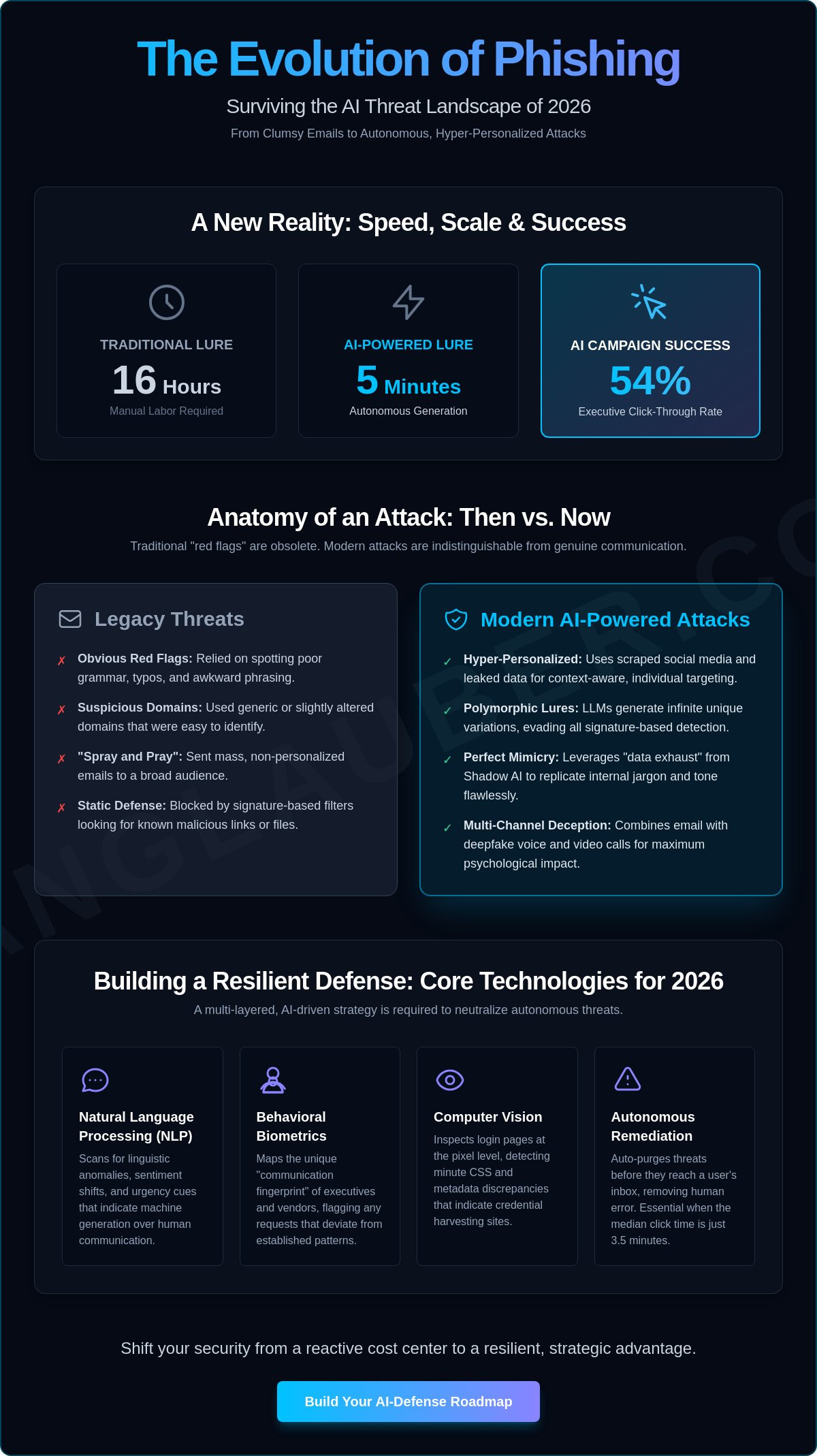
While traditional phishing lures once required sixteen hours of manual labor, an AI-powered campaign now reaches your executive inbox in just five minutes with a staggering 54% click-through rate. It's a sobering reality for leadership teams who see trust in internal communications eroding as deepfake-based CEO fraud becomes a standard adversary tactic. You've likely noticed that legacy security tools are struggling to keep pace, creating an information overload that obscures genuine risk. Implementing a robust framework for AI-driven phishing attack prevention is no longer a technical luxury; it's a structural necessity for organizational survival in 2026.
You don't have to remain in a state of reactive vulnerability. This guide will help you master the critical shift from outdated filters to autonomous, defense-in-depth strategies designed to neutralize hyper-personalized threats. We'll provide a scalable security roadmap that reduces the risk of high-value Business Email Compromise (BEC) while arming you with board-ready risk mitigation reports. By moving from the macro challenges of industrialized fraud to micro-level execution, you'll transform your security posture from a cost center into a resilient strategic advantage.
Key Takeaways
- Identify the shift from grammatical "red flags" to hyper-personalized social engineering and the role of behavioral biometrics in authenticating communication fingerprints.
- Construct a scalable roadmap for AI-driven phishing attack prevention by prioritizing "Explainable AI" (XAI) and API-integrated security solutions over legacy gateways.
- Modernize your human defense layer by moving beyond obsolete simulations toward rigorous out-of-band verification protocols for high-stakes requests.
- Empower the board with strategic risk mitigation data that bridges the gap between technical autonomous defense and corporate governance.
- Align your executive leadership with the 2026 threat landscape through strategic workshops focused on neutralizing the industrialization of generative AI fraud.
The Anatomy of AI-Driven Phishing: Why Traditional Defenses Fail in 2026
The era of the "obvious" phishing email is dead. By 2026, the industrialization of generative AI has transformed social engineering from a manual craft into an autonomous, high-speed weapon. Traditional defenses once relied on spotting clumsy typos or suspicious domains, but Large Language Models (LLMs) have erased those linguistic markers entirely. Attackers now leverage real-time social media scraping and leaked corporate data to generate lures in milliseconds. This shift from "spray and pray" tactics to hyper-personalized, autonomous engagement demands a fundamental rethink of comprehensive overview of phishing and the immediate adoption of AI-driven phishing attack prevention frameworks.
Static, signature-based defenses are fundamentally ill-equipped for this environment. These legacy systems look for known threats, yet AI specializes in creating unknown, unique variations. Modern security requires a move toward dynamic, intent-based analysis. Instead of checking if a link has been flagged before, your defense must scrutinize the underlying motive of a message. If an email creates artificial urgency while deviating from a sender's established communication style, it must be neutralized regardless of how "clean" the technical headers appear.
The Rise of Polymorphic Phishing and LLM Exploitation
Cybercriminals now utilize "jailbroken" LLMs to produce infinite variations of a single malicious prompt, ensuring no two emails are identical. Polymorphic phishing is a self-mutating code structure that evades traditional hash-based detection. A significant, often overlooked risk is Shadow AI. When employees use unauthorized AI tools to summarize sensitive internal documents, they inadvertently leak data that fuels personalized attacks. This "data exhaust" allows attackers to mirror internal jargon with terrifying accuracy, making the threat indistinguishable from a legitimate colleague's request.
Deepfakes and Voice Cloning: The New Frontiers of BEC
Business Email Compromise (BEC) has evolved far beyond the inbox. By 2026, multi-channel attacks incorporating AI-generated audio and video have become standard practice. The psychological impact of "vishing" (voice phishing) on finance teams is profound. It's difficult for an assistant to deny a high-pressure request when the voice on the phone perfectly matches the CEO's cadence and tone. We saw the precursor to this in 2024 when a deepfake video call led to a $25 million loss; today, these tactics are automated and scalable. This reality makes executive-level AI strategy workshops essential for identifying these sophisticated deception patterns before they result in catastrophic financial exfiltration.
Core Technologies for AI-Driven Phishing Attack Prevention
Effective defense in 2026 requires moving beyond simple filtering toward deep inspection of communication intent. Natural Language Processing (NLP) serves as the first line of defense, scanning for linguistic anomalies that suggest a message was generated by a machine rather than a human. By analyzing syntax and emotional resonance, these models identify subtle shifts in a sender's established "communication fingerprint." Behavioral biometrics take this further by mapping the unique interaction patterns of your CEO and vendors. If a high-stakes request arrives with a tone that deviates from historical data, the system flags it as a high-probability fraud attempt. This dual-perspective approach recognizes that while AI is the catalyst for these threats, it's also the only tool capable of achieving true strategic readiness.
Visual deception has also reached a level of sophistication that bypasses human detection. Computer vision technology now plays a vital role in AI-driven phishing attack prevention by inspecting login pages at the pixel level. It identifies minute discrepancies in CSS rendering or image metadata that indicate a credential-harvesting site. Because the median time for a user to click on a phishing email is a mere 3.5 minutes, autonomous remediation is essential. Modern frameworks must "auto-purge" threats before they ever reach the user's view, removing the possibility of human error entirely. This methodology is backed by the analysis of millions of message samples, ensuring that your defense is as data-driven as the attacks it faces.
Intent Analysis vs. Payload Detection
Modern phishing often contains no malicious links or attachments. Instead, it relies on social pressure and authority to trigger a wire transfer or data leak. AI models now evaluate "urgency" and "authority" metrics to assess the underlying risk of a message. This process is supported by graph-based analysis, which maps the complex web of relationships between senders and recipients. By understanding the typical flow of data within your organization, AI can spot an "out-of-network" request even when it originates from a compromised internal account. For those seeking to refine these technical guardrails into a usable strategy, an Executive AI Strategy Workshop can provide a structured starting point.
Zero Trust Architecture and Identity-Centric Security
Securing the inbox is only one component of a broader strategy for cybersecurity in the age of artificial intelligence. By integrating phishing prevention into a Zero Trust architecture, organizations shift from "trust but verify" to "never trust, always verify" at the API level. This identity-centric approach stops account takeover (ATO) by requiring continuous authentication based on behavioral signals. This methodology is central to Strengthening Human Resilience Against Phishing, ensuring that even if a credential is lost, the attacker cannot navigate your infrastructure. This layered defense ensures that identity remains the ultimate perimeter in a world where content is no longer reliable.
Evaluating AI Security Solutions: A Comparison Framework for Executives
Selecting a vendor for AI-driven phishing attack prevention requires a shift from evaluating technical features to assessing strategic outcomes. The market is currently saturated with "AI-washed" legacy tools that simply append basic scripts to aging infrastructure. To achieve true mastery in this era, leadership must distinguish between traditional Secure Email Gateways (SEG) and modern Integrated Cloud Email Security (ICES) solutions. While SEGs focus on perimeter defense, they often fail to detect internal-to-internal threats or lateral movement. ICES solutions, however, utilize API-based integration to sit directly within the cloud environment, providing the deep visibility needed to catch the 204% increase in AI-driven phishing attempts that bypass traditional controls.
A robust evaluation framework must prioritize four key pillars to ensure long-term resilience:
- Integration Ease: The solution should deploy via API in minutes without requiring MX record changes that disrupt mail flow.
- Explainable AI (XAI): The system must provide clear rationale for its detections, allowing security teams to understand why a specific communication was flagged as anomalous.
- Total Cost of Ownership (TCO): Beyond the license fee, executives must account for the labor costs associated with managing false positives and manual remediation.
- Threat Intelligence Synergies: High-performing tools leverage global, cross-industry data feeds to identify emerging AI-attack patterns before they reach your domain.
The False Positive Dilemma: Balancing Security and Productivity
Aggressive AI filtering can introduce friction that hampers organizational velocity. If your security posture is too rigid, it risks blocking legitimate high-value transactions; if it's too lax, it invites catastrophe. Success lies in "Human-in-the-loop" systems where AI handles the bulk of autonomous purging while flagging high-confidence anomalies for human confirmation. This balance is critical for maintaining trust in internal systems. Explainable AI features are particularly vital here, as they provide the transparency required for board-level risk reporting and meeting stringent 2026 regulatory compliance standards.
Cloud-Native vs. Legacy Infrastructure Compatibility
Modern enterprises operating on Microsoft 365 or Google Workspace require tools that understand the nuances of cloud-native communication. Legacy hardware-based solutions lack the agility to parse real-time metadata and behavioral signals. Navigating these complex integrations often requires the oversight provided by virtual ciso consulting services to ensure that your security stack isn't just a collection of tools, but a unified strategic framework. You must verify that a vendor's machine learning models are genuinely dynamic rather than static rule-based scripts masquerading as advanced intelligence.
Building a Cyber-Resilient Culture: The Human Element in 2026
Technology provides the armor, but the human element remains the final point of failure or fortitude. In an era where 88% of data breaches involve human error, technical guardrails for AI-driven phishing attack prevention must be reinforced by a culture of psychological skepticism. Traditional phishing simulations that rely on spotting "suspicious links" or "bad grammar" are now obsolete. Since AI can generate flawless, contextually perfect lures, your team can no longer rely on visual cues. They must be trained to recognize the psychological pressure points and emotional triggers that characterize modern social engineering.
Resilience in 2026 requires the implementation of rigid "Verification Protocols" for all high-stakes requests. Any directive involving financial transfers, sensitive data exfiltration, or credential changes must be verified through out-of-band communication. This means calling a known, pre-verified number or using a secondary encrypted channel before acting on an email or voice prompt. Fostering a "no-blame" culture is equally critical. If an employee feels they've made a mistake, they must feel empowered to report it immediately without fear of retribution. Rapid reporting is the only way to contain an AI-driven breach before it scales into a systemic crisis.
Modernizing Security Awareness for the Deepfake Era
Modern training must shift focus from technical red flags to emotional awareness. Employees should be taught to identify "manufactured urgency" and "unusual authority" as the primary indicators of a threat. Using safe, controlled deepfake examples in simulations helps build the necessary skepticism toward audio and video prompts. We recommend implementing a "Three-Second Pause" rule: a mandatory period of reflection before clicking any link or responding to a high-pressure request, allowing the rational mind to override the immediate emotional response triggered by AI-crafted lures.
Incident Response in the Age of AI Speed
Your Incident Response (IR) plan must operate at the same velocity as the AI attacking you. This necessitates pre-approved "kill switches" for compromised executive accounts, allowing security teams to freeze access instantly when an anomaly is detected. Cultural resilience is inextricably linked to the broader ai and cybersecurity landscape, where the speed of detection must be matched by the speed of executive decision-making. To ensure your leadership team is prepared to model this behavior, consider scheduling an Executive AI Strategy Workshop to align your cultural and technical defenses.
Strategic Governance: The vCISO's Roadmap for AI Prevention
The Virtual CISO (vCISO) serves as the primary architect of this defensive evolution, bridging the gap between technical capability and organizational resilience. Implementing AI-driven phishing attack prevention is not merely a software deployment; it's a structural realignment of how your organization perceives and mitigates risk. By 2026, the complexity of autonomous threats requires a governance model that is both agile and data-driven. The vCISO ensures that every layer of the defense-in-depth strategy aligns with the broader business objectives, transforming security from a reactive barrier into a competitive advantage.
Reporting these risks to the board requires a shift in language. Directors are less concerned with the mechanics of NLP and more focused on fiduciary liability and business continuity. Your briefing should frame AI-related risks in terms of potential impact on the balance sheet. With the average cost of a data breach reaching $4.88 million in 2025, the financial argument for a proactive posture is undeniable. Integrating these safeguards into the annual budget must be presented as a strategic investment in brand trust, a KPI that is increasingly sensitive to the integrity of corporate communications.
To ensure these strategies are grounded in reality rather than vendor hype, many organizations now leverage an ai cybersecurity consultant to perform independent risk assessments. These specialized advisors provide a neutral perspective, validating that your AI-driven phishing attack prevention roadmap is robust enough to withstand the multi-step, coordinated fraud attacks that rose by 180% year-over-year in 2026. This independent oversight builds confidence among stakeholders and ensures that your defensive stack remains ahead of the adversary's innovation curve.
Quantifying Risk and ROI for AI Security Investments
Board-level transparency depends on moving from "threat counts" to "potential loss avoidance." By demonstrating how autonomous defense reduces the risk of high-value Business Email Compromise (BEC), which saw losses exceeding $2.77 billion in 2025, you provide a clear ROI for security spending. This proactive stance also directly influences cyber insurance premiums. Carriers in 2026 are increasingly mandating AI-driven behavioral analysis as a prerequisite for coverage eligibility. Maintaining high standards of security governance isn't just about stopping attacks; it's about preserving the organization's insurability and long-term financial health.
The Path Forward: From Vulnerability to Mastery
The transition from reactive filters to autonomous mastery is a journey that requires both vision and discipline. You've moved beyond the "bad grammar" era into a landscape defined by hyper-personalized, real-time threats. Mastery involves the seamless integration of advanced technology, rigorous verification protocols, and an executive team that leads by example. If you're ready to move from a state of potential vulnerability to one of strategic readiness, the time for decisive action is now. Secure your organization with Dr. Daniel Glauber's vCISO Advisory and begin the process of building a framework that is as intelligent as the threats it faces.
Seizing Strategic Command of the Autonomous Threat Landscape
The shift toward AI-driven phishing attack prevention represents a fundamental evolution in corporate governance rather than a mere technical update. You've explored how autonomous intent analysis and behavioral biometrics replace the obsolete detection methods of the past. By aligning these advanced technologies with a culture of radical skepticism and out-of-band verification, your organization moves from a state of vulnerability to one of strategic mastery. This framework ensures that your defense is as intelligent and adaptive as the adversaries it faces, protecting both your financial assets and your brand's integrity.
Navigating this high-stakes landscape requires the foresight of a seasoned expert practitioner. Dr. Daniel Glauber, author of 'Cybersecurity in the Age of Artificial Intelligence' and a global vCISO with 30+ years of technology and innovation experience, provides the visionary leadership necessary to secure your organization's future. Book a Strategic Advisory Session with Dr. Daniel Glauber to transform your security posture into a resilient, board-ready framework. You possess the roadmap to neutralize hyper-personalized threats; now is the time to execute with confidence and lead your organization toward a secure, AI-empowered future.
Frequently Asked Questions
How does AI-driven phishing differ from traditional phishing?
Traditional phishing relies on static templates and manual delivery, often leaving visible markers like grammatical errors or generic greetings. AI-driven phishing utilizes autonomous agents to generate hyper-personalized content in real-time, scraping social data to mirror a sender's exact tone. It eliminates linguistic "red flags" entirely, making the lure indistinguishable from legitimate corporate correspondence through sheer contextual accuracy.
Can AI-driven phishing prevention stop deepfake audio attacks?
Modern AI-driven phishing attack prevention frameworks incorporate behavioral biometrics and acoustic intent analysis to neutralize synthetic voice threats. These systems identify the subtle, non-human artifacts in deepfake audio that the human ear cannot detect. By cross-referencing high-stakes voice requests with established communication fingerprints, the technology flags anomalies before a wire transfer or data leak occurs.
What is the best way to train employees to spot AI-generated emails?
Training must shift from technical inspection to psychological awareness. Employees should be taught to recognize "manufactured urgency" and "unusual authority" as primary indicators of a threat. Since AI produces flawless text, the focus should be on the request's intent. Implementing a mandatory "Three-Second Pause" allows staff to evaluate the emotional pressure of a message before taking action.
Is an AI-driven security solution worth the cost for a mid-sized company?
Investing in advanced defense is a structural necessity given that the average data breach cost reached $4.88 million in 2025. Mid-sized firms are frequently targeted because attackers assume their defenses are less sophisticated than global enterprises. A proactive AI-driven phishing attack prevention strategy protects your balance sheet by ensuring insurability and preventing catastrophic Business Email Compromise losses.
How do I explain the risk of AI phishing to my Board of Directors?
Frame the conversation around fiduciary liability and business continuity rather than technical specifications. Explain that AI has industrialized fraud, allowing attackers to scale hyper-personalized campaigns that bypass 204% more perimeter controls than legacy threats. Use quantitative data regarding potential loss avoidance to position security as a strategic investment that preserves brand trust and shareholder value.
What happens if our AI security tool produces too many false positives?
High false-positive rates indicate a need for "Explainable AI" (XAI) and "Human-in-the-loop" oversight. XAI provides the rationale behind each flag, allowing your team to refine detection parameters without disrupting operational velocity. This balanced approach ensures that aggressive filtering doesn't become a barrier to productivity while maintaining a high-integrity defensive posture across all communication channels.
Can AI-driven phishing prevention integrate with my existing Microsoft 365 setup?
Modern Integrated Cloud Email Security (ICES) solutions connect directly via API in minutes. Unlike legacy gateways that require complex MX record changes, these tools sit inside your cloud environment. This allows the AI to parse internal-to-internal communications and historical metadata, providing a deeper level of inspection that traditional filters simply cannot achieve within the Microsoft 365 ecosystem.
What is the role of a vCISO in preventing AI-driven attacks?
The vCISO acts as the strategic architect who translates complex AI threats into an actionable governance roadmap. They ensure that your security stack isn't just a collection of tools but a unified framework aligned with your risk appetite. By providing board-level briefings and overseeing Executive AI Strategy Workshops, the vCISO empowers leadership to maintain mastery over a rapidly shifting threat landscape.