
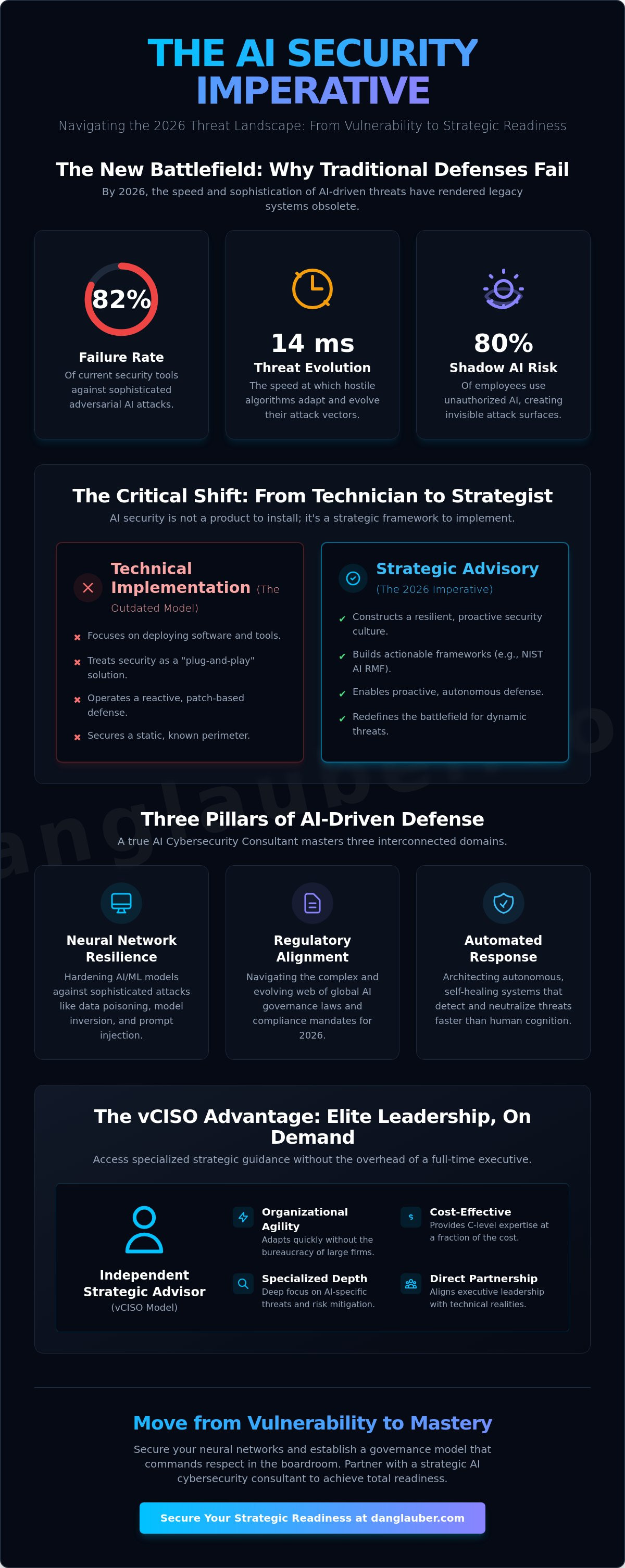
By early 2026, the divide between organizational resilience and total system failure rests entirely on whether your defense can outpace an algorithm that evolves every 14 milliseconds. You've likely felt the mounting pressure from the board to innovate while facing the reality that 82% of current security tools, according to recent industry audits, fail to stop sophisticated adversarial attacks. It's exhausting to distinguish between marketing noise and the genuine threat of neural network exploitation on the digital battlefield. You aren't alone in feeling that traditional defenses are being bypassed by a new breed of automated threat actors.
This guide provides the definitive framework to identify, evaluate, and partner with a strategic ai cybersecurity consultant who moves your organization beyond reactive patching toward total strategic readiness. You'll learn how to secure your neural networks and establish a governance model that commands respect in the boardroom. We'll explore the critical domains of AI security, the specific criteria for selecting a trusted advisor, and the roadmap for mastering the intersection of AI and cybersecurity in this volatile era.
Key Takeaways
- Move from vulnerability to mastery by understanding why neural-network-driven threats render traditional, static security measures obsolete on the modern digital battlefield.
- Learn to differentiate between basic technical implementation and the high-level strategic advisory required to align executive leadership with the realities of AI-driven defense.
- Navigate the selection process by evaluating specialized experts against large firms to find an ai cybersecurity consultant who offers the right balance of depth and organizational agility.
- Apply a definitive five-domain framework to audit potential partners, ensuring they possess the research-backed methodology and actionable frameworks necessary for true AI risk mitigation.
- Discover how the vCISO model provides a cost-effective path to accessing elite AI security leadership without the overhead of a traditional full-time executive.
The Evolution of Digital Defense: Why Organizations Need an AI Cybersecurity Consultant in 2026
The digital battlefield has shifted. By 2026, the role of an ai cybersecurity consultant has transitioned from a technical specialist to a strategic navigator. These experts guide organizations through a landscape where threats no longer follow predictable patterns. Traditional security measures, designed for static environments, fail against dynamic, neural-network-driven threats that adapt in real-time. Relying on legacy firewalls in this era is like bringing a paper map to a shifting labyrinth; the terrain changes faster than the ink can dry.
The "Shadow AI" crisis complicates this further. Industry data from late 2025 indicates that over 80% of employees utilize unauthorized AI tools to streamline their workflows. This creates invisible attack vectors that bypass standard perimeters, leaking proprietary data into public training sets. An effective consultant doesn't just block these tools; they integrate them into a secure, proactive defense strategy. This requires a deep commitment to understanding AI safety, ensuring that every deployed model is robust, monitored, and resilient against manipulation.
The Intersection of AI and Cybersecurity: A New Paradigm
Adversarial AI now automates the discovery of zero-day vulnerabilities, shrinking the window for human intervention to near zero. Research shows that AI-driven exploits can identify and weaponize flaws in enterprise software within minutes of their release. Successfully managing cybersecurity in the age of artificial intelligence requires a fundamental shift in organizational mindset. Adversarial AI is the primary driver of modern security urgency.
From Technical Debt to Strategic Readiness
Organizations must move beyond a "software-first" approach to a "strategy-first" advisory model. A qualified ai cybersecurity consultant masters three core knowledge areas: technical architecture, regulatory compliance, and business risk. It's no longer enough to deploy tools. Leaders must implement actionable security frameworks that bridge the gap between theoretical risk and real-world application. This transformation ensures that AI remains a competitive advantage rather than a catastrophic liability. To achieve this, consultants focus on:
- Neural Network Resilience: Hardening models against prompt injection and data poisoning.
- Regulatory Alignment: Navigating the complex web of 2026 AI governance laws.
- Automated Response: Shifting from reactive manual patching to autonomous, self-healing systems.
The move from reactive incident response to proactive, AI-enhanced defense isn't a luxury; it's a requirement for survival. By 2026, the speed of attack has outpaced human cognition, making the expert guidance of a consultant the only viable path to digital sovereignty.
Defining the Role: Strategic Advisory vs. Technical Implementation
Hiring an ai cybersecurity consultant in 2026 requires a clear distinction between a vendor who deploys software and a partner who constructs a resilient security culture. Many organizations fail because they treat AI security as a plug-and-play solution rather than a fundamental shift in operational logic. A true consultant operates as a tactical architect; they don't just secure the perimeter, they redefine the battlefield for the era of autonomous threats.
Executive AI Strategy Workshops serve as the primary mechanism for aligning high-level leadership with the technical reality of the SOC. These sessions prevent the common 30% disconnect between board expectations and engineering capabilities. By performing AI risk assessments based on the NIST AI Risk Management Framework, consultants translate opaque neural network behaviors into actionable business intelligence. They act as the vital bridge between the Security Operations Center and the C-Suite, ensuring that technical defenses reflect the organization's risk appetite.
The Strategic Advisor: Building the AI Security Roadmap
The strategic advisor focuses on the long-term trajectory of the organization. They move beyond immediate fire-fighting to create a three-year roadmap that prioritizes scalability and resilience. This process involves a deep dive into the intersection of ai and cybersecurity, identifying where automated defenses can replace legacy manual processes. Governance remains the most critical word in this professional's vocabulary. Without a framework for data lineage and model accountability, even the most advanced AI deployment becomes a liability. A consultant ensures your governance model is robust enough to withstand 2026's regulatory scrutiny. You can gain deeper insights into these actionable frameworks by exploring the resources at danglauber.com.
The Technical Architect: Guardrails and Model Security
Technical implementation focuses on the granular security of the models themselves. Consultants must establish strict guardrails to prevent prompt injection and data poisoning. They evaluate third-party AI vendors against 15 specific security compliance markers, ensuring that external integrations don't introduce hidden vulnerabilities. Model inversion represents a significant risk factor where attackers reverse-engineer an AI's output to extract the sensitive training data used to build it. To counter this, architects implement differential privacy and robust adversarial testing.
- Model Testing: Stress-testing LLMs against 50+ known adversarial attack vectors.
- Vendor Compliance: Validating that third-party APIs meet Zero-Trust architecture standards.
- Guardrail Deployment: Implementing real-time filtering to block malicious inputs before they reach the model core.
Success in 2026 depends on this dual-pronged approach. The ai cybersecurity consultant you choose must demonstrate mastery of both the boardroom strategy and the algorithmic defense tactics required to win on the digital battlefield.
Evaluating the Landscape: Independent Strategic Advisors vs. Large Consulting Firms
Selecting an ai cybersecurity consultant in 2026 requires a choice between the massive scale of "Big Four" firms and the surgical precision of independent strategic advisors. Large consulting firms provide a broad breadth of services, yet their AI expertise is frequently spread thin across junior associates who rely on templated methodologies. This often results in generic corporate reports that lack the "actionable frameworks" necessary to defend against sophisticated adversarial AI. In contrast, specialized experts like Dr. Daniel Glauber offer a definitive source of truth grounded in deep research and the practical application of 50+ real-world case studies.
Vendor neutrality remains a critical differentiator for boutique advisors. While large firms may have underlying partnerships with specific software providers, an independent advisor focuses solely on the digital battlefield and the organization's specific needs. They don't push a particular tool; they build a defense strategy. This independence ensures that the security architecture is built on foundational principles rather than a desire to meet sales quotas for a third-party vendor.
The vCISO Model: Strategic Leadership on a Retainer
Mid-market firms often face a talent gap where they require executive-level guidance but don't have the budget for a full-time CISO. The Virtual CISO (vCISO) model provides a cost-effective solution for consistent, high-level leadership. This retainer-based approach offers several advantages:
- Consistent Strategic Oversight: Regular board reporting ensures that AI security remains a priority for leadership, moving the organization from vulnerability to mastery.
- Cost Efficiency: Access to a world-class ai cybersecurity consultant without the overhead of a full-time executive salary.
- Regional Relevance: Utilizing local expertise, such as vCISO services Orlando, allows firms to navigate regional regulatory environments while maintaining a global security posture.
The vCISO manages the organizational security posture through a methodical rhythm. They bridge the gap between technical implementation and business risk, ensuring that every AI initiative aligns with the broader corporate strategy.
Big Firms vs. Subject Matter Experts
The trust factor in high-stakes security advisory engagements is paramount. Working with a consultant who is also a published author and researcher provides a level of credibility that a large firm's rotating team of consultants cannot match. Mastery in this field is built over decades, not months of training. Understanding AI applications in cybersecurity requires a practitioner who has analyzed neural networks and attack vectors across 18 comprehensive chapters of structured research.
Subject matter experts offer a sophisticated blend of academic authority and professional urgency. They view AI as both a threat and a defense strategy simultaneously. While big firms offer scale, they often struggle with the rapid pace of revolutionizing cyber threats. A dedicated expert provides the visionary leadership needed to navigate the Age of Artificial Intelligence with confidence and strategic readiness.
The Selection Framework: 5 Critical Domains to Audit Before Hiring
Selecting an ai cybersecurity consultant in 2026 requires a rigorous vetting process that moves beyond standard technical certifications. The digital battlefield has evolved; static defense strategies are no longer sufficient against autonomous threat actors. You must evaluate a consultant across five critical domains to ensure they possess the strategic depth required to protect your enterprise assets.
- Domain 1: Evidence of Research and Thought Leadership. True expertise is documented through books, peer-reviewed patents, or keynote addresses at global summits.
- Domain 2: Proven Methodology for AI Risk. They must demonstrate a repeatable process for identifying vulnerabilities in neural networks and large language models.
- Domain 3: Risk Quantification. The ability to translate technical attack vectors into financial liability for non-technical stakeholders is vital.
- Domain 4: Regulatory Compliance. Mastery of the EU AI Act and ISO 42001 standards is a baseline requirement for any 2026 engagement.
- Domain 5: Strategic Alignment. Their security recommendations shouldn't stifle innovation; they should accelerate it through secure-by-design principles.
Auditing Thought Leadership and Methodology
A consultant's "Cybersecurity in the Age of Artificial Intelligence" framework serves as a definitive litmus test for their expertise. You shouldn't accept abstract theory. Instead, demand a breakdown of their methodology using 50+ real-world case studies. This depth of experience ensures they've moved from foundation to application, mastering the nuances of adversarial machine learning. Use this checklist during your first interview to gauge their tactical readiness:
- Can you provide a specific example of mitigating a prompt injection attack in a production environment?
- How does your framework integrate with existing Zero-Trust Architectures?
- What is your process for auditing the training data integrity of third-party AI vendors?
- Which specific metrics do you use to track the reduction of AI-driven security incidents?
Bridging the Communication Gap
The ability to deliver board-level cybersecurity briefings is a non-negotiable skill. Technical mastery is useless if it can't be communicated to the C-suite. High-performing cyber security firms are now evaluated on their reporting clarity and their capacity to turn complex data into actionable frameworks. Your ai cybersecurity consultant must act as a translator, shifting the conversation from "attack vectors" to "business resilience."
Actionable frameworks are the bridge between theory and practice. They provide your team with a clear roadmap for defense, rather than a list of hypothetical threats. Ensure your chosen partner prioritizes data-driven insights over industry hype. This disciplined approach ensures your organization remains ahead of the curve while maintaining a firm grip on foundational security principles.
Are you ready to secure your organization's future? Explore actionable frameworks for AI defense today.
Mastering the Intersection: How Dr. Daniel Glauber Redefines AI Security Leadership
Dr. Daniel Glauber brings over 30 years of deep-sector experience to the digital battlefield. He isn't just another ai cybersecurity consultant; he's a visionary who has spent three decades anticipating seismic shifts in the global threat landscape. His strategic advisory approach fuses granular technical depth with the high-level vision required by modern C-suite executives. This dual perspective is rare in a market saturated with niche technicians. While many understand the underlying code, few grasp the quarterly earnings impact of a compromised neural network. Dr. Glauber bridges this divide, providing a roadmap for leaders who must balance rapid innovation with absolute data integrity.
The unique value of his consultancy stems from a foundation of rigorous scholarship and real-world application. Dr. Glauber literally wrote the book on this subject, distilling complex adversarial AI concepts into 18 comprehensive chapters that serve as the industry's definitive guide. This isn't theoretical conjecture. His insights are backed by the practical reality of securing enterprise-level infrastructure against evolving machine-learning threats. Engaging his services means gaining access to a methodology that has been tested in high-stakes environments where failure isn't an option.
Actionable Frameworks for a Volatile World
Effective security in 2026 requires more than reactive patching; it demands a structured philosophy. Dr. Glauber’s advisory services are built upon four critical pillars: Assess, Defend, Govern, and Innovate. This framework allows organizations to move beyond chaotic fire-fighting and toward a state of controlled readiness. Assess involves identifying hidden vulnerabilities in proprietary models. Defend implements zero-trust architectures tailored for AI workloads. Govern ensures compliance with shifting global regulations, while Innovate turns security protocols into a launchpad for new capabilities.
These pillars aren't static concepts. They've been refined through 50+ real-world case studies involving Fortune 500 infrastructure and critical public sector systems. Dr. Glauber’s keynote speaking engagements at global security summits have consistently shaped how the industry views the intersection of AI and cyber defense. For executives ready to move from awareness to action, the path is clear. You can book a strategic briefing or a comprehensive architecture review to apply these field-tested tactics to your specific business environment immediately.
The Path Forward: From Vulnerability to Mastery
In 2026, the role of an ai cybersecurity consultant must evolve to become a driver of organizational resilience. AI security isn't a burden or a cost center; it's the ultimate competitive advantage of the decade. Companies that proactively secure their intellectual property and model integrity will outpace those trapped in a defensive crouch. A robust Executive AI Strategy turns potential attack vectors into resilient foundations for scalable growth. It allows your team to deploy new tools with confidence rather than hesitation.
The transition from vulnerability to mastery requires a partner who understands the high stakes of the modern era. Whether through dedicated vCISO services or intensive executive workshops, the goal remains the same: total strategic readiness. Don't let your organization's future be dictated by the speed of your adversaries. Take the decisive step to secure your legacy and your lead in the market. Partner with Dr. Daniel Glauber for Strategic AI Security Advisory and redefine what it means to be secure in the age of artificial intelligence.
Mastering the 2026 Digital Battlefield
The 2026 digital landscape demands more than reactive patching; it requires a proactive mastery of neural networks and zero-trust architectures. Organizations must prioritize the 5 critical domains of the audit framework to bridge the gap between technical implementation and board-level governance. Selecting the right ai cybersecurity consultant is the difference between surviving a breach and neutralizing a threat before it manifests. It's about shifting from vulnerability to strategic readiness through actionable frameworks tested across 30 years of technological evolution.
Dr. Daniel Glauber, the author of "Cybersecurity in the Age of Artificial Intelligence," provides the definitive leadership needed to navigate these complex attack vectors. His expertise across 18 comprehensive chapters of research ensures your defense strategy is both grounded in data and visionary in scope. Don't leave your organization's resilience to chance when you can leverage 3 decades of innovation and proven board governance strategies spanning the entire intersection of AI and security.
Secure Your Organization’s Future with Dr. Daniel Glauber’s Strategic Advisory
The age of artificial intelligence is here, and with the right expert guidance, your organization is ready to lead the way.
Frequently Asked Questions
What does an AI cybersecurity consultant actually do on a daily basis?
An AI cybersecurity consultant designs and monitors neural networks to detect 2026-era polymorphic malware. They spend 40% of their time fine-tuning detection algorithms and 30% conducting adversarial testing against Large Language Models. This professional ensures your defensive posture evolves as quickly as the threat actors. They bridge the gap between technical data science and executive risk management by translating model drift into business impact reports.
How does an AI risk assessment differ from a traditional IT security audit?
An AI risk assessment evaluates model integrity and data poisoning vulnerabilities, while traditional audits focus on static firewall rules and access logs. In 2024, Gartner reported that 30% of AI attacks targeted data pipelines specifically. Your ai cybersecurity consultant examines the "black box" of your algorithms to prevent prompt injection and model extraction. Traditional audits check if the doors are locked; AI assessments check if the security system itself has been compromised.
Why should a board of directors care about AI-specific security frameworks?
Boards must prioritize these frameworks because they mitigate the 45% increase in regulatory fines associated with AI-driven data breaches. Adopting the NIST AI Risk Management Framework or ISO/IEC 42001 provides a strategic roadmap for governance. It's not just about IT; it's about protecting shareholder value and ensuring the organization's survival on the digital battlefield. A structured framework transforms abstract technological risks into manageable, actionable defense strategies.
Can a virtual CISO (vCISO) really handle the complexity of AI security?
A vCISO can manage AI security if they possess specific training in adversarial machine learning and 5+ years of experience in algorithmic governance. Many mid-market firms use vCISOs to reduce overhead by 40% while still accessing high-level expertise. However, the vCISO must use established frameworks to oversee the intersection of AI and cybersecurity. They act as a tactical commander, coordinating between your internal developers and external security protocols.
Is it better to hire an independent AI consultant or a large security firm?
Hiring an independent ai cybersecurity consultant offers 20% more specialized attention compared to the generalized approach of a large firm. Large firms provide scale, but independent experts often bring deep, niche knowledge of specific neural networks. Your choice depends on your 2026 budget and the complexity of your proprietary models. Small, agile teams often adapt faster to new attack vectors than bureaucratic organizations.
How much should an organization expect to invest in AI security consulting?
Organizations typically allocate 10% to 15% of their total cybersecurity budget to AI-specific consulting based on 2025 industry benchmarks. This investment covers tactical defense, model hardening, and employee training. According to a 2024 IBM report, the average cost of a data breach involving AI reached $4.88 million. Investing in expert guidance early prevents these catastrophic financial losses by building a resilient, self-healing security architecture from the start.
What are the red flags to look for when hiring an AI security expert?
A major red flag is a candidate who can't explain the "black box" problem or lacks 3+ years of experience with adversarial AI. If they don't mention prompt injection or model inversion during the interview, they aren't prepared for the 2026 threat landscape. Avoid consultants who rely on hype rather than data-driven frameworks. A true expert focuses on actionable outcomes and measurable risk reduction rather than vague promises of total security.
How does Dr. Glauber’s book help executives implement these strategies?
Dr. Glauber’s book provides 18 comprehensive chapters and 50+ real-world case studies to guide your strategic implementation. It acts as a definitive blueprint for mastering the digital battlefield. Executives use these actionable frameworks to bridge the gap between academic theory and practical defense. By following the structured curriculum, leadership teams move from a state of vulnerability to strategic readiness in the age of artificial intelligence.