
What if the very cybersecurity firms you rely on for protection are actually compounding your organizational risk through fragmented, tool-heavy complexity? You've likely experienced the relentless exhaustion of the vendor pitch cycle, where every solution claims "AI-powered" supremacy while failing to address the fundamental shift in the digital battlefield. According to 2024 industry research, 74% of technology leaders feel overwhelmed by the sheer volume of disconnected tools in their stack. It's a dangerous gap that leaves your enterprise vulnerable as adversarial AI accelerates the pace of modern attack vectors.
I recognize the difficulty in distinguishing between mere tool-sellers and true strategic partners who can defend your perimeter in 2026. This guide provides an actionable framework designed to move your board from a position of uncertainty to one of strategic mastery. We'll explore the intersection of AI and cybersecurity by establishing a clear taxonomy of the current market. You'll gain a rigorous methodology for vetting firm readiness and a blueprint for selecting partners that align perfectly with your specific business risk.
Key Takeaways
- Learn to navigate the 2026 market by distinguishing between technical tools and strategic operations to avoid critical hiring mismatches.
- Understand why traditional signature-based defenses are obsolete and how top-tier cybersecurity firms are deploying neural networks for predictive, automated defense.
- Identify hidden vulnerabilities within your organization by applying the "Security Debt" audit to align your maturity level with the right specialized experts.
- Transition your leadership mindset from simple breach prevention to a model of strategic resilience that prioritizes rapid recovery and business continuity.
- Discover the "Pragmatic Visionary" framework for balancing cutting-edge AI innovation with the foundational security principles required for long-term defense.
Defining the Landscape: The Three Tiers of Cybersecurity Firms
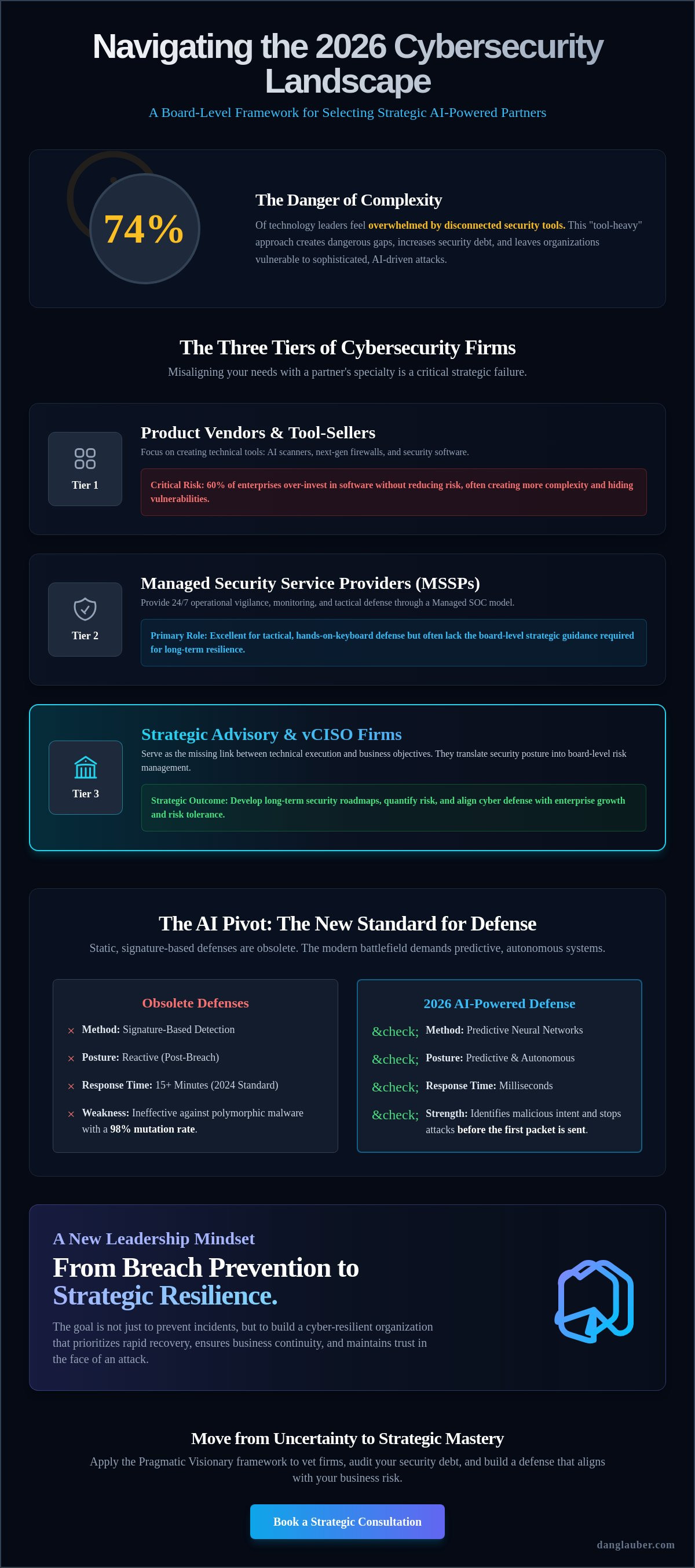
By 2026, the market for cybersecurity firms has evolved beyond a monolithic industry into a complex, segmented ecosystem of specialized tools, tactical operations, and high-level strategy. A cybersecurity firm is a strategic partner in the digital battlefield. Organizations frequently stumble by misaligning their operational needs with their chosen partners. They often hire a technical firm to solve what is fundamentally a strategic governance problem. This mismatch creates a dangerous gap where tools are deployed without a cohesive mission, leaving the organization vulnerable to sophisticated adversaries who exploit structural weaknesses rather than just software bugs.
Defining the strategic advisor as the missing link in modern corporate governance is essential for survival. This role moves security from the server room to the boardroom. Without this layer, technical teams become overwhelmed by the sheer volume of data produced by modern defense systems. To master this environment, leaders must look toward a comprehensive overview of computer security that integrates technical depth with business objectives. The intersection of AI and cybersecurity has made this integration non-negotiable for any firm seeking to maintain a competitive advantage while securing its digital assets.
Managed Security Service Providers (MSSPs) vs. Product Vendors
MSSPs focus on 24/7 monitoring and the Managed SOC model. They're excellent for operational vigilance but don't always provide the high-level strategy required for long-term resilience. Product vendors build the essential tools, including AI scanners and next-generation firewalls, but they don't necessarily manage them. The danger of tool-led security is a significant risk in 2026. Data from industry reports suggests that 60% of enterprises over-invest in software while failing to see a reduction in actual risk. More software doesn't always equal more safety; it often just adds layers of complexity that hide critical vulnerabilities. Tactical tools are useless without the right hands to wield them.
Strategic Advisory and vCISO Firms
The mid-market has seen a rapid rise in virtual CISO consulting services as organizations realize they need executive-level security leadership. These advisory firms bridge the gap between technical complexity and business value. They focus on risk quantification, board reporting, and developing actionable frameworks that guide the organization through the digital battlefield. By 2026, the vCISO model has become the standard for firms that require expert-driven guidance without the overhead of a full-time executive. These firms don't just fix printers; they build long-term security roadmaps that align with the company's growth and risk tolerance. This strategic layer ensures that every defense dollar is spent on a specific, measurable outcome.
The AI Pivot: How Top Firms are Revolutionizing Defense in 2026
The digital battlefield of 2026 has no room for static defenses. Traditional signature-based detection proved useless when automated, polymorphic malware reached a 98% mutation rate in late 2025. Modern cybersecurity firms have abandoned reactive posture for predictive mastery. They've built neural networks that identify intent rather than just code snippets. By analyzing trillions of data points across global networks, these firms stop attacks before the first packet is even sent.
Adversarial AI is the primary threat vector for 2026 enterprise security, representing a sophisticated evolution where attackers weaponize machine learning to manipulate or bypass defensive models. You can't hire a firm that doesn't treat this as a core competency. Following CISA's guidance on AI in cybersecurity is no longer optional for those seeking federal-grade protection. It's a requirement for survival in a world where hackers use your own tools against you.
Autonomous Detection and Response
The transition from human-in-the-loop to human-on-the-loop has redefined response windows. In 2024, a 15-minute response time was considered elite; in 2026, top cybersecurity firms deliver millisecond-level mitigation. Generative AI now handles the heavy lifting of summarizing complex threat intelligence into executive-ready briefings. This shift reduces alert fatigue for internal IT teams by 65% compared to 2023 levels. It allows security leaders to focus on high-level strategy instead of chasing false positives.
AI Governance and Risk Management
Your security partner must vet your internal AI implementations as rigorously as your firewall. Shadow AI discovery is now a critical domain, as a 2025 industry report found that 40% of corporate data leaks originated from unsanctioned AI usage. Firms must provide clear Cybersecurity in the Age of Artificial Intelligence frameworks to secure these assets. This involves continuous monitoring of model drift and data leakage within a Zero-Trust Architecture. If you want to master these risks, you can schedule a strategic consultation to audit your current AI governance.
Evaluating Firm Specializations: When to Hire Which Expert
The digital battlefield demands more than a generic defense. Selecting the right partner among various cybersecurity firms requires a clinical assessment of your current posture. Organizations often fall into the trap of over-purchasing tools while neglecting the underlying strategy. A strategic framework must align your maturity level with a firm's core competency. This alignment prevents the common mistake of hiring a global giant for a niche technical problem or a boutique shop for a massive compliance overhaul.
Before signing a contract, conduct a 'Security Debt' audit. This process identifies where legacy systems and unpatched vulnerabilities have created a deficit in your defense. Using the NIST Cybersecurity Framework (CSF) 2.0 provides a standardized baseline to measure these gaps. It ensures your selection process is data-driven rather than reactive. By quantifying your debt, you can determine if you need a firm to rebuild foundations or one to polish existing perimeters.
Size dictates the engagement's depth. The 'Big Four' consulting giants offer massive scale and global reach, ideal for Fortune 500 entities with complex regulatory needs across multiple jurisdictions. Boutique firms provide specialized, surgical strikes. They're often better for high-stakes niche requirements, such as securing a proprietary neural network or conducting deep-dive forensics in Manufacturing. Industry expertise isn't optional. A firm specializing in FinTech understands the 2026 updates to banking regulations, whereas a Healthcare specialist focuses on the life-and-death stakes of medical device security.
Technical Execution: Penetration Testing and SOCs
Red Teams provide the necessary friction to stress-test your architecture. They simulate real-world adversaries to find the cracks your internal team missed. Managed Detection and Response (MDR) handles the daily grind of threat hunting; it's a tactical necessity for 24/7 visibility. However, technical testing is a tactical hunt for specific bugs. It's a snapshot in time, not a strategic solution for long-term resilience.
Leadership and Governance: vCISO and Board Briefings
When internal culture ignores security protocols, it's a sign you need a cybersecurity speaker for executives to reset the corporate mindset. A vCISO provides the strategic leadership many mid-market firms lack. They manage third-party vendor risks and ensure compliance isn't just a checkbox. A monthly retainer for strategic guidance often provides a 40% cost saving over a full-time executive hire while delivering the same level of mastery over the digital battlefield.
The C-Suite Audit: 5 Critical Questions for Vetting Cybersecurity Firms
Selecting a partner in the current digital battlefield requires a departure from traditional procurement. You aren't just buying a firewall or a monitoring service; you're securing the continuity of your enterprise. Most cybersecurity firms offer a menu of technical solutions, but true strategic partners provide a roadmap for resilience. We've moved past the binary question of whether a breach will occur. The focus now is how quickly your organization recovers when the perimeter is breached. Compliance is a baseline, not a strategy. It serves as your entry ticket to the market, but it won't protect your intellectual property from a sophisticated neural network attack.
Vetting for AI and Future-Proofing
Question 1: How do you differentiate between AI-driven threats and traditional attack vectors?
The firm must demonstrate an understanding of how adversarial AI accelerates the reconnaissance phase of an attack. It's not enough to block known signatures. They must identify polymorphic code that changes its own structure to evade detection. If their answer relies on legacy database updates, they aren't prepared for 2026 threats.
Question 2: What is your framework for securing our internal AI and LLM deployments?
As 65% of enterprises now integrate generative AI into core workflows, your partner must have specific protocols for prompt injection defense and data leakage prevention within your proprietary models. Securing the model is as critical as securing the server it runs on.
Question 3: Can you quantify our cyber risk in dollars, not just technical scores?
A high-velocity defense strategy requires financial clarity. According to IBM’s 2024 Cost of a Data Breach report, the average cost hit $4.88 million. If cybersecurity firms can't translate a vulnerability into a potential loss of revenue or market capitalization, they don't understand your business risk.
Operational and Cultural Alignment
Question 4: How will you integrate with our existing IT team without creating friction?
The best partners act as force multipliers. They shouldn't replace your internal talent; they should provide the actionable frameworks that allow your team to operate at a higher tactical level. Look for firms that prioritize knowledge transfer over proprietary black-box solutions.
Question 5: What is your process for reporting to the Board of Directors?
The Board doesn't need a 50-page technical log. They require a concise executive briefing that links security posture to long-term growth and regulatory obligations. Mastery of the digital landscape requires moving from technical jargon to strategic leadership language.
Stop accepting static PDF reports that collect digital dust. Demand dynamic dashboards that offer real-time visibility into your defensive posture. True resilience comes from data-driven insights and a commitment to continuous adaptation rather than boilerplate templates.
Moving Toward Strategic Resilience: The Dr. Glauber Approach
Procuring a high-end software license does not equate to achieving strategic resilience; especially when facing adversaries who utilize automated lateral movement and generative social engineering. By 2026, the gap between organizations that simply own tools and those that master them has widened significantly. True defense at the intersection of ai and cybersecurity requires a practitioner-expert who can interpret the logic behind neural networks rather than just monitoring a dashboard. This is the core of the Pragmatic Visionary model. It moves beyond the hype of cybersecurity firms that promise "set and forget" solutions, focusing instead on balancing groundbreaking innovation with foundational security principles like Zero-Trust Architecture and rigorous data hygiene.
The battlefield is shifting. Transitioning from reactive firefighting to a proactive, AI-ready posture involves more than just faster patching. It requires a fundamental redesign of how defense is structured. Organizations must integrate predictive analytics into their SOC workflows to anticipate attack vectors before they manifest. Data from 2025 indicates that companies adopting this practitioner-led approach reduced their mean time to contain (MTTC) breaches by 55 percent compared to those relying solely on automated off-the-shelf software.
The Virtual CISO Advantage
Accessing top-tier executive leadership is no longer restricted to the Fortune 500. The Virtual CISO (vCISO) model provides organizations with the strategic depth of a seasoned C-suite professional without the overhead of a full-time hire. This role is critical for developing a security roadmap that actively supports business innovation. Instead of acting as a "department of no," a vCISO bridges the gap between technical complexity and executive decision-making. They translate technical risks into business impact, ensuring that every security investment aligns with the organization's growth objectives for 2026 and beyond.
Executive Education and Workshops
A cyber-resilient culture must be engineered from the top down. Cybersecurity firms often focus on end-user training, yet leadership teams remain the primary targets for high-value social engineering. AI strategy workshops empower boards and executives to understand the tactical implications of the current threat landscape. These sessions move beyond basic awareness, providing actionable frameworks to govern AI usage and secure the digital supply chain. Mastery of the digital battlefield starts with an informed leadership team capable of making rapid, data-driven decisions during a crisis.
Secure your organization’s future. Mastery over the evolving threat landscape is within reach. Contact us today to schedule a strategic advisory session and begin building your framework for long-term resilience.
Mastering the 2026 Digital Battlefield
The evolution of the threat landscape demands a transition from reactive measures to proactive mastery. Leading cybersecurity firms are no longer just service providers; they're strategic partners deploying Adversarial AI frameworks and Zero-Trust Architectures to neutralize 2026-era attack vectors. You've identified the three tiers of modern defense and learned how to audit your current posture using 5 critical C-Suite questions. This isn't just about software. It's about building institutional resilience through a structured, data-driven approach. Success in this era requires a bridge between abstract AI concepts and real-world application.
Dr. Daniel Glauber brings 30+ years of technology and innovation experience to this challenge. As the author of "Cybersecurity in the Age of Artificial Intelligence," he's established definitive frameworks for navigating the intersection of AI and security. Whether you're refining your Zero-Trust protocols or defending against neural network exploits, his expertise provides the clarity needed for strategic readiness. Don't wait for a breach to reveal your vulnerabilities. Mastery of the digital battlefield is within reach for those who act now.
Secure your organization's future in the age of AI—book a strategy session with Dr. Daniel Glauber
Your path to strategic resilience starts with a single, decisive step toward a more secure tomorrow.
Frequently Asked Questions
What is the difference between a cybersecurity firm and an MSP?
Cybersecurity firms focus exclusively on the digital battlefield and threat mitigation, while Managed Service Providers (MSPs) handle general IT infrastructure and help-desk support. According to Gartner, 60% of organizations will transition to specialized security providers by 2026 to address complex attack vectors. These specialized firms provide deep penetration testing and zero-trust implementation that standard MSPs don't typically offer.
How much should a mid-sized company spend on a cybersecurity firm in 2026?
Mid-sized companies should allocate 10% to 15% of their total IT budget to cybersecurity firms to maintain a resilient defense posture. The 2024 SANS Institute report indicates this percentage has risen from 7% in 2021 due to the rise of adversarial AI. This investment ensures your organization has the foundational security principles required to survive modern threats.
Does our company need a specialized AI cybersecurity firm?
Your organization requires a specialized AI cybersecurity firm if you process sensitive data or utilize machine learning in your daily operations. By 2026, 80% of enterprise software will include AI components, which necessitates experts who understand the intersection of AI and cybersecurity. These firms provide actionable frameworks to secure neural networks against sophisticated manipulation attempts.
What are the top 3 things to look for in a cybersecurity contract?
The top three elements are clearly defined Service Level Agreements (SLAs) for incident response, comprehensive data liability clauses, and specific requirements for continuous monitoring. A 2025 Forrester analysis suggests that contracts failing to specify 24/7 detection capabilities result in 40% higher recovery costs after a breach. You must ensure the contract outlines the exact countermeasures the firm will deploy during a zero-day event.
Can a cybersecurity firm help with regulatory compliance like GDPR or CCPA?
Cybersecurity firms provide the technical controls and data mapping required to satisfy rigorous regulatory frameworks like GDPR and CCPA. These firms implement zero-trust architectures that ensure 100% data traceability, which is a core requirement for modern compliance audits. According to the 2024 IAPP report, companies using specialized security firms reduce their risk of non-compliance fines by 55%.
How do cybersecurity firms use AI to protect data?
Modern cybersecurity firms utilize neural networks to analyze millions of data points in real time to identify anomalous behavior. They deploy predictive analytics to stop attack vectors before they penetrate the network perimeter. This shift from reactive to proactive defense is essential for mastering the digital battlefield in 2026.
What happens if a cybersecurity firm fails to prevent a breach?
The outcome of a breach depends on the liability limits and incident response protocols established in your service agreement. Most professional firms provide forensic analysis and remediation services as part of their recovery strategy. Data from the 2024 IBM Cost of a Data Breach Report shows that firms with pre-defined response plans save $2.32 million per incident compared to those without such frameworks.
How often should we have a cybersecurity firm audit our systems?
You should hire a cybersecurity firm to audit your systems at least twice per year, or quarterly if you operate in high-risk sectors like finance. The 2025 NIST guidelines recommend continuous monitoring supplemented by these deep-dive assessments to identify new vulnerabilities. Regular audits transform your security posture from a static defense into a dynamic, evolving shield.