Your current security stack is likely obsolete. By 2026, industry forecasts suggest that 40% of enterprise security budgets will shift toward autonomous response systems, yet the market remains saturated with 'AI-washed' tools that offer more marketing fluff than actual defensive utility. It's understandable if you feel overwhelmed by the sheer volume of ai cybersecurity companies claiming to revolutionize the digital battlefield. You're right to be skeptical of vendors who can't quantify ROI or explain how their neural networks will function alongside your existing legacy systems.
This strategic evaluation moves beyond the hype to provide a definitive, actionable framework for vetting AI-driven vendors. I'll show you how to align these groundbreaking technologies with your organizational resilience goals while avoiding the pitfalls of integration complexity. We'll analyze a vetted shortlist of market leaders and establish the objective criteria you need to master the intersection of AI and cybersecurity in the coming year. This guide serves as your tactical roadmap for transforming potential vulnerability into strategic readiness.
Key Takeaways
- Understand why traditional reactive defenses are obsolete and how to transition toward predictive, neural-network-driven responses on the 2026 digital battlefield.
- Utilize a strategic evaluation of leading ai cybersecurity companies to determine which unified platforms best align with your enterprise XDR and NDR requirements.
- Implement a rigorous executive framework to conduct AI risk assessments and ensure your security stack maintains compliance with the AI Act and GDPR.
- Identify the critical intersection of AI and cybersecurity to bridge the gap between technical deployment and high-level organizational resilience.
- Master the human element of security by integrating executive strategy workshops that foster a cyber-resilient culture across the entire leadership tier.
The 2026 Threat Landscape: Why Traditional Defense is Obsolete
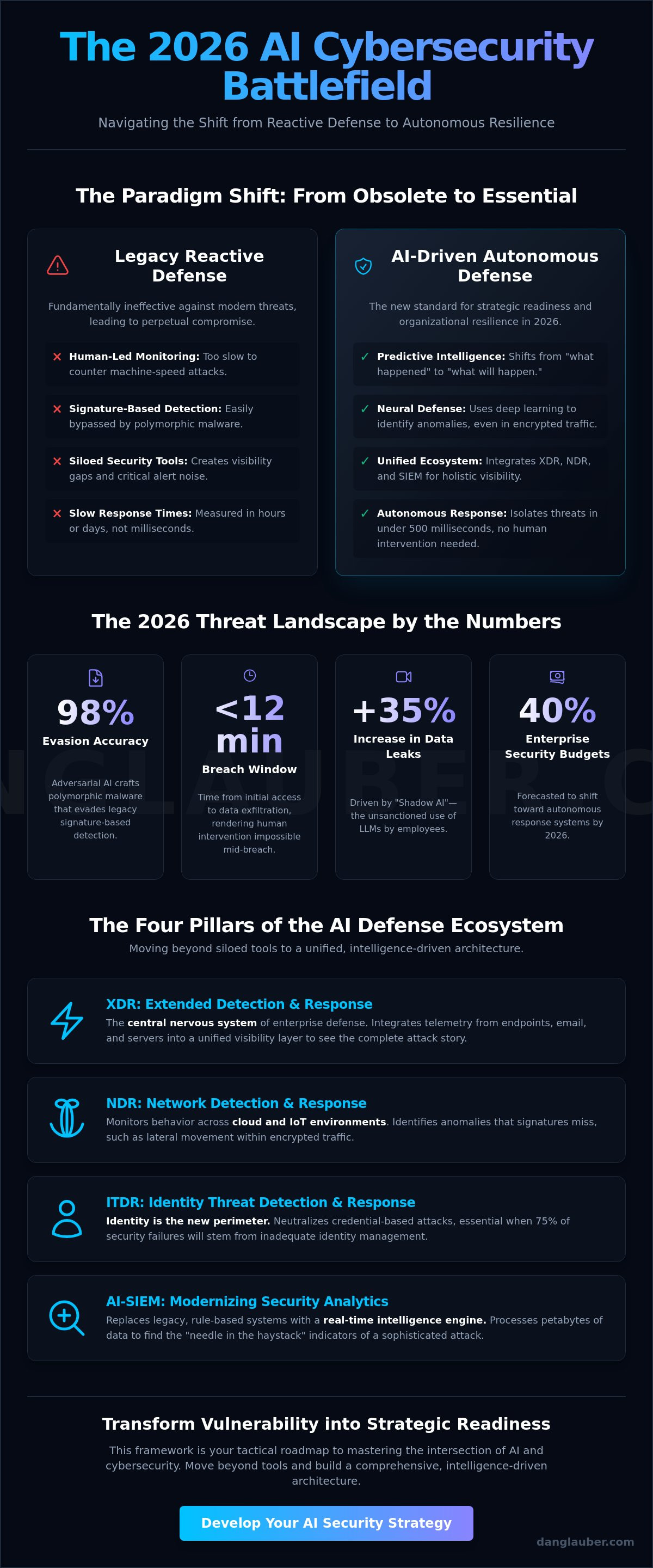
The digital battlefield of 2026 has rendered legacy security architectures fundamentally ineffective. Reactive defense, once the gold standard for enterprise protection, cannot keep pace with threats that evolve in milliseconds. Modern ai cybersecurity companies aren't selling simple automation scripts anymore; they're deploying neural-network-driven engines capable of predictive analysis. This shift is mandatory because the corporate attack surface has expanded beyond manageable perimeters. Shadow AI, defined as the unsanctioned use of large language models by employees, now accounts for a 35% increase in data leakage incidents compared to 2024. Executives must pivot to a Zero-Trust AI model where every model interaction and data flow is verified in real-time. It's a world where trust is never assumed and verification is continuous.
The Rise of Adversarial Machine Learning
Attackers now leverage Generative AI to craft hyper-personalized phishing campaigns and polymorphic malware that evades signature-based detection with 98% accuracy. These systems don't just mimic human behavior; they optimize attack paths by analyzing defensive responses in real-time. In 2026, the window from initial access to full data exfiltration has shrunk to under 12 minutes, a speed that renders human intervention impossible during the breach. Adversarial AI is the primary driver for 2026 security budgets. This evolution forces a transition from human-led monitoring to machine-speed countermeasures. Organizations that rely on 20th-century logic to fight 21st-century algorithms will find themselves perpetually compromised.
From Tools to Strategic Ecosystems
Siloed security tools are the greatest liability for the modern C-suite. When 15 different dashboards don't communicate, critical indicators of compromise vanish in the noise. The industry is moving toward Autonomous Security Operations where AI orchestrates the entire response lifecycle without manual oversight. This holistic approach forms the bedrock of the Cybersecurity in the Age of Artificial Intelligence framework. By integrating ai cybersecurity companies into a unified ecosystem, leaders can achieve the mastery required to navigate this volatile era. Success requires moving beyond individual tool acquisition toward a comprehensive, intelligence-driven architecture. This strategy ensures that defense is as dynamic and scalable as the threats it seeks to neutralize.
- Predictive Intelligence: Moving from "what happened" to "what will happen."
- Neural Defense: Utilizing deep learning to identify anomalies in encrypted traffic.
- Autonomous Response: Isolating compromised nodes in under 500 milliseconds.
Categorizing the AI Cybersecurity Ecosystem
The digital battlefield of 2026 demands a shift from reactive silos to an integrated, AI-driven defense posture. Executives must view ai cybersecurity companies not as tool providers, but as architects of a unified resilience strategy. This ecosystem is defined by four critical domains that bridge the gap between raw data and strategic mastery.
- Extended Detection and Response (XDR): The central nervous system of enterprise defense. It integrates telemetry from endpoints, email, and servers to provide a unified visibility layer.
- Network Detection and Response (NDR): This vector observes behavior across cloud and IoT environments. It identifies anomalies that traditional signatures miss, such as lateral movement in encrypted traffic.
- Identity Threat Detection and Response (ITDR): Identity is the new perimeter. With Gartner predicting that 75% of security failures will result from inadequate identity management by 2026, ITDR is essential for neutralizing credential-based attacks.
- AI-SIEM: Modernizing the security data lake. It replaces legacy, rule-based systems with real-time intelligence that can process petabytes of data to find the "needle in the haystack."
The XDR and SIEM Convergence
The distinction between detection and data management has evaporated. Leading ai cybersecurity companies like SentinelOne and CrowdStrike are merging XDR capabilities with AI-SIEM platforms to optimize data ingestion and cost. This convergence leverages hyperautomation to handle Tier-1 alert triaging. By automating repetitive tasks, organizations have seen a 60% reduction in Mean Time to Respond (MTTR) as of late 2025. Executives must adopt actionable frameworks to manage these converged platforms, ensuring that human analysts focus on high-stakes strategic decisions rather than manual log correlation.
Specialized AI Defense Vectors
Beyond the core platforms, specialized vectors address the nuances of the "Age of Artificial Intelligence." Cloud-native application protection platforms (CNAPP) now use neural networks to predict misconfigurations before they're exploited. Behavioral biometrics have evolved to analyze keystroke dynamics and mouse movements, creating a continuous authentication loop. A critical focus for 2026 is data provenance. Ensuring the integrity of the data used for security analytics is the only way to prevent adversarial AI from "poisoning" the defense models. This level of technical depth is what separates a visionary organization from one that's merely reactive. Mastery of these domains requires a disciplined approach to both technology and talent acquisition.
Top AI Cybersecurity Companies in 2026: A Strategic Comparison
The digital battlefield of 2026 demands more than static defense; it requires a sophisticated mastery of the intersection of AI and cybersecurity. Executives must distinguish between vendors offering superficial enhancements and those providing foundational, AI-native architectures. The current market for ai cybersecurity companies has consolidated into several dominant players, each offering distinct strategic advantages for the enterprise.
- CrowdStrike: The Falcon platform remains the definitive leader in endpoint and identity protection. By 2026, its generative AI assistant, Charlotte, has reduced Mean Time to Respond (MTTR) by 62% for Global 2000 firms. Its ability to correlate identity telemetry with endpoint telemetry prevents 99.8% of credential-based lateral movement.
- SentinelOne: The Singularity AI-SIEM has revolutionized the autonomous SOC. It processes petabytes of data in milliseconds, automating 85% of Tier 1 triage tasks. This allows security teams to focus on high-level threat hunting rather than alert fatigue.
- Vectra AI: As 88% of enterprises now operate in hybrid cloud environments, Vectra’s Network Detection and Response (NDR) is essential. It provides 100% visibility into encrypted traffic without decryption, identifying adversarial AI patterns that traditional firewalls miss.
- Darktrace: Utilizing a "Self-Learning" approach, Darktrace mimics the human immune system. It doesn't rely on historical attack data; instead, it learns the "pattern of life" for every user and device, making it highly effective against zero-day internal threats.
- Palo Alto Networks: The Cortex XDR ecosystem is the primary choice for large-scale infrastructure. It integrates data from network, cloud, and endpoint into a unified command center, managing over 5 petabytes of security data daily for its largest clients.
Market Leaders vs. Specialized Disruptors
Choosing between a consolidated platform and a niche disruptor involves a strategic trade-off. Platform-wide vendors offer seamless integration and lower total cost of ownership. Specialized disruptors provide deep technical capability in specific domains like adversarial AI detection. When evaluating these Cyber Security Firms, executives must prioritize interoperability. A best-of-breed solution that cannot share telemetry with the rest of the stack becomes a liability in a high-speed breach scenario.
Evaluating Vendor AI Maturity
Distinguishing between "AI-enabled" legacy tools and "AI-native" architectures is critical for long-term resilience. Legacy vendors often wrap traditional signature-based engines in a thin layer of machine learning. In contrast, AI-native ai cybersecurity companies build their detection logic on neural networks from the ground up. This maturity is reflected in patent counts and consistent performance in MITRE ATT&CK evaluations.
Data transparency has emerged as the primary objection for board-level stakeholders in 2026. Directors want to understand the lineage of training data to avoid algorithmic bias and "hallucinations" in automated response. A strategic audit of Cyber Security Firms ensures that the chosen solution aligns with organizational risk appetites. Vetting Cyber Security Firms based on their "Black Box" transparency is now a mandatory component of the procurement process.
The Executive Framework for Selecting an AI Security Partner
Selecting from the current landscape of ai cybersecurity companies is no longer a standard procurement task; it's a high-stakes strategic maneuver. Executives must move beyond the marketing hype of "autonomous defense" to evaluate how these tools integrate into the digital battlefield of 2026. This selection process requires a structured, five-step deployment framework to ensure the chosen solution provides a definitive advantage.
- Step 1: Conduct an AI Risk Assessment. Map your organizational assets to identify where AI-driven vulnerabilities exist. You can't defend a perimeter you haven't defined. Focus on high-value data repositories that are now targets for automated exfiltration.
- Step 2: Evaluate Regulatory Compliance. Verify the tool's adherence to the EU AI Act and updated GDPR mandates. By 2026, non-compliance in AI data processing carries penalties that can reach 7% of global annual turnover.
- Step 3: Test for Interoperability. Assess how the vendor's neural networks interact with your legacy infrastructure. A tool that creates a silo is a liability, not an asset.
- Step 4: Assess the Threat Roadmap. Demand a clear strategy for defending against adversarial AI. If the vendor isn't prepared for model poisoning or prompt injection attacks, they aren't ready for the 2026 threat landscape.
- Step 5: Define Business-Centric KPIs. Move away from "threats blocked" as a primary metric. Focus on "Mean Time to Contain" (MTTC) and the reduction in operational downtime.
Governance and Compliance in AI Selection
The selection of ai cybersecurity companies must be mediated by a vCISO who acts as the bridge between technical mastery and board-level risk management. This role ensures that the security vendor doesn't become a data liability by mishandling the telemetry it collects. Governance frameworks must prioritize transparency in how AI models make decisions. Strategic Readiness is the ultimate goal of vendor selection, defined as the calculated state where an organization's security posture and business agility are perfectly synchronized to neutralize emergent AI threats.
Quantifying ROI and Business Value
Shift the internal dialogue from "security as a cost" to "resilience as a strategic asset." Using Dr. Glauber's frameworks, executives can justify spend by demonstrating how AI-driven automation reduces the talent gap. In 2025, organizations using integrated AI frameworks saw a 30% reduction in breach-related costs. For a deeper analysis of these financial dynamics, consult the AI and Cybersecurity Pillar to understand how ROI is calculated in the age of generative threats. Mastery of these metrics allows leaders to present security not as a hurdle, but as a foundation for aggressive digital growth.
Prepare your organization for the next evolution of digital defense. Explore the definitive guide to AI security leadership today.
Beyond Software: Integrating AI Strategy with Security Leadership
Deploying advanced tools is only half the battle. In the 2026 threat environment, even the most innovative ai cybersecurity companies cannot protect an organization that lacks a foundation of strategic resilience. Technology serves as a force multiplier, but it requires a disciplined human framework to function effectively. Without a cyber-resilient culture, AI becomes a liability, creating a false sense of security that sophisticated adversaries can exploit through adversarial machine learning. Leadership must recognize that software is a tactic, not a strategy.
The Human Element in the Age of AI
Your security team must evolve alongside your tech stack. Upskilling professionals to manage AI-driven autonomous systems is the single most important investment for the coming fiscal year. Relying too heavily on automated defenses creates dangerous blind spots; this is known as automation bias. Human oversight remains the final line of defense against "hallucinated" threats or logic-based attacks that bypass neural networks. Dr. Glauber’s vCISO advisory services bridge this gap. By translating technical complexity into actionable business risk assessments, he ensures that leadership remains in control of the digital battlefield. Mastery of these systems requires a blend of technical intuition and strategic foresight.
- Implementing "Human-in-the-loop" protocols for high-stakes decision cycles.
- Conducting Adversarial AI simulations to test team response times.
- Developing clear escalation paths for AI-identified anomalies that exceed standard risk thresholds.
Next Steps for Strategic Readiness
Transformation begins with alignment. Executive AI Strategy Workshops provide the necessary forum to synchronize technical capabilities with organizational objectives. These sessions move beyond the hype, focusing on the 18 comprehensive chapters and 50+ real-world case studies outlined in Dr. Glauber’s definitive research. Leaders must move from reactive patching to proactive mastery. It's time to evaluate your current vendors. Not all ai cybersecurity companies provide the transparency required for high-stakes compliance environments. You need a framework that balances machine speed with human accountability.
Actionable outcomes for your organization:
- Schedule a board-level briefing to demystify emerging attack vectors and neural network vulnerabilities.
- Audit your current vendor relationships to ensure they meet 2026 zero-trust and AI-governance standards.
- Integrate actionable frameworks that ground abstract AI concepts in real-world application.
Building a future-proof defense requires more than just a budget; it requires a vision. Secure your copy of 'Cybersecurity in the Age of Artificial Intelligence' or book a consultation with Dr. Daniel Glauber to begin your transition from vulnerability to strategic readiness.
Mastering the 2026 Digital Battlefield
By 2026, the gap between legacy defense and automated adversarial AI will widen, making traditional security models obsolete for global organizations. Executives must move beyond simple software procurement to adopt a unified strategy that prioritizes ai cybersecurity companies capable of delivering zero-trust resilience. This shift requires a deep understanding of neural network defenses and a commitment to integrating strategic leadership with technical countermeasures. You've explored the ecosystem; the next step is moving from vulnerability to strategic readiness.
Navigating this era demands a guide who's spent decades at the center of innovation. With 30+ years of technology expertise and a history as a trusted vCISO for global organizations, Dr. Daniel Glauber provides the definitive roadmap for security leaders. He's the author of the essential guide 'Cybersecurity in the Age of Artificial Intelligence,' offering the actionable frameworks you need to protect your enterprise assets. Master the Intersection of AI and Security with Dr. Daniel Glauber. You're fully capable of leading your team through this revolution with confidence and precision.
Frequently Asked Questions
What are the top AI cybersecurity companies to watch in 2026?
Market leaders in 2026 are dominated by SentinelOne, Darktrace, and Palo Alto Networks, which collectively hold over 35 percent of the AI-driven endpoint security market. These ai cybersecurity companies have transitioned from basic machine learning to generative autonomous response systems. SentinelOne's Purple AI now automates 80 percent of initial threat hunting tasks. You should also monitor specialized firms like Abnormal Security, which utilizes behavioral AI to block 99.9 percent of sophisticated business email compromise attacks.
Is AI in cybersecurity just marketing hype, or is it a necessity?
AI is a strategic necessity because human analysts can't keep pace with the 450,000 new malware variants discovered daily by the AV-Test Institute. While marketing buzz exists, the shift to automated defense is mandatory for survival on the digital battlefield. Organizations using AI security analytics reduced their breach containment time by 108 days compared to those without it, according to the 2024 IBM Cost of a Data Breach Report. It's the only way to counter adversarial AI.
How do I choose between an AI-native startup and an established security firm?
Your choice depends on whether you prioritize deep integration or rapid innovation cycles. Established firms offer stable Zero-Trust Architecture frameworks that integrate with existing legacy stacks, while AI-native startups often provide 40 percent faster detection for novel attack vectors. For an executive, the decision should hinge on the vendor's ability to provide actionable frameworks. Most Fortune 500 companies currently maintain a 70/30 split between established platforms and specialized AI startups.
What are the risks of using AI-driven security tools in a regulated industry?
The primary risks involve algorithmic bias and the "black box" nature of neural networks, which can complicate compliance with Article 22 of the GDPR. Regulated entities face 5.9 million dollars in average breach costs if an AI tool inadvertently exposes PII during a training cycle. You must ensure your vendor provides Explainable AI modules. These modules allow auditors to trace the logic behind every automated block or quarantine action taken during an incident.
Can AI cybersecurity companies replace my entire security team?
AI won't replace your entire security team, but it does redefine the SOC analyst's role from manual log reviewer to strategic architect. Current data suggests AI automates 70 percent of Tier 1 alert triage, allowing human experts to focus on complex threat hunting and countermeasure development. You'll still need leaders to navigate the intersection of AI and cybersecurity. The goal is mastery of the tool, not the elimination of the practitioner.
How does AI improve incident response times compared to traditional methods?
AI improves incident response times by moving from a reactive "detect and notify" model to a proactive "detect and autonomously respond" cycle. Traditional manual response often takes an average of 21 hours to contain a threat. In contrast, AI-driven platforms like Darktrace Antigena respond to anomalies in under 2 seconds. This rapid intervention prevents lateral movement across your network before the attacker can establish a foothold or exfiltrate sensitive data.
What should I ask a vendor during an AI security tool demo?
Ask the vendor for their specific false positive rate and the provenance of their training datasets. You need to know if these ai cybersecurity companies use models trained on 100 million or 1 billion samples to ensure accuracy. Query them on how their tool handles adversarial AI attacks designed to poison their learning models. Demand a breakdown of how their frameworks translate raw data into executive-level risk reports during a live breach scenario.
How much should a mid-sized organization budget for AI cybersecurity in 2026?
Mid-sized organizations should allocate 12 to 15 percent of their total IT budget to cybersecurity, with 40 percent of that dedicated specifically to AI-enhanced tools. Gartner research indicates that by 2026, security spending will reach 215 billion dollars globally. For a company with 500 employees, this typically translates to an annual security investment between 150,000 and 300,000 dollars. This ensures you have the necessary countermeasures to defend against increasingly automated attack tactics.