
By 2026, the distinction between a technical glitch and a strategic failure will vanish entirely as cyber threats evolve into existential business risks. You've likely felt the exhaustion of "AI-powered" marketing promises that fail to protect the bottom line. It's frustrating to watch security budgets climb while the clarity of your actual resilience remains clouded by technical jargon. Most cyber security firms focus on selling you a shield, but few understand how that shield fits into your broader corporate objective. With the average cost of a data breach reaching $4.45 million according to recent industry benchmarks, the inability to translate technical metrics into business risk is no longer just an IT hurdle; it's a leadership crisis.
This guide provides the definitive blueprint to move beyond tool-based defense. You'll discover how to identify partners that function as strategic allies rather than mere vendors, ensuring every dollar spent reinforces your organization's position on the digital battlefield. We'll examine a structured framework for vetting partners based on their ability to translate adversarial AI threats into actionable risk metrics for executive stakeholders. This approach transforms security from a cost center into a pillar of digital mastery that commands respect in the boardroom and ensures long-term resilience.
Key Takeaways
- Master the shift from passive perimeter defense to proactive, AI-driven resilience at the critical intersection of modern threat intelligence and strategic defense.
- Learn to distinguish between tool-centric vendors and strategy-first cyber security firms to ensure your technical stack supports long-term business objectives.
- Apply the Glauber Framework to evaluate partners based on their AI readiness and their ability to translate technical vulnerabilities into actionable financial risk data.
- Utilize a definitive executive vetting checklist to conduct a gap analysis of your internal leadership and align your security posture with your primary risk profile.
- Discover how integrating a vCISO strategic advisory role can bridge the divide between technical complexity and board-level governance for maximum organizational resilience.
The Evolving Landscape of Cyber Security Firms in 2026
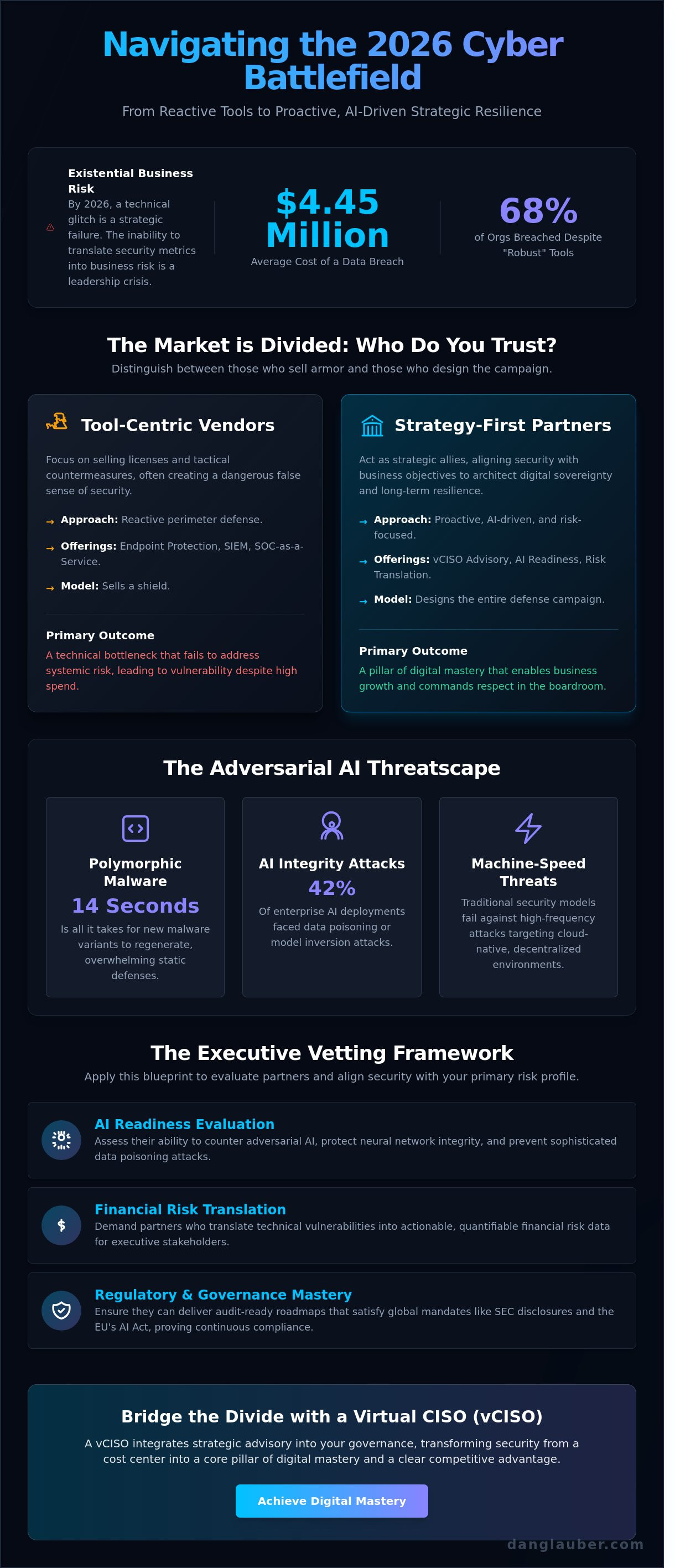
The definition of a modern cyber security firm has undergone a radical transformation. By 2026, these entities have transitioned from reactive firewall managers to strategic architects of digital sovereignty. Organizations can no longer rely on static perimeter defenses; the current digital battlefield requires proactive, AI-driven resilience that anticipates threats before they manifest. Relying solely on a "tool-only" approach has proven disastrous for 68% of mid-to-large organizations that suffered breaches in 2025 despite having robust software suites. Static software deployments create a false sense of security. They lack the adaptive intelligence to counter polymorphic malware that regenerates every 14 seconds. Boards that prioritize tool acquisition over strategic mastery find themselves vulnerable to the very technology they purchased.
When evaluating the vast landscape of cyber security firms, directors must distinguish between vendors selling licenses and partners offering comprehensive defense strategies. Modern cyber security firms act as the vanguard in the intersection of AI and cybersecurity. They provide the intellectual framework necessary to survive high-frequency, machine-speed attacks. This shift is mandatory because traditional security models fail to address the nuances of 2026's decentralized, cloud-native environments. A firm's value is now measured by its ability to integrate actionable frameworks into the existing corporate governance structure, ensuring that security is a business enabler rather than a technical bottleneck.
The Rise of Specialized AI Security Partners
Traditional generalist models are collapsing under the weight of Adversarial AI. Specialized firms now focus exclusively on neural network integrity and preventing data poisoning. These threats target the logic of machine learning models rather than just the data they hold. In 2025, 42% of enterprise AI deployments faced integrity attacks, making specialized expertise a prerequisite for operational safety. Firms specializing in neural network integrity protect against model inversion attacks, where hackers reconstruct private training data from public AI outputs. Generalist IT security models lack the depth to counter these sophisticated attack vectors, necessitating a move toward specialized AI security partners who understand the mechanics of machine learning vulnerabilities.
Regulatory Pressures Driving Firm Selection
Global mandates, such as the evolved SEC disclosure requirements and the EU’s AI Act, have transformed security from a technical hurdle into a fiduciary obligation. Cyber security firms must now deliver audit-ready security roadmaps that satisfy both regulators and shareholders. The selection process now prioritizes vendors capable of proving continuous compliance through automated reporting and real-time telemetry. Boards require partners that can translate technical risk into the language of financial impact and regulatory standing. Regulatory Resilience is the organizational capacity to maintain operational continuity while meeting 100% of global transparency and disclosure mandates in real-time.
Categorizing the Market: Software Vendors vs. Strategic Advisors
The global ecosystem of cyber security firms is fundamentally divided between those who build the armor and those who design the campaign. The tool-first category focuses on the technical perimeter, deploying endpoint protection, SIEM platforms, and SOC-as-a-Service to mitigate immediate attack vectors. These vendors provide the essential tactical countermeasures required to survive the digital battlefield. However, tools alone don't constitute a strategy. Without a governing framework, even the most advanced neural networks will fail to protect an organization from systemic risk.
The strategy-first category prioritizes governance, utilizing vCISO services and risk advisory to align security with business objectives. Hybrid models exist, but they frequently face conflicts of interest when their advisory arm recommends their own proprietary software. Identifying your location on the Security Maturity Curve is vital for effective procurement. A 2023 report indicated that 68% of mid-market enterprises remain in the reactive phase, where they're overwhelmed by tool alerts but lack a cohesive defense plan. Moving toward mastery involves shifting from a tool-heavy approach to one rooted in strategic readiness; to see how structured planning can support this transition, you can find out more about building effective operational templates.
Managed Security Service Providers (MSSPs)
Outsourcing technical operations to an MSSP provides immediate access to specialized talent that many firms can't afford to hire internally. The 2024 labor market shows a significant gap in available security professionals, making the MSSP model attractive for mid-market firms needing 24/7 monitoring. The primary pitfall is the "Set it and Forget it" mentality. When leadership treats security as a utility rather than a strategic pillar, they lose the visibility necessary for high-level decision-making. An MSSP is an effective tactical partner, but it isn't a substitute for institutional oversight.
Virtual CISO and Strategic Advisory Firms
Strategic cyber security firms provide leadership-as-a-service, bridging the gap between the server room and the boardroom. They translate technical debt, such as unpatched legacy systems or fragmented cloud architectures, into business risk metrics that executives can understand. This translation is essential because board-level risk management requires a clear view of how digital threats impact the bottom line. The primary deliverable here is the briefing, a structured communication that moves the conversation from "Are we safe?" to "Are we resilient?" To build this resilience, leaders should adopt actionable frameworks that unify technical capability with executive governance.
The Glauber Framework: Evaluating Firms in the Age of AI
The intersection of AI and cybersecurity demands a radical departure from legacy procurement models. Boards can't afford to settle for vendors that merely react to known threats; they must partner with cyber security firms that demonstrate mastery over a shifting digital battlefield. The Glauber Framework provides a rigorous lens to evaluate these partners through four critical domains. First, AI Readiness requires a firm to treat AI as both a sophisticated weapon and a primary shield. Second, Business Alignment ensures that technical risks translate into fiscal realities. Third, Tactical Agility measures how quickly a partner pivots when attackers deploy novel exploits. Finally, Governance Mastery ensures the board receives actionable frameworks rather than a deluge of technical noise.
Assessing a Firm's AI Defense Capabilities
Distinguishing between real machine learning utility and "AI-washed" marketing is a board's first priority. Ask potential cyber security firms how they use Large Language Models (LLMs) to accelerate threat hunting. If their solution doesn't integrate Zero-Trust architecture, it's already obsolete. AI allows attackers to bypass traditional perimeters at machine speed. A partner must prove their defense systems can identify anomalous behavior within neural networks, not just match signatures of old malware. According to the 2024 IBM Cost of a Data Breach Report, organizations that deployed AI and automation extensively saved an average of $2.22 million in breach costs. Your chosen firm should provide data proving they can deliver these specific efficiencies through automated response protocols.
Quantifying Strategic Value Over Technical Cost
The traditional cost-per-seat pricing model is a relic that fails to account for systemic resilience. Boards need to evaluate the ROI of a strategic security roadmap that scales with the business. A technical cost is a line item; strategic value is a risk mitigation asset. When a firm presents a proposal, look for evidence of how their strategy reduces the probability of a "Material Event" as defined by the 2023 SEC disclosure rules. This shift moves the conversation from "how much does this cost?" to "how much capital is being protected?"
- Strategic Security ROI: The measurable ratio between capital invested in proactive defense frameworks and the quantifiable reduction in potential financial loss from business interruption, regulatory fines, and reputational erosion.
- Actionable Proof Points: Demand case studies where the firm reduced the Mean Time to Identify (MTTI) a breach by at least 30% through predictive analytics.
- Framework Integration: Ensure the firm uses established standards like the NIST Cybersecurity Framework 2.0 to ground their strategy in recognized industry benchmarks.
Selecting a partner isn't about buying software. It's about securing a visionary advisor who understands that in the age of artificial intelligence, the speed of your defense must exceed the speed of the threat. The Glauber Framework ensures your governance remains ahead of the curve, transforming security from a cost center into a strategic advantage.
The Executive Vetting Checklist: Selecting Your Partner
Selecting a partner to defend your organization requires more than a technical audit; it demands strategic alignment. Most cyber security firms focus on the perimeter, yet boards must focus on the business. This vetting process ensures your chosen partner can translate technical telemetry into executive action. The digital battlefield is unforgiving, and your choice of ally determines whether you achieve mastery or remain in a state of perpetual vulnerability.
- Step 1: Conduct a gap analysis of internal leadership. Determine if your CISO possesses the "boardroom voice" or if they require a partner to bridge the communication gap.
- Step 2: Define your primary risk profile. A 2023 industry report found that 68% of boards prioritize business continuity over pure compliance. Decide if your focus is regulatory adherence, rapid innovation, or 24/7 operational resilience.
- Step 3: Evaluate the firm’s track record with 50+ real-world case studies. Evidence is the only currency that matters. Demand proof of how they've handled adversarial AI and complex breach scenarios in your specific sector.
- Step 4: Request a sample board-level briefing. Test their ability to explain Zero-Trust Architecture or Neural Network vulnerabilities without relying on jargon. If they can't explain the "why" to a CFO, they're a liability.
- Step 5: Verify their Executive AI Strategy. Ensure they have a documented framework for training your leadership on the intersection of AI and cybersecurity.
Red Flags to Watch for During the RFP Process
Avoid cyber security firms that rely solely on automated reporting. Data without context is just noise. The most dangerous partners offer "Black Box" security solutions without transparent logic; this creates a single point of failure that your board cannot audit. If a firm fails to demonstrate executive-level communication during the initial pitch, they'll likely fail during a crisis. Transparency and clarity are non-negotiable requirements for governance.
The Role of Executive Training in Firm Selection
The best firms don't just defend; they educate. They act as mentors who empower your leadership team to make informed, data-driven decisions. Integrating interactive workshops into your long-term security retainer ensures that your board stays ahead of the curve. This educational foundation is often built on authoritative texts. For instance, Dr. Glauber's "Cybersecurity in the Age of Artificial Intelligence" provides 18 comprehensive chapters that serve as a definitive guide for mastering these critical domains. These actionable frameworks transform abstract threats into manageable defense strategies.
Beyond the Vendor: Integrating Strategic Advisory into Governance
Effective governance demands a shift from reactive procurement to proactive leadership. Many cyber security firms focus solely on deploying tools, yet they fail to align those tools with the organization's long-term objectives. A monthly vCISO retainer provides the most efficient path to resilience because it maintains a continuous state of readiness. It moves the organization away from the firefighting mentality of annual audits toward a posture of strategic mastery. This ongoing engagement ensures that security isn't a seasonal conversation but a permanent board priority.
The gap between technical complexity and business value is often where governance fails. Boards don't need to understand the intricacies of neural networks; they need to understand how those networks protect the company's valuation. A strategic partner acts as a translator. They turn technical attack vectors into actionable risk assessments that the board can use to make informed decisions. This transition from vulnerability to preparedness is the hallmark of sophisticated digital leadership. It allows the C-suite to view security as a business enabler rather than a cost center.
The vCISO Advantage for Mid-to-Large Organizations
The financial logic of the vCISO model is compelling for 2026 and beyond. A full-time CISO in a major metropolitan area often commands a compensation package exceeding $325,000, excluding benefits and equity. By contrast, a vCISO retainer offers high-level expertise at a scalable cost. Dr. Daniel Glauber's advisory ensures that your security roadmap isn't a generic template. It's a customized strategy built for your specific technological environment. This model provides ongoing strategic leadership, ensuring that Zero-Trust Architecture and other critical domains are integrated into the company's DNA. While most cyber security firms focus on software implementation, this advisory focuses on the development of a resilient strategic framework.
Mastering the Future of Digital Security
The intersection of AI and cybersecurity is no longer a futuristic concept; it's a permanent business reality. Recent 2025 reports indicate that adversarial AI is now used in 75 percent of sophisticated phishing campaigns targeting executive leadership. Building a cyber-resilient culture requires more than just employee training; it requires a commitment from the top to safeguard leaders across all vectors. In addition to digital defense, Stone Security Services provides executive protection and personal bodyguard services to ensure comprehensive safety in the physical world. Board members must lead by example, treating digital defense as a core pillar of corporate responsibility. This mastery allows the organization to navigate the digital battlefield with confidence rather than fear. It's about moving from a state of potential vulnerability to one of strategic readiness.
Take the definitive step toward organizational resilience. Secure your organization’s future with Dr. Daniel Glauber’s vCISO Advisory.
Mastering Risk on the 2026 Digital Battlefield
The shift toward 2026 demands a fundamental pivot from reactive procurement to strategic governance. Boards won't survive by relying solely on automated tools to defend against adversarial AI. True resilience depends on selecting cyber security firms that bridge the gap between technical defense and corporate strategy. By applying the Glauber Framework, organizations move beyond basic compliance toward a state of mastery. This process involves vetting partners against 18 specific knowledge domains to ensure they're prepared for the complex intersection of AI and security.
Dr. Daniel Glauber leverages 30+ years of tech innovation expertise to guide leadership through these high-stakes transitions. He's the author of 'Cybersecurity in the Age of Artificial Intelligence' and serves as a specialized vCISO for mid-to-large organizations. Transforming your security posture from a cost center into a strategic advantage is the final step in executive readiness. Schedule a Board-Level Briefing with Dr. Daniel Glauber today to begin fortifying your defense. You have the power to turn digital threats into opportunities for organizational growth.
Frequently Asked Questions
What is the difference between a cyber security firm and an MSSP?
A cyber security firm provides high-level strategic consulting and specialized offensive security, while a Managed Security Service Provider (MSSP) focuses on day-to-day operational monitoring. Firms typically handle complex tasks like Zero-Trust Architecture design or deep incident response forensics. MSSPs maintain the essential infrastructure of security, such as firewall management and log collection. Choosing the right partner depends on whether your Board requires tactical maintenance or strategic mastery of the digital battlefield.
How much should a mid-market company spend on a cybersecurity firm?
Mid-market organizations should allocate between 6% and 14% of their total IT budget to security initiatives. According to the 2023 Deloitte Global Survey, this investment level ensures a robust defense against evolving attack vectors. For a company with a $10 million IT budget, this translates to $600,000 to $1.4 million annually. This capital supports the actionable frameworks and defensive countermeasures required to protect critical enterprise assets from sophisticated threats.
Can a cybersecurity firm help with SEC compliance and reporting?
Expert cyber security firms directly assist with SEC compliance by implementing the rigorous four-day disclosure rule established in December 2023. They provide the technical documentation and materiality assessments needed for mandatory Form 8-K filings. These firms ensure your governance structure meets the SEC’s expectations for board-level oversight. This proactive approach transforms a regulatory burden into a strategic advantage for your shareholders and stakeholders.
What are the most important criteria for choosing a firm in 2026?
The most critical criteria for 2026 include mastery of Adversarial AI defense and a proven track record in Zero-Trust implementation. Organizations must prioritize partners that utilize neural networks to predict breaches before they occur. Look for cyber security firms with at least 50 real-world case studies involving automated threat hunting. Technical depth and the ability to translate complex risks into actionable frameworks are non-negotiable for future-proofing your enterprise.
How do cyber security firms use AI to defend against modern threats?
Modern cyber security firms deploy AI-driven neural networks to analyze billions of data points in milliseconds. This technology identifies anomalous patterns that human analysts would miss, providing a definitive edge against automated attack vectors. By using machine learning for predictive modeling, these firms shift from reactive recovery to proactive neutralization. This evolution is essential for navigating the intersection of AI and cybersecurity in the current high-stakes threat environment.
Is a virtual CISO firm better than hiring an in-house security team?
A virtual CISO (vCISO) firm is often superior for mid-market companies, offering a 30% to 40% reduction in overhead compared to a full-time executive hire. These firms provide access to a collective of experts rather than a single individual’s limited experience. It’s a pragmatic solution that brings high-level strategy to organizations that don't yet require a permanent, in-house security department. This model ensures professional urgency without the long-term cost of a C-suite salary.
What happens if a cybersecurity firm's own tools are breached?
If a firm’s tools are compromised, established Blast Radius protocols and contractual indemnification clauses limit the damage to your infrastructure. The 2023 MOVEit breach demonstrated that supply chain vulnerabilities are a reality on the digital battlefield. Leading firms maintain rigorous internal Zero-Trust standards to ensure a breach in one segment doesn't grant access to client data. You must verify their incident response plan includes specific countermeasures for their own software stack.
How often should a firm provide reports to the Board of Directors?
Cybersecurity leaders should provide comprehensive reports to the Board of Directors at least once per quarter. The National Association of Corporate Directors (NACD) recommends this cadence to ensure governance keeps pace with rapid technological shifts. Between these sessions, the Board needs immediate notifications for any material incidents as defined by 2023 regulatory standards. Consistent reporting builds a foundation of transparency and allows for data-driven strategic decisions at the highest level.