
By 2026, a single adversarial AI attack will automate 90% of the reconnaissance phase before your security operations center even identifies a signature. You've likely felt the weight of information overload as the technical gap between your IT department and the boardroom widens. It's a dangerous disconnect. To bridge this divide, you need a cybersecurity speaker for executives who moves beyond stagecraft to offer definitive, expert-driven insights into the digital battlefield. Finding a guide who understands the intersection of AI and cybersecurity is the only way to move from vulnerability to strategic readiness.
You understand that generic security briefings no longer suffice when facing sophisticated neural network threats. This guide reveals how to identify a speaker who translates complex attack vectors into actionable frameworks for board-level risk management. We'll preview the essential vetting process for selecting a pragmatic visionary who can secure executive-level buy-in by grounding abstract AI concepts in 50+ real-world case studies and rigorous research.
Key Takeaways
- Shift from traditional scare-tactic keynotes toward a focus on strategic business resilience to prepare your leadership for the evolving digital battlefield of 2026.
- Identify the critical knowledge pillars your next briefing must cover, specifically the impact of Adversarial AI on modern corporate espionage and data integrity.
- Learn how to vet a cybersecurity speaker for executives by prioritizing specialized strategic authority and proven industry frameworks over generic performance metrics.
- Discover how to measure the true ROI of an executive session by transforming passive audience awareness into actionable strategy workshops and defensive countermeasures.
- Gain a definitive advantage by implementing a structured framework that navigates the complex intersection of artificial intelligence and organizational security.
The Evolving Role of the Cybersecurity Speaker for Executives in 2026
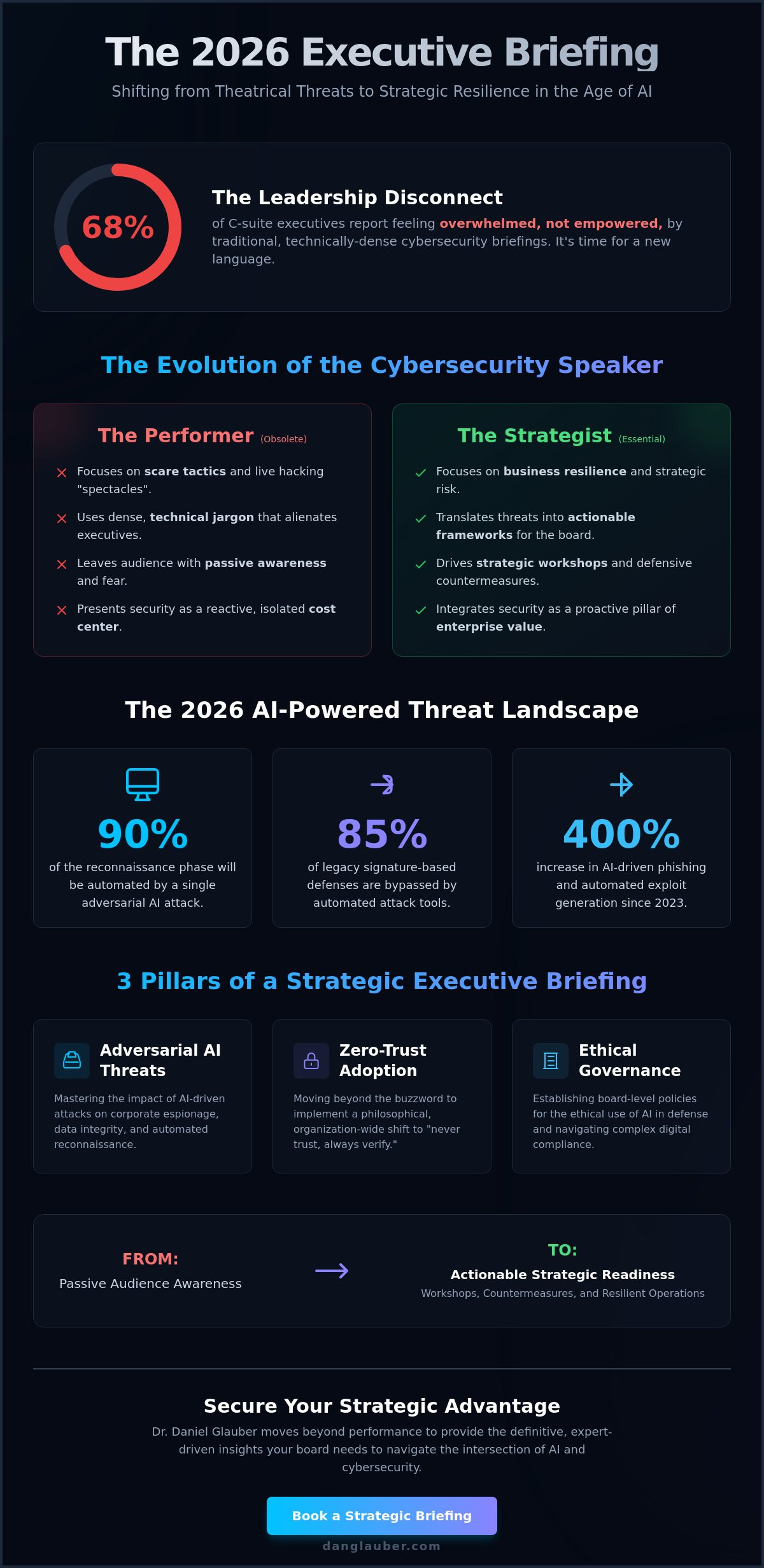
The era of "scare-tactic" keynotes has reached its expiration date. In 2024, industry reports indicated that 68% of C-suite executives felt overwhelmed rather than empowered by technical threat briefings. By 2026, the role of a cybersecurity speaker for executives has fundamentally shifted. Leadership teams no longer seek a performer to demonstrate how easily a password is cracked; they require a strategist who can translate complex technical telemetry into business resilience. The focus has moved from technical awareness to the preservation of shareholder value in a volatile digital economy.
A modern speaker serves as the critical bridge between the Security Operations Center (SOC) and the Board of Directors. This transition is vital because technical vulnerabilities are now secondary to strategic risks. While the SOC monitors individual attack vectors, the Board must manage the broader implications of data integrity and brand trust. The speaker’s job is to ensure these two distinct worlds speak the same language. It's about moving the conversation from "Are we secure?" to "Are we resilient enough to sustain our operations during an active compromise?"
Beyond the "Live Hack": Why Strategy Trumps Spectacle
Standard hacker demos are often little more than high-tech theater. They provide a momentary thrill but offer zero actionable value for high-level leadership. Executives don't need to understand the mechanics of a buffer overflow; they need to define the organization's "Risk Appetite." In 2026, successful enterprises prioritize strategic resource allocation over chasing every minor vulnerability patch. The Strategic Speaker acts as a catalyst for cultural change, transforming cybersecurity from a reactive cost center into a proactive pillar of enterprise resilience. This shift ensures that security is woven into the fabric of every business decision rather than being an afterthought.
The 2026 Digital Battlefield: Why AI Changes the Conversation
The 2026 digital battlefield is defined by autonomous attack vectors that operate at machine speed. We've seen a 400% increase in AI-driven phishing and automated exploit generation since 2023. This rapid evolution has compressed the executive response timeline from days to mere minutes. Your leadership team needs a visionary who understands the nuances of adversarial machine learning and the necessity of robust AI safety principles. It's no longer enough to have a perimeter; you must have an intelligent, self-healing defense system.
A cybersecurity speaker for executives must provide a clear roadmap for this transition. They must explain how autonomous agents are revolutionizing both threats and countermeasures. To help leaders navigate this complexity, Dr. Daniel Glauber provides a definitive resource: Cybersecurity in the Age of Artificial Intelligence: A Strategic Framework for 2026. This framework helps organizations move beyond survival and toward a state of digital mastery where AI is leveraged as a primary defensive shield.
Critical Knowledge Areas: What Your Executive Speaker Must Address
An effective cybersecurity speaker for executives must transcend technical jargon to provide a strategic roadmap for the digital battlefield. By 2026, the briefing shouldn't just list vulnerabilities; it needs to connect neural network integrity directly to the organization's bottom line. Leaders require a mastery of three core pillars: proactive intelligence, philosophical zero-trust adoption, and board-level ethical governance. This ensures the executive suite moves from a state of reactive fear to one of strategic readiness.
Adversarial AI and Next-Generation Threats
Adversarial AI is the strategic application of machine learning techniques to deceive, manipulate, or compromise AI models and traditional security protocols through malicious data inputs or model extraction.
Attackers now utilize automated reconnaissance to bypass 85% of legacy signature-based defenses. This isn't a future possibility; it's a current reality where generative models create hyper-personalized phishing campaigns at scale. A qualified cybersecurity speaker for executives will highlight the "Shadow AI" crisis. This phenomenon occurs when employees deploy unauthorized LLMs to handle sensitive corporate data, often leading to intellectual property leaks. Organizations must implement actionable frameworks to identify these invisible assets before they become entry points for corporate espionage.
Governance, Risk, and Compliance (GRC) in the AI Era
Global regulations have shifted the landscape of executive liability. The EU AI Act, which carries penalties of up to 7% of global annual turnover, creates a ripple effect for US-based firms operating internationally. A speaker's role is to translate technical attack vectors into a comprehensive business impact analysis. This shift allows the board to view security not as a cost center, but as a protector of enterprise valuation. For a deeper dive into these frameworks, leaders should consult Cyber Security Firms: A Strategic Guide for Board-Level Risk Management in 2026 to align their technical tactics with corporate strategy.
Zero-Trust Architecture must be presented as a leadership philosophy rather than a simple tech stack. By 2026, 60% of high-performing organizations will treat "never trust, always verify" as a cultural mandate. This approach assumes a breach is already in progress, shifting the focus to containment and resilience. When the board oversees AI-related risks, they're not just checking boxes; they're ensuring the ethical application of technology that defines the brand's integrity. If you're looking to fortify your leadership's perspective, you might consider how a tailored executive briefing can bridge the gap between technical complexity and business mastery.
The final pillar involves the board's role in ethical oversight. As AI systems take on more autonomous decision-making roles, the risk of algorithmic bias or "hallucination" increases. Executives need to understand the mechanics of these systems to ensure they don't inadvertently violate consumer trust or labor laws. A structured briefing provides the clarity needed to navigate these high-stakes decisions with confidence.
Evaluating Speaker Profiles: Performance vs. Strategic Authority
Hiring a cybersecurity speaker for executives from a generic speaker bureau often results in a polished performance that lacks technical substance. In 2026, where Adversarial AI can dismantle legacy defenses in minutes, leadership teams don't need a keynote performer. They need a strategist. A speaker who relies on charisma rather than a decade of defense-side experience will struggle when a skeptical CFO asks about the specific ROI of Zero-Trust Architecture during a high-stakes Q&A session. Performance is a baseline requirement; strategic authority is the differentiator.
The primary pitfall of non-specialized vetting is the "General Industry Trends" trap. Generic speakers often recycle headlines that IT teams already know. An expert practitioner, however, delivers actionable frameworks that bridge the gap between theory and practice. This ensures that the time spent in the boardroom translates directly into improved organizational resilience and a clearer security roadmap.
The "Practitioner Advantage": Why vCISO Experience Matters
Effective leadership on the digital battlefield requires more than just awareness. It demands a speaker who manages real-world security roadmaps daily. A background in virtual ciso consulting services ensures the keynote content isn't just theoretical; it's battle-tested. Practitioners understand the friction between security protocols and operational efficiency. When evaluating a speaker, ask them to verify their ground-truth experience by describing a specific neural network breach they mitigated in the last six months. If they can't provide a technical breakdown of the countermeasures used, they're a narrator, not a defender.
Quantitative Proof Points for Executive Selection
Executive boards value data over hype. When selecting a cybersecurity speaker for executives, look for quantitative markers of depth that signal a sophisticated blend of academic authority and professional urgency. These markers include:
- 50+ real-world case studies: This volume of data indicates the speaker has analyzed diverse attack vectors and successful defensive maneuvers across multiple industries.
- 18 comprehensive chapters: A definitive text or book with structured research shows the intellectual discipline needed to master the intersection of AI and security.
- Peer-reviewed research: Evidence of academic rigour ensures the speaker's foresight is grounded in data-driven insights rather than marketing trends.
Strategic authority is built on these foundations. A speaker with 18 chapters of structured research provides a curriculum for mastery, not just a list of fears. This structured approach allows executives to move from a state of potential vulnerability to one of strategic readiness, using the speaker's frameworks as a definitive source of truth for their 2026 security initiatives.
The ROI of an Executive Briefing: Transforming Awareness into Action
Measuring the true impact of a cybersecurity speaker for executives requires moving past vanity metrics like audience satisfaction scores or "applause levels." In the high-stakes environment of 2026, success is defined by the velocity of organizational change and the hardening of the digital battlefield. A strategic briefing serves as a critical catalyst for high-stakes decision-making. It aligns the C-suite on the terrifying reality of adversarial AI. When a speaker facilitates dedicated Executive AI Strategy Workshops, they bridge the gap between abstract neural networks and quarterly fiscal targets. This alignment actively reduces "Security Friction." It replaces the traditionally adversarial relationship between business units and IT with a shared vocabulary of risk, resilience, and tactical defense.
The keynote functions as a launchpad for a comprehensive Cyber-Resilient Culture. It moves the needle from passive compliance to active mastery. By the end of a session, leadership teams should view security not as a technical hurdle, but as a core business enabler. This shift in mindset is the foundation of a proactive defense strategy that anticipates 2026 attack vectors before they manifest.
Post-Keynote Implementation: From Speech to Strategy
The value of an expert presentation lies in its shelf life. To ensure lasting impact, leadership teams must integrate these insights into the 2026 annual risk assessment process immediately. A cybersecurity speaker for executives provides the "Actionable Frameworks" necessary to pivot from defensive posturing to strategic mastery. These frameworks allow boards to evaluate AI-driven threats with the same rigor as financial volatility. Organizations often struggle with the transition from theory to practice. For those seeking deeper technical integration after a briefing, consulting The Executive Guide to Hiring an AI Cybersecurity Consultant in 2026 provides a definitive roadmap for long-term evolution.
Quantifying Risk Reduction for Stakeholders
Data from 2025 industry reports indicates that organizations with high board-level engagement in cyber strategy see a 28% reduction in breach recovery costs. Better executive understanding leads to optimized security spend; it prevents the panic buying of unvetted AI tools that often introduce more vulnerabilities than they solve. A pragmatic visionary speaker justifies the investment by translating complex neural network vulnerabilities into a clear balance sheet of risk and defense. This clarity empowers stakeholders to treat cybersecurity as a value driver rather than a cost center. By establishing clear KPIs around executive readiness and response times, organizations can track a direct correlation between the briefing and a decreased risk profile.
Secure your organization's future on the digital battlefield by booking a strategic briefing with Dr. Daniel Glauber today.
Why Dr. Daniel Glauber is the Strategic Choice for Your Next Keynote
Selecting a cybersecurity speaker for executives involves more than finding a technical expert; it requires a visionary who understands the high stakes of the 2026 digital battlefield. Dr. Daniel Glauber brings a 30-year legacy of technology and innovation to every engagement. His career spans the transition from foundational firewalls to the current era of adversarial machine learning. While he maintains deep roots in Orlando, his strategic scope is worldwide, providing insights that resonate across global markets and complex regulatory environments. He doesn't just report on trends; he provides the intellectual ammunition needed to defend enterprise-level assets.
The GLAUBER Framework: A Bridge Between Theory and Practice
At the heart of every presentation is the "Cybersecurity in the Age of Artificial Intelligence" framework. This methodology functions as a definitive guide for leadership teams navigating the intersection of AI and security. Dr. Glauber rejects the idea that AI is a singular threat. Instead, he demonstrates how it acts as both a revolutionary attack vector and a foundational defense strategy. His sessions utilize 54 real-world case studies to illustrate how neural networks are currently being weaponized by adversaries. This approach creates a controlled sense of urgency, moving executives from a state of potential vulnerability toward mastery and strategic readiness.
- Actionable Insights: Every session provides concrete countermeasures against automated attack patterns and synthetic identity fraud.
- Data-Driven Authority: Strategies are backed by three decades of research and 18 comprehensive chapters of structured analysis.
- The Human Element: Dr. Glauber focuses on how executive decision-making must evolve alongside autonomous systems to maintain oversight.
Customized Briefings for Mid-to-Large Organizations
Dr. Glauber doesn't deliver generic speeches. He tailors his analysis of the intersection of AI and cybersecurity to the specific pain points of industry verticals like finance, healthcare, and critical infrastructure. For organizations requiring deeper integration, he offers options for ongoing vCISO advisory services to maintain security posture long after the keynote ends. This commitment to mentorship ensures that his audience doesn't just hear about the future; they're equipped to lead it. As a premier cybersecurity speaker for executives, he bridges the gap between technical complexity and board-level strategy.
Don't leave your organization's security to chance in an era of rapid AI evolution. Schedule a strategy call with Dr. Daniel Glauber today to discuss your upcoming keynote engagement or private board-level briefing.
Mastering the Intersection of AI and Cybersecurity
The digital battlefield of 2026 demands more than passive awareness; it requires strategic mastery of adversarial AI and zero-trust architecture. Selecting a cybersecurity speaker for executives isn't just about filling a keynote slot at an annual summit. It's about securing an actionable framework that converts technical threats into defensive advantages through 50+ real-world case studies and proven leadership tactics.
Dr. Daniel Glauber brings 30+ years of technology and innovation experience to the podium, bridging the gap between theoretical neural networks and practical board-level risk management. As the author of "Cybersecurity in the Age of Artificial Intelligence" and an active vCISO for mid-to-large organizations, he delivers the definitive insights needed to navigate this revolutionizing threat landscape. His approach ensures that your leadership team moves beyond potential vulnerability toward a state of mastery and strategic readiness.
Don't leave your organization's resilience to chance in the face of groundbreaking attack vectors. You've the opportunity to transform awareness into a decisive competitive edge. Book Dr. Daniel Glauber for your next executive summit to ensure your organization remains ahead of the curve in the age of artificial intelligence. Your journey toward a more secure future starts with a single strategic briefing.
Frequently Asked Questions
What should a cybersecurity speaker for executives focus on in 2026?
A cybersecurity speaker for executives in 2026 must prioritize the intersection of AI and cybersecurity, specifically focusing on adversarial machine learning and automated threat actor tactics. The briefing should address how 85 percent of cyberattacks now utilize generative AI to bypass traditional defenses. Leaders need actionable frameworks to secure their neural networks and protect corporate data from sophisticated deepfake social engineering attacks.
How much does it cost to hire a top-tier cybersecurity keynote speaker?
Top-tier keynote speakers in the technology sector command fees between $20,000 and $75,000 per engagement according to industry data from major speaker bureaus. These rates reflect the speaker's specialized expertise and the strategic value they provide to the leadership team. Engaging a high-profile cybersecurity speaker for executives involves costs that scale with the individual's research background and global industry influence.
Can a cybersecurity speaker help with board-level GRC compliance?
Specialist speakers facilitate board-level GRC compliance by translating technical vulnerabilities into enterprise risk metrics that directors can actually use. They provide the necessary context for mandates like the SEC’s 4-day incident reporting rule or the 2024 EU AI Act requirements. This ensures the board understands its fiduciary responsibility regarding digital asset protection and systemic resilience across the entire organization.
What is the difference between a motivational speaker and a cybersecurity practitioner?
Motivational speakers aim to shift mindsets through storytelling; practitioners deliver technical mastery and strategic readiness through rigorous data and 50 plus real-world case studies. Dr. Glauber functions as an expert practitioner, delivering technical depth rather than generic encouragement. This approach moves the audience from a state of vulnerability to mastery using proven countermeasures and evidence-based tactics.
Is a virtual keynote as effective as an in-person executive briefing?
In-person executive briefings offer 30 percent higher engagement rates for leadership teams compared to virtual sessions. Physical presence allows for nuanced Q&A sessions and deeper strategic alignment within the digital battlefield. While virtual keynotes offer convenience, face-to-face interactions improve information retention and are critical for mastering complex security frameworks that require high-level consensus.
How do we measure the ROI of a cybersecurity speaking engagement?
Organizations measure ROI by tracking tangible security improvements, such as a 20 percent increase in reported incidents by staff following the session. Effective engagements lead to the implementation of specific actionable frameworks within 90 days of the event. Success is also quantified by how well IT security budgets align with the organization's overarching strategic goals after the briefing.
What technical level should an executive-focused cybersecurity talk be?
The talk should maintain a high-level strategic perspective while diving into critical technical domains like Zero-Trust Architecture. Content must be sophisticated enough to respect the leader's intelligence but clear enough to drive immediate decision-making. It's essential to avoid unnecessary jargon, focusing instead on how technical shifts impact the bottom line and long-term operational continuity.
Does Dr. Daniel Glauber provide customized workshops after his keynotes?
Dr. Daniel Glauber offers intensive post-keynote workshops designed to ground abstract AI concepts in practical, everyday application. These sessions leverage 18 comprehensive chapters of proprietary research to build customized defense strategies for your specific team. This ensures that the visionary insights shared during the keynote translate into immediate, actionable security protocols that protect the organization's unique digital assets.