

The global cost of cybercrime is projected to hit $10.5 trillion this year. Despite this, many directors still treat security as a line-item expense rather than a strategic asset. When you are presenting cybersecurity risk to the board 2026, you're no longer just managing a department; you're navigating a digital battlefield. Currently, 80% of phishing attacks leverage AI-generated content. It's a struggle to fight for budget against aggressive AI growth initiatives, especially when leadership views the July 2023 SEC disclosure rules as a mere checkbox exercise.
You understand that meeting the February 5, 2026 IIA Cybersecurity Topical Requirement is only the baseline. True resilience requires more. This guide will empower you to bridge that gap by mastering the art of translating technical, AI-driven threats into the precise language of business value and strategic resilience. We will move beyond fear-based metrics. Instead, we provide an actionable framework for securing board-approved budgets and establishing cybersecurity as a core pillar of your organization's leadership at the intersection of AI and cybersecurity.
Key Takeaways
- Learn to translate complex technical telemetry into strategic business narratives to avoid the common pitfalls of the "Compliance Trap."
- Master the shift from reporting vulnerabilities to articulating business continuity risks by quantifying the real-world cost of digital friction.
- Position operational resilience as a distinct competitive advantage that secures enterprise contracts instead of viewing it as a regulatory burden.
- Utilize an actionable 5-step framework for presenting cybersecurity risk to the board 2026 that integrates specific adversarial AI threat scenarios.
- Enhance your executive credibility by adopting a pragmatic visionary approach to security governance and board-level briefings.
The 2026 Boardroom Reality: Why Traditional Reporting Fails
Modern board reporting is the translation of technical telemetry into strategic business narratives. In the 2026 economic landscape, cybersecurity has transitioned from a back-office IT problem to an existential risk. Leaders who succeed at presenting cybersecurity risk to the board 2026 recognize that technical metrics mean nothing without business context. We've entered an era where global cybercrime costs are projected to reach $10.5 trillion this year. This staggering figure has transformed security into a non-negotiable pillar of fiscal responsibility. Boards are no longer satisfied with knowing that a firewall is active; they demand to know how a breach would halt the supply chain or erode shareholder value.
Falling into the "Compliance Trap" is a common failure for many organizations. While meeting the SEC’s July 2023 disclosure mandates or the June 3, 2026 Regulation S-P amendments is mandatory, these regulations represent the floor, not the ceiling. Compliance ensures you avoid fines; it doesn't ensure you survive an attack. Boards are currently obsessed with AI growth, which provides your greatest reporting opportunity. By framing security as the strategic accelerator that allows AI initiatives to scale safely, you transform from a cost center into a growth enabler. Presenting cybersecurity risk to the board 2026 requires this fundamental shift in perspective.
The Rise of Adversarial AI and Board Accountability
The digital battlefield has changed. Automated attack vectors now leverage neural networks to bypass traditional defenses, shortening the response window for executives from days to minutes. This speed has led to a significant legal shift. Directors now face personal liability for catastrophic breaches if they fail to exercise due diligence. Mastering this environment requires a deep dive into Cybersecurity in the Age of Artificial Intelligence: A Strategic Framework for 2026. When 53% of security leaders identify AI-powered attacks as their primary challenge, board-level accountability isn't just a best practice; it's a legal necessity.
Moving Beyond the 'Red-Amber-Green' Dashboard
Static RAG charts are relics of a simpler time. They fail to capture the dynamic, shifting nature of modern threats. Instead of data dumps, boards require actionable frameworks that ground technical issues in a solid IT risk management framework. These models bridge the "Context Gap" that often leaves executives confused. The Context Gap is the fundamental failure to align technical vulnerability data with the strategic priorities of the business, leaving directors blind to the actual operational impact of a cyber event. To be effective, your reporting must move from "what happened" to "what this means for our 2026 revenue targets."
Translating Technical Risk into Business Value
Effective communication in the 2026 boardroom requires a total abandonment of technical jargon. When you are presenting cybersecurity risk to the board 2026, your goal is to replace the term "vulnerabilities" with "Business Continuity Risks." Directors don't manage patches; they manage the organization's ability to generate revenue and maintain market position. By quantifying the cost of "Digital Friction", which is the operational slowdown caused by inadequate security controls, against the $4.88 million average cost of a data breach, you provide the board with a clear financial choice. Security is no longer a hurdle to AI innovation. It's the prerequisite. In the Intersection of AI and Cybersecurity, a robust defense strategy is what allows the organization to deploy neural networks with confidence, ensuring that adversarial AI doesn't turn a growth initiative into a catastrophic liability.
Quantitative risk analysis is the bridge between the server room and the executive suite. High-ticket security investments in Zero-Trust Architecture are often met with skepticism unless they're framed through the lens of loss prevention and insurance premium stabilization. You must demonstrate how a specific investment reduces the average 277-day incident containment window, thereby protecting the bottom line. This methodical approach transforms cybersecurity from an opaque insurance policy into a strategic asset that preserves the organization's capital and reputation on the digital battlefield.
The Power of Strategic Vocabulary
To command respect, you must adopt 2026 "Power Words" like Operational Resilience, Competitive Integrity, and Data Sovereignty. These terms resonate with stakeholders who prioritize long-term stability over short-term technical fixes. For instance, linking a zero-day exploit to a potential 5% drop in stock price or increased customer churn transforms an abstract threat into a tangible fiscal reality. Many cyber security firms now specialize in validating these business narratives, providing the external data points needed to justify complex security roadmaps. Using this vocabulary ensures your message isn't lost in translation.
The 'So What?' Test for Every Slide
Every slide in your presentation must pass the "So What?" test. If a metric doesn't lead to a business decision, it's technobabble that causes board disengagement. Consider a case study from a recent vCISO advisory session where a leader identified a vulnerability in a proprietary neural network. Instead of explaining the technical weight-bias attack, they translated it into a "Supply Chain" risk that could halt production for 15 days. This approach aligns with CISA’s guidance on board-level cyber risk oversight, ensuring every security discussion is a governance discussion. To sharpen your delivery, attending an Executive AI Strategy Workshop can help align your technical roadmap with high-level board expectations.
Regulatory Compliance vs. Operational Resilience
In the 2026 regulatory environment, the gap between being "compliant" and being "secure" has widened into a chasm. When presenting cybersecurity risk to the board 2026, you must articulate that meeting legal mandates is merely defensive posturing. Regulations like the EU Cyber Resilience Act, which begins its reporting obligations on September 11, 2026, or the German NIS2 implementation registration deadline of March 6, 2026, are the floor, not the ceiling. Compliance is a lagging indicator of security; it confirms what happened yesterday rather than predicting what will happen tomorrow. To move beyond this, frame cybersecurity as a competitive edge. Organizations that demonstrate superior resilience win more enterprise contracts because they represent a stable, low-risk node in an increasingly fragile global supply chain.
Innovation and security are often viewed as opposing forces, particularly concerning the rise of "Shadow AI." Currently, 53% of security leaders believe AI-powered attacks are their biggest challenge, yet employees continue to bypass protocols to use unapproved generative tools. Instead of acting as the "Department of No," report on these activities as an unmet business need that requires secure enablement. Balancing risk appetite with the need for rapid innovation means providing the board with the data to decide where to accept friction for the sake of integrity. This strategic alignment ensures that security supports, rather than stifles, the organization's aggressive AI growth targets.
Meeting the 2026 Reporting Standards
The 2026 reporting landscape is defined by the SEC's July 2023 disclosure rules and the upcoming June 3, 2026 Regulation S-P amendments. When discussing "Materiality," avoid focusing solely on financial loss. Instead, present it through the lens of operational continuity and stakeholder trust. This approach aligns with the ISACA guide on board-level cyber risk reporting, which emphasizes translating technical metrics into governance-ready insights. Effective reporting satisfies legal requirements while providing the board with the clarity needed to discharge their oversight duties effectively.
Building the Resilience Narrative
Shift the conversation from "Prevention" to "Time to Recover" (TTR). In a world where global cybercrime costs are projected to reach $10.5 trillion in 2026, assuming total prevention is a strategic fallacy. Positioning the board as the "Strategic High Command" on the digital battlefield empowers them to focus on mission-critical outcomes. Utilizing virtual ciso consulting services provides the external validation necessary to prove that your resilience framework is grounded in industry-leading standards. Resilience is the ability to sustain a hit and remain operational, a narrative that commands far more respect than promises of perfect security.
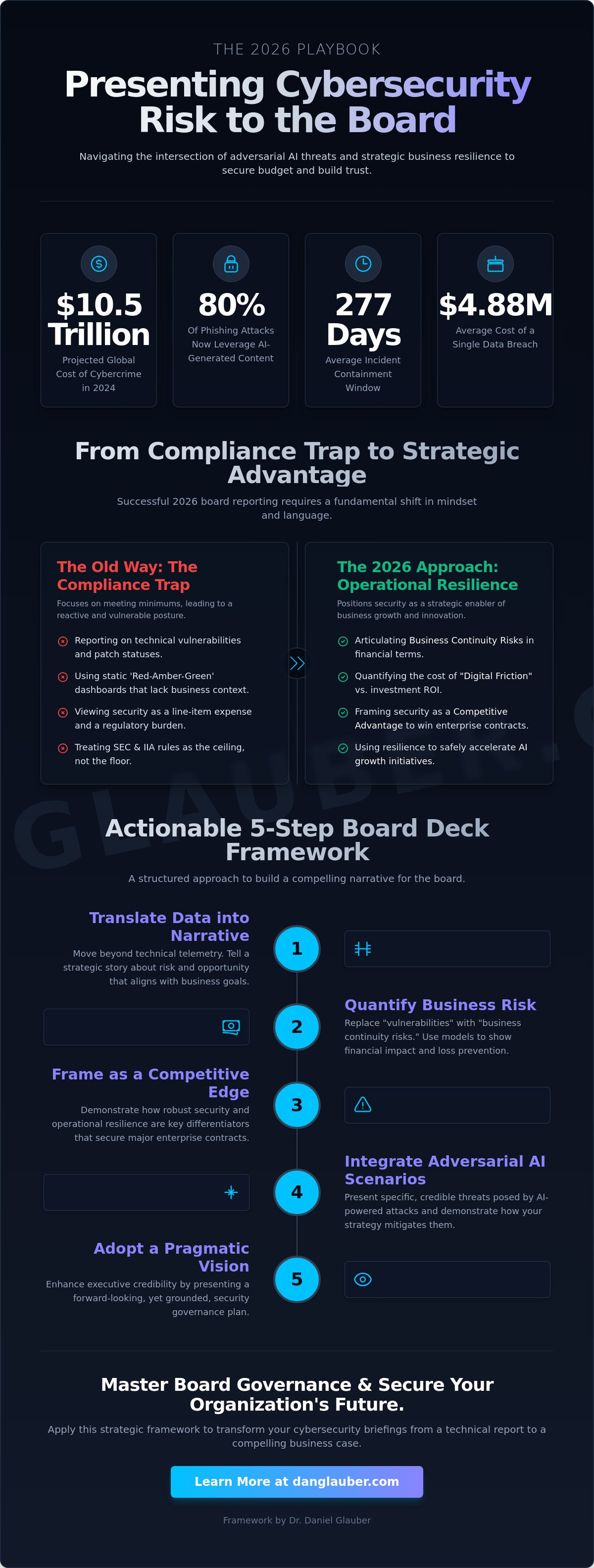
How to Build the 2026 Board Deck: A 5-Step Framework
Your presentation deck is the strategic briefing that guides the organization's high command through the digital battlefield. In 2026, a successful deck must move beyond technical telemetry to provide a narrative of mastery and preparedness. When presenting cybersecurity risk to the board 2026, you need a structured architecture that mirrors a strategic framework. This five-step process ensures your message is both authoritative and actionable.
- Step 1: The Executive Summary. This is your "State of the Union." It provides a high-level snapshot of the organization's current resilience posture compared to the evolving threat landscape, specifically highlighting shifts since the February 5, 2026 IIA requirements.
- Step 2: The AI Threat Landscape. Use specific, real-world adversarial examples. Detail how 80% of phishing attacks now utilize generative AI to bypass legacy filters. Integrate current ai and cybersecurity trends to show the board you're ahead of the curve.
- Step 3: Risk Quantification. Map every major threat to a dollar amount. Use the global average breach cost of $4.88 million as a baseline to explain potential impacts on specific business units.
- Step 4: The Resilience Roadmap. Explain where the investment goes. With global security spending projected to reach $183.9 billion this year, justify your portion by linking it to specific defensive outcomes.
- Step 5: The 'Ask'. End with clear, definitive decisions. Don't leave the room without a board-level commitment to the strategic path forward.
Visualizing Risk: Data vs. Narrative
Guidelines for 2026 data visualization demand a shift away from static heat maps. Directors require dynamic impact simulations that show how a ransomware event would cascade through the supply chain. Use "War Gaming" results to bring these risks to life, making the abstract nature of neural network vulnerabilities tangible for non-technical leaders. This narrative approach transforms a data dump into a compelling story of strategic readiness. If you need to refine this narrative, booking a Board-Level Cybersecurity Briefing can provide the expert-driven authority your deck requires.
The Art of the 'Ask'
Structure your budget request as a "Business Enablement" fund rather than a defensive cost. When handling the "Why now?" objection, point to the June 3, 2026 compliance deadline for Regulation S-P amendments as a non-negotiable driver. You must be prepared with data to justify the "How much?" by showing the ROI of avoiding the $1.85 million average cost of a ransomware incident. Decision-ready reporting is the only way to ensure the board moves from a state of potential vulnerability to one of strategic mastery. Your goal is to make the decision to invest feel like the only logical path for the organization's survival.
Mastering Board Governance with Dr. Glauber
The complexity of the 2026 digital battlefield requires a shift from technical defense to strategic mastery. Successfully presenting cybersecurity risk to the board 2026 often hinges on the credibility of the messenger. Internal teams frequently struggle with the "Context Gap" where technical telemetry fails to resonate with directors focused on fiduciary duties. This is where an external perspective becomes critical. Dr. Daniel Glauber provides the academic authority and professional urgency needed to bridge this divide, ensuring that security is viewed as a pillar of business resilience rather than a cost center. His expertise helps you move from a state of potential vulnerability to one of strategic readiness.
The role of an ai cybersecurity consultant in this landscape is to act as a strategic translator. By framing neural network vulnerabilities in terms of market stability and competitive integrity, Dr. Glauber helps the C-Suite understand the high stakes of the Age of Artificial Intelligence. Engaging an advisor who has navigated these shifts for over 30 years provides the board with a definitive source of truth. This partnership moves the conversation beyond technical jargon toward a unified vision of organizational strength at the intersection of AI and security.
Executive AI Strategy Workshops
Dr. Glauber’s Executive AI Strategy Workshops are designed to move leadership teams from a state of uncertainty to one of total mastery. These sessions aren't generic training. They're grounded in actionable frameworks tailored to the 2026 market. By utilizing 50+ real-world case studies, Dr. Glauber illustrates how adversarial AI can be countered with robust defense strategies. This evidence-based approach drives deep engagement, helping directors visualize the intersection of AI and security through the lens of operational continuity and long-term value preservation.
Securing the Future: Your Next Steps
Ongoing support is essential for maintaining the board's confidence as threats evolve throughout the year. A Monthly Virtual CISO Retainer ensures that your process for presenting cybersecurity risk to the board 2026 remains decision-ready and aligned with the latest regulatory shifts, such as the September 11, 2026 reporting obligations. For organizations seeking to align their entire executive team, booking a keynote engagement provides a groundbreaking perspective on the future of the digital battlefield. It's time to transform your security narrative into a strategic asset. Book a Board-Level Briefing with Dr. Daniel Glauber today to secure your organization's future.
Commanding the Strategic Narrative in 2026
The 2026 boardroom demands more than just a list of patches; it requires a vision of resilience at the intersection of AI and cybersecurity. Successful leaders have moved beyond the June 3, 2026 Regulation S-P deadline to focus on building a sustainable competitive edge. By mastering the art of presenting cybersecurity risk to the board 2026, you ensure that leadership recognizes security as a fundamental pillar of business continuity. You've learned to quantify digital friction and utilize a structured 5-step framework to turn technical telemetry into strategic narratives that command respect from the high command.
Bridging the gap between technical complexity and executive oversight requires a partner who understands the digital battlefield. Dr. Daniel Glauber, author of 'Cybersecurity in the Age of Artificial Intelligence', brings over 30 years of technology innovation and security leadership to your organization. As a specialist in AI-driven risk frameworks for the C-Suite, he provides the definitive authority needed to secure board-approved budgets. Elevate your board reporting with Dr. Daniel Glauber's vCISO Advisory and transform your security posture from a defensive cost into a strategic asset. You're now equipped to lead your organization through this era of rapid AI evolution with absolute confidence.
Frequently Asked Questions
How often should I present cybersecurity risk to the board in 2026?
You should present cybersecurity risk at least quarterly, with ad-hoc briefings for material incidents as mandated by the July 2023 SEC disclosure rules. In 2026, the February 5 IIA requirements also mandate that internal audit functions assess these governance structures regularly. This frequency ensures leadership stays ahead of the rapid evolution of attack vectors on the digital battlefield, maintaining a state of constant preparedness.
What are the top 3 metrics boards actually care about in an AI-driven world?
Boards in 2026 prioritize Cyber Value at Risk (CyVaR), Time to Recover (TTR), and AI Integrity Scores. CyVaR translates threats into potential financial losses, while TTR measures operational resilience. These metrics move the conversation away from technical jargon and toward the $183.9 billion global spending landscape where business value and strategic readiness are the primary concerns for every director.
How do I explain 'Adversarial AI' to a non-technical board member?
Explain Adversarial AI as the use of neural networks by attackers to automate and scale sophisticated breaches. You can note that 80% of phishing attacks now leverage AI-generated content to bypass traditional defenses. Frame it as a tactical shift where the enemy uses the same innovation we use for growth as a weapon for exploitation, requiring a dual-perspective defense strategy.
What is the difference between cyber risk and strategic business risk?
Cyber risk refers to the potential for digital asset loss; strategic business risk is the broader impact on the organization's mission and revenue. When presenting cybersecurity risk to the board 2026, you must show how a digital failure directly causes a strategic failure. A breach isn't just a technical event; it's a disruption to your competitive integrity and long-term market position.
Should I include specific technical vulnerabilities in my board report?
You shouldn't include specific technical vulnerabilities unless they represent a material threat to business continuity. Boards don't need to know about individual CVEs; they need to understand the aggregate risk to critical domains. Focus on the "Context Gap" by explaining how technical weaknesses could result in the $4.88 million average cost of a data breach, rather than listing server-level details.
How do I handle a board member who thinks compliance is 'good enough'?
Remind them that compliance is a lagging indicator and merely the floor of a sound defense strategy. With cybercrime costs projected to hit $10.5 trillion in 2026, meeting the June 3 Regulation S-P amendments won't stop a determined adversary. Use case studies to demonstrate that compliant companies still suffer catastrophic losses when they lack the mastery required for true operational resilience.
What is the role of the CISO during a board-level AI risk assessment?
The CISO acts as the strategic architect and translator during a board-level AI risk assessment. They're responsible for identifying how neural networks might be poisoned or manipulated by external threats. Their role is to ensure that the intersection of AI and cybersecurity remains a space for safe innovation rather than a source of unmanaged liability or digital friction for the directors.
Can a vCISO present to the board on behalf of the company?
A vCISO can and often should present to the board to provide an objective, expert-driven perspective. When presenting cybersecurity risk to the board 2026, an external advisor like Dr. Daniel Glauber brings the academic authority needed to validate internal strategies. This third-party viewpoint often commands more respect and helps bridge the gap between the server room and the C-Suite effectively.