

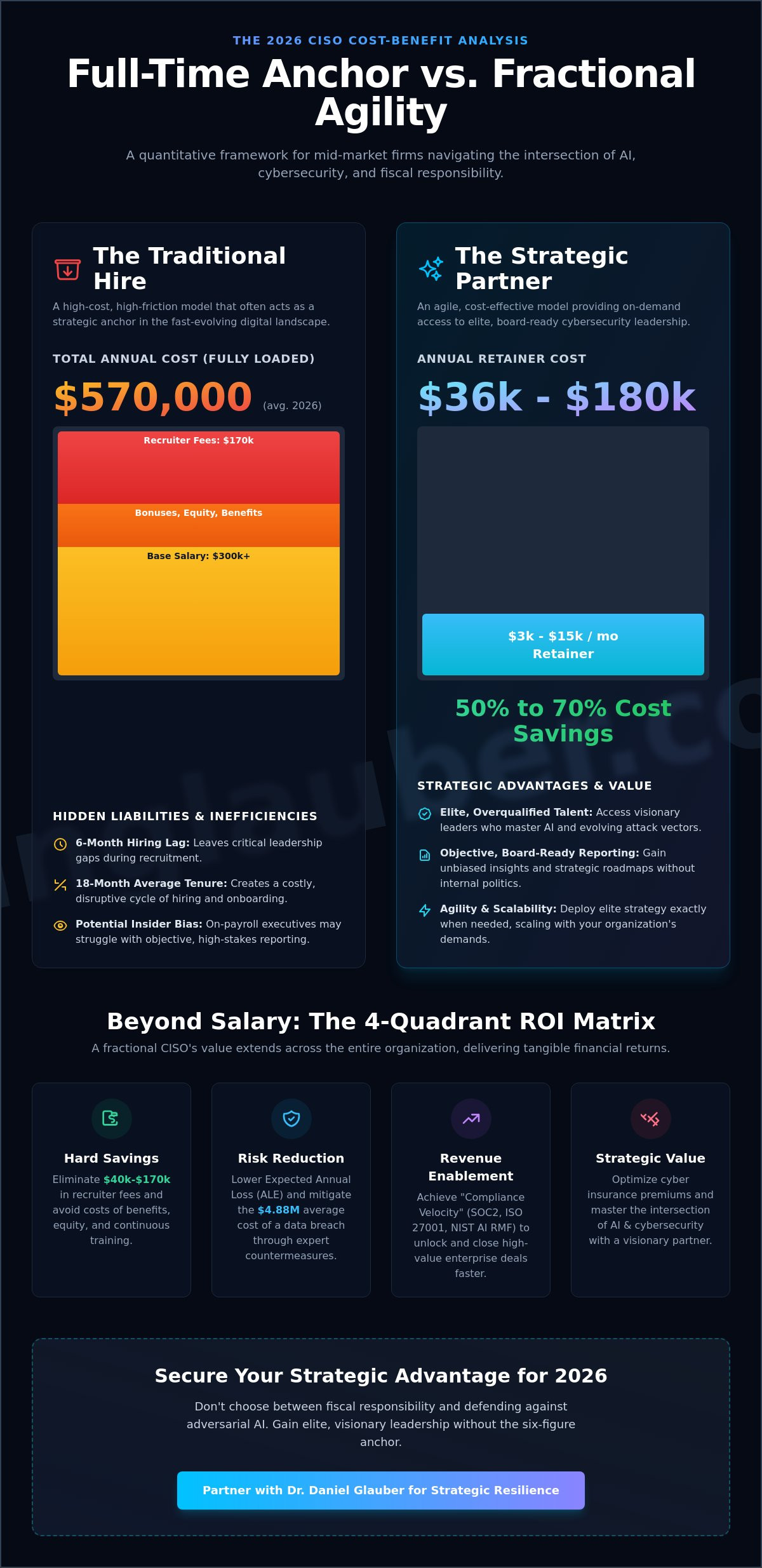
Hiring a full-time security chief in 2026 isn't necessarily a sign of organizational strength; it's often a $570,000 strategic anchor that limits your agility on the digital battlefield. As boards demand immediate roadmaps for AI-related vulnerabilities and the talent market remains critically tight, the traditional recruitment model is failing. This fractional ciso cost benefit analysis proves that mid-market firms can capture elite, visionary leadership without the $170,000 recruiter fees or the six-month hiring lag. You don't have to choose between fiscal responsibility and defending against adversarial AI.
We recognize that the pressure to secure your neural networks while reducing executive spend feels like an impossible mandate. This guide provides a groundbreaking breakdown of how a fractional model delivers board-ready reporting and strategic mastery with 50% to 70% cost savings compared to a full-time executive. You'll gain a clear view of the 2026 financial benchmarks, including the delta between $420,000 salaries and $3,000 monthly retainers. We're moving beyond basic security checks to help you dominate the intersection of AI and cybersecurity with an actionable framework for sustainable growth.
Key Takeaways
- Access elite leadership without the $400,000 price tag by understanding how the 2026 talent crisis shifts the economics of executive security.
- Utilize our definitive fractional ciso cost benefit analysis to compare $180,000 retainers against $570,000 fully loaded salaries for a clear view of your ROI.
- Learn to quantify the "Cost of Inaction" using the Expected Annual Loss framework to provide your board with data-driven security justifications.
- Discover why external fractional advisors provide more objective, high-stakes reporting than traditional on-payroll executives who may suffer from insider bias.
- Master the intersection of AI and cybersecurity with an actionable framework designed to defend against adversarial neural networks and evolving attack vectors.
The Economics of Security Leadership in the Age of AI
The digital battlefield of 2026 demands more than just a gatekeeper. Organizations are realizing that the traditional model of hiring a single person is being replaced by a more agile approach: subscribing to elite expertise. This shift is the foundation of any modern fractional ciso cost benefit analysis. A Chief Information Security Officer (CISO) today must possess deep mastery of neural networks and adversarial AI. Finding this specific combination in a full-time hire is becoming nearly impossible for mid-market firms. A fractional CISO provides that high-level strategic leadership on a long-term, part-time basis, ensuring you don't sacrifice vision for budget.
The talent crisis has reached a breaking point. As of May 2026, full-time AI security experts command compensation packages exceeding $400,000. For companies with 1,000 or more employees, the salary benchmark alone has hit $420,000. This isn't just about a paycheck. It's about the total investment required to secure the intersection of AI and cybersecurity. Organizations are moving away from tactical consultants who focus on short-term fixes and are instead seeking fractional executives who can drive comprehensive, board-ready security roadmaps.
The True Cost of an In-House CISO in 2026
The financial burden of a full-time executive is staggering. Beyond the $350,000 base reality, you're paying for bonuses, equity, and comprehensive benefits. Recruiter fees alone can drain up to $170,000 from your budget before the candidate even starts. There's also the hidden cost of turnover. With a national average tenure of just 18 months, companies are trapped in a cycle of expensive recruitment and onboarding. Training costs add another layer of complexity. Keeping a full-time hire proficient in neural network threats requires a continuous, high-cost educational investment that many firms can't sustain.
Fractional as a Strategic Bridge
A fractional model allows you to bridge the gap between technical complexity and board-level risk management. You gain access to overqualified talent that would otherwise be out of reach. This approach is grounded in the principles found in Cybersecurity in the Age of Artificial Intelligence. It's about deploying elite strategy exactly when it's needed most. Instead of a tactical consultant who merely manages tools, you're securing a visionary leader who understands how to master the evolving attack vectors of 2026 while maintaining a firm grip on foundational security principles.
Fractional CISO Cost-Benefit Analysis: A Quantitative Framework
A rigorous fractional ciso cost benefit analysis must move beyond simple salary comparisons; it requires a deep dive into the financial mechanics of risk. While a mid-market fractional retainer typically ranges from $3,000 to $12,000 per month, a fully loaded full-time hire in 2026 demands between $230,000 and $570,000 annually. This 50% to 70% reduction in direct expenditure is only the baseline. To understand the true Strategic Role and Value of a Fractional CISO, executives must calculate the reduction in Expected Annual Loss (ALE). By applying advanced countermeasures to neural network vulnerabilities, a fractional leader lowers the probability of incurring the $4.88M average cost of a data breach.
Compliance velocity also provides a tangible financial lift. Meeting SOC2, ISO 27001, or the NIST AI RMF 1.0 standards faster allows your organization to unlock new revenue streams and close enterprise deals that were previously out of reach. Additionally, sophisticated leadership directly influences insurance premium optimization. Carriers in 2026 are heavily scrutinizing security leadership; having an expert at the helm who understands the intersection of AI and cybersecurity can significantly reduce your cyber liability costs. Exploring these variables during an Executive AI Strategy Workshop ensures your leadership team aligns on these critical financial trade-offs.
The 4-Quadrant ROI Matrix
- Hard Savings: Eliminating recruiter fees ($40k-$170k) and the massive overhead of executive benefits and equity.
- Risk Avoidance: Quantifiable mitigation of high-impact attack vectors before they manifest as catastrophic losses.
- Strategic Gain: Drastically faster time-to-market for secure AI products by integrating security into the development lifecycle from day one.
- Operational Efficiency: Rationalizing the security stack to eliminate redundant tools, which often consume between $50,000 and $150,000 of the annual budget.
Intangible Benefits: The 'Visionary' Factor
Boardroom credibility is a currency that's hard to overstate. Having a published author and recognized practitioner in your corner provides a level of assurance that an internal hire might struggle to match. This relationship also facilitates executive mentorship, upskilling your existing IT team under the guidance of a seasoned expert who has navigated the digital battlefield for decades. The Expert Premium is the quantifiable value of 30+ years of technology innovation applied directly to your organization's specific risk profile. It's a strategic maneuver that transforms security from a cost center into a competitive advantage.
Structural Comparison: Fractional vs. Full-Time CISO Models
Choosing between an on-payroll executive and a fractional partner isn't just a budget decision; it's a structural maneuver that dictates your organization's agility. A comprehensive fractional ciso cost benefit analysis reveals that the value of objectivity often outweighs the perceived convenience of proximity. While a full-time hire is physically present, they're often subject to internal politics and "insider bias" that can cloud strategic judgment. In contrast, fractional leaders are specifically incentivized to speak truth to power, providing a transparent view of your vulnerabilities without the fear of jeopardizing a permanent position.
The digital battlefield of 2026 moves too fast for a siloed perspective. A fractional executive brings a breadth of experience from multiple industries, allowing them to identify emerging adversarial AI tactics in one sector and apply countermeasures in yours before the threat manifests. This cross-pollination of expertise provides cost-effective security leadership that a single-industry internal hire simply cannot replicate. To ensure deep integration, we utilize structured communication cadences that prevent the fractional leader from feeling like an outsider, turning them into a seamless extension of your executive suite.
When to Hire Full-Time (and When to Stay Fractional)
There's a specific complexity threshold where an organization's footprint requires 40 or more hours of strategic oversight every week. If your firm is managing massive, high-velocity data pipelines or facing ultra-specific regulatory mandates that require a named, full-time officer on the ground, the transition makes sense. However, many mid-market firms find success in a hybrid approach. They use fractional leadership to build the foundational security program and establish a zero-trust architecture before hiring a permanent successor to maintain the established roadmap.
The vCISO vs. Fractional CISO Distinction
It's vital to distinguish between a vCISO as a service-level agreement and a fractional executive role. While virtual CISO consulting services serve as the delivery mechanism, the fractional model is about high-level ownership and board-level accountability. In the Orlando market and beyond, executives must evaluate whether they need a local presence for physical site audits or if global remote expertise provides a more sophisticated defense against neural network threats. The choice depends on your specific attack vectors and the maturity of your existing IT infrastructure.
Strategic Framework: Evaluating Your Need for Fractional Expertise
Determining the right leadership model requires a methodical transition from financial calculation to strategic execution. Performing a fractional ciso cost benefit analysis is meaningless without a clear understanding of your specific operational requirements. You must move beyond surface-level security checks and evaluate your organization's posture against the sophisticated threats of the current landscape. This framework ensures that your choice of leadership aligns with both your fiscal constraints and your long-term resilience goals.
- Step 1: Inventory your current AI and digital security attack vectors. Identify the data pipelines feeding your neural networks and the external APIs that increase your exposure.
- Step 2: Quantify the 'Cost of Inaction'. Calculate the potential regulatory fines, lost customer trust, and recovery expenses associated with a major breach. This number often dwarfs the cost of elite leadership.
- Step 3: Assess your board's appetite for cybersecurity governance. Determine if your leadership team seeks a simple compliance checkbox or a definitive shield against adversarial threats.
- Step 4: Determine your budget for cyber security firms vs. individual advisors. Larger firms offer broad resources, but an individual fractional CISO provides dedicated executive presence and accountability.
- Step 5: Select an advisor who provides 'Actionable Frameworks' rather than just reports. You need a practitioner who delivers usable strategy that can be implemented by your existing IT staff.
The AI Risk Readiness Assessment
The use of Generative AI is the primary catalyst for seeking specialized fractional leadership in 2026. If your organization has integrated large language models or automated decision-making systems, your risk profile has fundamentally changed. You must evaluate whether your prospective advisor understands the nuances of adversarial AI and the unique vulnerabilities inherent in neural network security. Aligning your defense with executive AI strategy workshops allows your leadership to master these complex domains before they become liabilities.
Vetting Your Fractional CISO
Vetting an elite advisor requires looking beyond standard certifications like the CISSP. Search for quantitative proof of mastery, such as a history of published research, keynote speaking engagements, and a track record of industry innovation. The ideal candidate must possess the "culture fit" necessary to translate complex Zero-Trust Architecture concepts into the language of business risk. A monthly retainer model is the most effective structure for this relationship, as it ensures consistent strategic momentum and provides your team with a reliable mentor on the digital battlefield. To secure a definitive strategy for your organization, consider booking a Board-Level Cybersecurity Briefing today.
Partnering with Dr. Daniel Glauber for Strategic Resilience
Dr. Daniel Glauber operates as a Pragmatic Visionary, bridging three decades of technological innovation with the specific, high-velocity threats of 2026. Choosing to work with an expert practitioner means moving beyond the basic security checks provided by traditional advisors. While a standard fractional ciso cost benefit analysis often focuses on immediate payroll reduction, the true value lies in the long-term strategic resilience of your organization. By leveraging the actionable frameworks established in Dr. Glauber's 18 comprehensive chapters on the intersection of AI and cybersecurity, your leadership team gains a definitive shield against adversarial neural networks and evolving attack vectors.
The Monthly Virtual CISO Retainer is designed to provide more than just a set number of hours; it's a subscription to elite, visionary leadership. This model ensures consistent strategic momentum, allowing for the deep integration of security principles into your organizational culture. You aren't just hiring a consultant to fill a gap; you're securing a mentor who has navigated the digital battlefield through 50 plus real-world case studies. This partnership facilitates a seamless transition from technical complexity to board-ready reporting, ensuring your security posture remains ahead of the curve while optimizing your executive-level spend.
From Orlando to the Global Digital Battlefield
Dr. Glauber provides a unique blend of local expertise in the Florida market and a sophisticated, worldwide strategic perspective. Whether your firm is a growing tech entity in Orlando or a global enterprise, the approach remains methodical and data-driven. You can initiate this partnership through a project-based AI risk assessment to identify immediate vulnerabilities or opt for a long-term advisory retainer for sustained defense. We invite you to move from a state of potential vulnerability to one of absolute mastery through a dedicated strategic briefing that addresses your specific risk profile.
Next Steps for Your Organization
Securing your organization's future requires immediate, decisive action. You should begin by scheduling a preliminary board-level briefing to align your executive team on the current threat landscape and the financial advantages of fractional leadership. Reviewing our Strategic Guide for Board-Level Risk Management will provide the foundational knowledge needed to evaluate your current posture. Don't leave your neural networks exposed to adversarial tactics while you wait for a full-time hire. Secure your strategic frontier today and transform your security department from a cost center into a resilient competitive advantage.
Mastering the Strategic Frontier of 2026
The digital battlefield doesn't wait for recruitment cycles or budget approvals. This fractional ciso cost benefit analysis demonstrates that mid-market agility is your greatest defense against adversarial AI. By optimizing your executive spend, you redirect capital toward innovation while maintaining a definitive shield over your neural networks. You've seen how the intersection of AI and cybersecurity requires a leader who speaks the language of both the server room and the boardroom; a leader who transforms risk into a competitive advantage.
Dr. Daniel Glauber brings 30 plus years of technology and innovation experience to your specific risk profile. As the author of Cybersecurity in the Age of Artificial Intelligence, he provides the actionable frameworks necessary to move from vulnerability to mastery. Don't let your organization fall behind the curve of revolutionizing cyber threats. It's time to secure your future with an expert practitioner who understands the high stakes of modern defense. Schedule a Board-Level Briefing with Dr. Daniel Glauber to fortify your strategic resilience today. Your path to a secure, AI-driven future is within reach.
Frequently Asked Questions
What is the typical monthly cost of a fractional CISO?
Typical monthly retainers for a fractional CISO range from $2,000 to $20,000 as of May 2026. For a mid-market organization with 100 to 500 employees, you'll likely see costs between $3,000 and $12,000 per month. Firms in highly regulated sectors like finance or healthcare often pay $10,000 to $20,000 monthly due to the increased documentation and audit requirements. This pricing structure remains significantly lower than the $350,000 plus required for a full-time executive hire.
How many hours per week does a fractional CISO usually work?
A fractional CISO typically dedicates four to ten hours per week to your organization, though this scales based on your specific risk profile. This isn't about filling a 40-hour seat; it's about high-impact strategic windows where elite expertise is applied to critical domains. During periods of heavy audit or AI implementation, these hours might increase temporarily. The focus remains on delivering board-ready results rather than tracking clock-in times on the digital battlefield.
Is a fractional CISO different from a cybersecurity consultant?
The primary difference lies in executive accountability and long-term strategic ownership. A cybersecurity consultant is usually hired for a tactical, fixed-scope project like a single risk assessment. A fractional CISO serves as a member of your leadership team, providing continuous guidance and representing security interests at the board level. They don't just point out problems; they own the roadmap and ensure the organization masters its defensive posture over time.
Can a fractional CISO help with AI-related security risks?
Specialized fractional leadership is essential for managing the intersection of AI and cybersecurity in 2026. They provide actionable frameworks to defend against adversarial AI and secure the neural networks powering your business. This includes evaluating the risk of large language models and ensuring your data pipelines are resilient against evolving attack vectors. Most traditional consultants lack this specific depth, making a visionary fractional leader a critical asset for AI-driven firms.
What happens if we have a major data breach outside of their scheduled hours?
Emergency response protocols are built into most fractional advisory retainers to ensure leadership during a crisis. While the CISO isn't a 24/7 technical monitoring service, they take command of the incident response strategy when a breach occurs. They coordinate with your legal, PR, and technical teams to mitigate damage and ensure regulatory compliance. This leadership is vital for managing the $4.88M average cost associated with modern data breaches.
Does a fractional CISO manage our existing technical security team?
A fractional CISO provides strategic oversight and mentorship to your existing technical staff without replacing their day-to-day functions. They act as a bridge between technical execution and executive vision, upskilling your IT team through specialized guidance. While they don't typically handle HR tasks like payroll or scheduling, they define the standards and zero-trust architectures your team must implement. This relationship ensures your staff operates with mastery under expert practitioner leadership.
How do we measure the ROI of a fractional CISO engagement?
You measure ROI by tracking insurance premium optimization, compliance velocity, and the reduction of your Expected Annual Loss. A thorough fractional ciso cost benefit analysis also factors in the 50% to 70% savings compared to full-time executive compensation. By achieving SOC2 or NIST AI RMF 1.0 certification faster, you unlock revenue streams that were previously inaccessible. These quantitative proof points demonstrate that elite security leadership is a profit enabler, not just a cost.
What certifications or qualifications should I look for in 2026?
Look for a combination of traditional credentials like the CISSP and quantitative proof of industry innovation. In 2026, authorship and keynote speaking history are definitive markers of an expert who stays ahead of adversarial tactics. You should prioritize candidates who demonstrate deep mastery of AI-specific security frameworks and have a track record of bridging technical jargon with business risk. A visionary leader provides the foresight necessary to navigate the Age of Artificial Intelligence.