
What if your most trusted employee unknowingly authorizes a high-value wire transfer because a deepfake of your CFO sounded more convincing than your current training protocols? In the digital battlefield of 2026, traditional phishing simulations are failing against sophisticated adversarial AI, leaving organizations more vulnerable than ever. You're likely struggling with how to build a security first culture that doesn't feel like a productivity anchor to your staff. It's a common frustration; employees often view security mandates as hurdles rather than shields, while the boardroom remains disconnected from the technical realities of the server room.
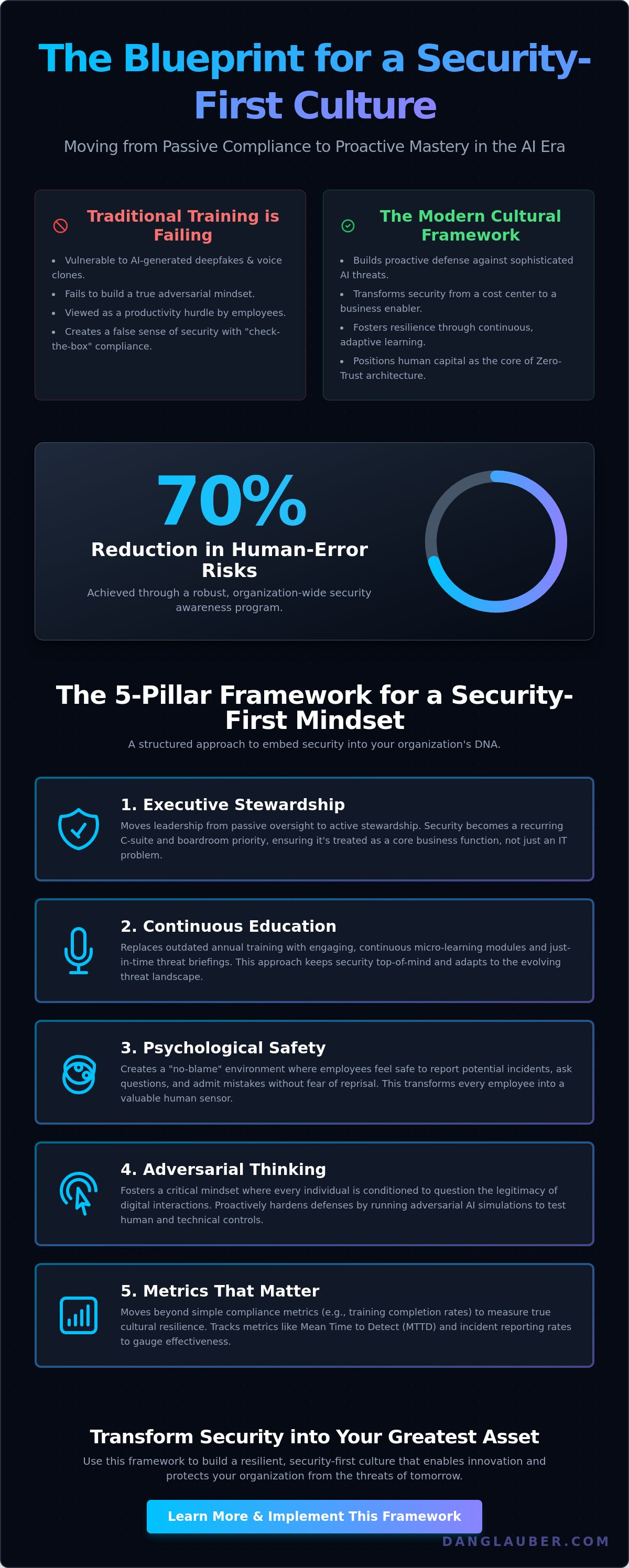
We agree that the pressure is mounting, especially with the May 2026 CIRCIA final rule requiring 24 hour ransomware payment reporting. However, industry data shows that a robust security awareness program leads to a 70% reduction in human-error risks. This guide offers the definitive strategic framework to move your organization from passive compliance to proactive mastery. We will examine the NIST CSF 2.0 2026 revision, the CMMC final rule issued in November 2025, and the actionable tactics required to transform security into a seamless business enabler at the intersection of AI and cybersecurity.
Key Takeaways
- Implement a high-level strategic framework that moves executive leadership from passive oversight to active stewardship, ensuring security is prioritized at the highest levels of governance.
- Master the methodology of how to build a security first culture by replacing outdated annual training with continuous, micro-learning modules that foster an adversarial mindset across the entire workforce.
- Resolve the productivity paradox by positioning security protocols as vital enablers of innovation, allowing your team to adopt new AI workflows with confidence and speed.
- Bridge the communication gap between the server room and the boardroom by translating technical vulnerabilities into actionable business risks within a Zero-Trust architecture.
- Develop a living security strategy that sustains long-term resilience through the use of adversarial AI simulations to proactively test and harden your organizational defenses.
Defining Security-First Culture in the Age of Artificial Intelligence
A security-first culture is no longer a peripheral HR initiative; it is a shared organizational immune system designed to neutralize digital threats before they manifest as catastrophic breaches. In the high-stakes environment of 2026, the digital battlefield has shifted. We have moved beyond the era of passive compliance, where employees simply checked boxes on an annual training module. To survive, organizations must foster an active adversarial mindset. This requires every individual to think like a threat actor, questioning the legitimacy of every digital interaction. Mastery begins with a firm grasp of foundational Information Security principles, yet it must evolve to meet the specific demands of the digital battlefield. Understanding how to build a security first culture today means recognizing that your human capital is the final and most critical layer of your Zero-Trust Architecture.
Artificial Intelligence has fundamentally revolutionized cyber threats by shifting the focus from technical perimeters to human psychology. While firewalls and neural networks protect the network, adversarial AI targets the cognitive biases of your staff. This transformation places the intersection of AI and cybersecurity at the heart of modern resilience. It is a dual-perspective reality where AI serves as both a sophisticated attack vector and a vital component of your defense strategy.
Why Traditional Awareness Training is Obsolete
Standard phishing simulations are failing because they cannot replicate the terrifying precision of AI-generated deepfakes and voice cloning. In 2026, a simple "check the sender address" tip is useless when an employee receives a high-fidelity video call from a synthetic version of their CEO. This creates an urgency trap. Employees, pressured by the need for AI-driven productivity, often bypass security protocols to meet aggressive deadlines. The Shadow AI crisis occurs when staff integrate unauthorized generative models into their daily workflows, effectively bypassing organizational oversight and creating invisible data leakages.
The ROI of Cultural Resilience
Investing in cultural health yields quantifiable returns that extend far beyond simple risk mitigation. A resilient culture significantly reduces the Mean Time to Detect (MTTD) incidents, as empowered employees act as distributed sensors across the organization. Research indicates that a robust security-first mindset can lead to a 70% reduction in security-related risks, directly protecting long-term brand equity. By integrating cybersecurity in the age of artificial intelligence into your core values, you transform security from a cost center into a business enabler. Leaders who prioritize how to build a security first culture find that trust becomes their most valuable currency in an increasingly skeptical market.
The 5-Pillar Framework for Building a Security-First Mindset
Developing a resilient organization requires more than technical countermeasures; it demands a fundamental shift in human behavior. To master how to build a security first culture, leaders must implement a structured framework that bridges the gap between high-level strategy and daily operations. This isn't a one-time project but a continuous evolution of organizational behavior. Our framework rests on five critical domains: Executive Stewardship, Continuous Education, Psychological Safety, Adversarial Thinking, and Metrics that Matter. Each pillar supports the others, creating a comprehensive defense-in-depth strategy that starts with people.
Executive Stewardship ensures that leadership moves beyond merely "signing the check" for security tools. Leaders must embody the values they expect from their teams, making security a recurring agenda item in every board meeting. Continuous Education replaces the obsolete annual compliance video with micro-learning and "just-in-time" training that addresses current threats. Psychological Safety is equally vital. According to recent insights on cybersecurity culture in the age of AI, a "report-first" environment is essential for early detection. When employees don't fear retribution for mistakes, they become your most effective sensors. Adversarial Thinking involves training staff to anticipate AI-driven social engineering tactics. Finally, Metrics that Matter focus on behavioral changes, such as the speed of incident reporting, rather than simple course completion percentages.
Step 1 & 2: Leadership Alignment and Dynamic Learning
Success begins with the vanguard. Conducting executive AI strategy workshops ensures that the C-suite understands the specific risks posed by neural networks and automated attack vectors. This alignment allows you to implement "Security Champions" in every department. These individuals act as decentralized experts, translating complex security requirements into the specific context of their team's daily work. We use AI-driven simulations to keep this learning dynamic. These tools generate realistic, personalized scenarios that challenge employees to apply their knowledge in real-time, effectively combating the "urgency trap" where productivity often overrides caution.
Step 3, 4 & 5: Creating the Human Firewall
Gamification is a powerful tool for increasing engagement across diverse teams. By turning security training into a competitive, rewarding experience, you foster a sense of shared responsibility. Clear, Actionable Frameworks must be established so every employee knows exactly what to do when they suspect a deepfake or a synthetic voice attack. We recommend establishing a "Security Scorecard" for each department. This tracks cultural progress through concrete data points, such as the reduction in "mean time to report" suspicious activity. This data-driven approach allows you to refine your strategy, ensuring that your journey of how to build a security first culture remains on track and measurable. If you're looking to solidify this foundation, consider a board-level cybersecurity briefing to ensure your leadership is prepared for the 2026 threat landscape.
Overcoming the 'Productivity vs. Security' Paradox
The most persistent objection in the digital battlefield is the claim that security inhibits tactical speed. In the race to adopt neural networks and automated workflows, employees often view safeguards as bureaucratic roadblocks. However, mastering how to build a security first culture requires reframing this dynamic entirely. Security isn't the brake that stops the vehicle; it's the high-performance suspension that allows an organization to navigate treacherous terrain at maximum velocity. Without it, tactical speed leads directly to a catastrophic strategic failure. By 2026, over 80% of enterprise workflows will involve some form of generative AI, making the integration of safety and speed a non-negotiable requirement for survival.
We must transition toward a model of "Invisible Security." This involves making the secure choice the path of least resistance through automation and intuitive design. When security is positioned as an enabler of innovation, it provides a definitive perimeter within which creativity can flourish. It allows teams to experiment with groundbreaking tools because they know the foundational countermeasures are already in place. This shift moves the organization from a state of constant friction to one of strategic readiness, where defense is a natural byproduct of every action taken at the desktop.
Integrating Security into AI Workflows
Organizations must vet Generative AI tools without stifling the very creativity they seek to harness. This is achieved by developing a "Green-Light" list-a curated directory of approved AI applications that have passed rigorous data privacy and adversarial AI risk assessments. This proactive vetting prevents the "Shadow AI" crisis while giving employees the tools they need to stay competitive. We mitigate security fatigue by reducing the cognitive load on staff, ensuring that every protocol is meaningful and every alert is actionable rather than a repetitive nuisance that invites bypass tactics.
The Role of a vCISO in Balancing Risk
Strategic leadership acts as the vital bridge between agility and safety. Utilizing virtual CISO consulting services provides your organization with the expert oversight needed to identify cultural blind spots that internal teams might overlook. A vCISO doesn't just manage technical debt; they translate complex attack vectors into business risks for board-level briefings. This ensures that the boardroom and the server room are aligned on the mission. By leveraging external vCISO expertise, you can implement how to build a security first culture that scales with your AI ambitions, transforming security from a perceived hurdle into a cornerstone of organizational resilience.
Operationalizing Security: From the Boardroom to the Desktop
Bridging the gap between the server room and the executive suite is the most critical challenge in modern defense. To master how to build a security first culture, organizations must translate abstract technical vulnerabilities into concrete business risks. A high-severity vulnerability is not just a line item in a report; it's a potential 4% hit to annual revenue or a catastrophic breach of customer trust. By framing security in terms of fiscal impact and operational continuity, you ensure that the board recognizes cybersecurity as a core business function rather than a technical overhead. This alignment is the only way to sustain the resources required for a long-term campaign against evolving threats.
Operationalizing this mindset requires a Zero-Trust Culture. This philosophy extends beyond network architecture; it's a behavioral mandate to verify every internal request and trust no digital interaction by default. We implement specific security guardrails for high-risk roles, such as Finance and HR, where the stakes of a successful AI-driven social engineering attack are highest. When near-misses occur, we conduct blameless post-mortem reviews. These sessions foster collective learning, turning potential disasters into actionable intelligence for the entire workforce. This practice shifts the focus from individual blame to systemic resilience, ensuring that how to build a security first culture becomes a shared mission across every department.
Board-Level Governance and Accountability
By May 2026, the complexity of the digital battlefield makes a dedicated cybersecurity committee a board-level necessity. Governance must move beyond oversight to active accountability. Leading organizations are now linking executive compensation directly to organizational security health metrics, such as the speed of vulnerability remediation and employee reporting rates. For a deeper analysis of these requirements, consult our guide for cyber security firms. This strategic alignment ensures that risk management is woven into the very fabric of leadership, providing a top-down mandate for cultural transformation.
Empowering the Individual Contributor
Resilience is built at the desktop. We recommend creating a dedicated "Security" channel on Slack or Teams for real-time threat sharing, allowing employees to report suspicious AI-generated anomalies instantly. Empowering individuals with tools to self-audit their digital footprint reduces the surface area for adversarial AI attacks. We also teach the "30-Second Rule": a mandatory pause to evaluate the emotional tone and urgency of any incoming communication. This simple tactic is a powerful countermeasure against the psychological manipulation common in modern cyber threats. If you're ready to align your leadership with these principles, schedule a board-level cybersecurity briefing to solidify your strategic defense.
Sustaining the Culture: Mastery Through Continuous Evolution
Security culture is a living strategy, not a static project with a defined completion date. In the high-velocity environment of 2026, organizational resilience requires a commitment to continuous evolution. Mastery is achieved when security principles are so deeply embedded that they survive leadership changes, rapid scaling, and the introduction of groundbreaking technologies. Understanding how to build a security first culture involves recognizing that the digital battlefield is constantly shifting. We must move beyond the initial implementation of frameworks to a state of perpetual readiness, where defense is as dynamic as the threats it seeks to neutralize.
Adversarial AI simulations serve as the essential stress tests for this cultural resilience. These simulations go beyond technical scans; they challenge the collective decision-making processes of your workforce in real-time. By subjecting employees to high-fidelity, synthetic threats, you identify "Cultural Drift"-the natural dilution of security values that occurs during periods of rapid growth or organizational change. Addressing this drift requires integrating security mastery into the professional development path of every employee. When security performance is tied to career advancement, it ceases to be an external mandate and becomes a core professional competency.
The Path to Mastery
The journey toward organizational resilience is documented extensively in my book, Cybersecurity in the Age of Artificial Intelligence. This work provides the comprehensive roadmap for navigating the complex intersection of AI and cybersecurity through 18 detailed chapters and 50+ real-world case studies. For leaders seeking to refine their long-term strategy, hiring an AI cybersecurity consultant provides the specialized expertise necessary to audit cultural health and implement actionable frameworks. Remember that security is not a department; it is a shared mindset that must be nurtured at every level of the hierarchy.
Preparing for the Future Battlefield
We must anticipate the next wave of autonomous cyber threats that will operate at machine speed, bypassing human intervention entirely. Building a culture that is "Adaptive by Design" ensures your organization can pivot its tactics without losing strategic focus. The 5-pillar framework-Executive Stewardship, Continuous Education, Psychological Safety, Adversarial Thinking, and Metrics that Matter-is the foundation for this long-term survival. By consistently applying these principles, you transform your staff into a proactive powerhouse capable of identifying how to build a security first culture that outpaces the most sophisticated adversaries. Your commitment to this evolution is the definitive factor in whether your organization remains a victim or becomes a master of the digital age.
Mastering the Human Element in the Age of Autonomy
The transition toward organizational resilience requires a permanent departure from the check-the-box compliance of the past. You now possess the strategic framework to move beyond passive awareness and instill an active adversarial mindset that treats every employee as a critical sensor. By implementing the 5-pillar framework and resolving the productivity paradox, you ensure that defense is a seamless enabler of innovation. Mastering how to build a security first culture is the only definitive way to survive the 2026 threat landscape where synthetic media and automated attack vectors are the norm. It's a journey that demands continuous evolution rather than a one-time project.
As a vCISO for global organizations with over 30 years of technology and innovation experience, I have dedicated my career to bridging the gap between theory and practice. Whether through my 18 chapter book, Cybersecurity in the Age of Artificial Intelligence, or my work as a featured speaker on digital security, I provide the actionable insights needed for mastery. Secure your organization's future; book Dr. Daniel Glauber for a keynote or executive briefing today. Your proactive leadership today creates the resilient powerhouse of tomorrow.
Frequently Asked Questions
What is the fastest way to start building a security-first culture?
The most efficient starting point is an executive AI strategy workshop to align the C-suite with the May 2026 CIRCIA reporting requirements. This top-down mandate ensures that how to build a security first culture becomes an organizational priority rather than a siloed IT task. By establishing clear accountability at the leadership level, you provide the necessary resources and authority for the rest of the 5-pillar framework to succeed.
How do I measure the ROI of security awareness training in 2026?
You should track behavioral shifts such as the Mean Time to Detect (MTTD) and the percentage of employees reporting suspicious anomalies. Research indicates that a robust security-first mindset can lead to a 70% reduction in human-error risks. Moving beyond completion rates to these quantitative proof points allows you to demonstrate how cultural health directly protects the bottom line and long-term brand equity.
Can AI help build a better security culture within my company?
AI is a powerful defense tool that enables personalized, micro-learning experiences tailored to an individual's specific risk profile. At the intersection of AI and cybersecurity, these tools generate realistic adversarial simulations that challenge employees to identify synthetic threats. This creates a dynamic feedback loop that hardens your human firewall more effectively than any static, outdated training module could hope to achieve.
What should I do if my executive team doesn't prioritize security culture?
You must translate technical vulnerabilities into material business risks that impact the balance sheet. Reference the November 2025 CMMC final rule or the 2023 SEC disclosure requirements to highlight the legal and financial consequences of negligence. A board-level cybersecurity briefing can often bridge this gap by showing how a proactive culture serves as a definitive competitive advantage in the 2026 digital marketplace.
How do I prevent 'security fatigue' among my employees?
Mitigating fatigue requires moving toward "Invisible Security" where the most secure action is also the most intuitive for the employee. By automating background checks and using just-in-time training, you reduce the cognitive burden on your staff. When security protocols feel like helpful guardrails instead of hurdles, employees are far more likely to maintain the high level of vigilance required on the digital battlefield.
Is a security-first culture different for remote vs. in-office teams?
Remote environments demand a more rigorous application of Zero-Trust principles because the traditional technical perimeter is non-existent. You must foster a portable security-first culture where employees understand their role in securing home networks and unvetted devices. While the core pillars remain the same, the tactics shift toward decentralized accountability and more frequent, micro-targeted communications to keep security top-of-mind outside the office.
How often should security training be updated to keep up with AI threats?
Training must transition from an annual event to a continuous, living strategy that evolves alongside the threat landscape. With adversarial AI advancing daily, waiting even three months to update your curriculum leaves your team vulnerable. High-performing organizations now use AI-driven platforms to push weekly updates that reflect the latest synthetic voice clones and deepfake tactics seen in the wild.
What is the role of a vCISO in establishing company-wide culture?
A vCISO serves as a strategic mentor who bridges the gap between technical execution and executive leadership. They provide a neutral, external audit of your current cultural health and identify blind spots that internal teams might overlook. By implementing how to build a security first culture through a vCISO advisory, you gain access to a definitive roadmap backed by real-world case studies and expert-driven foresight.