
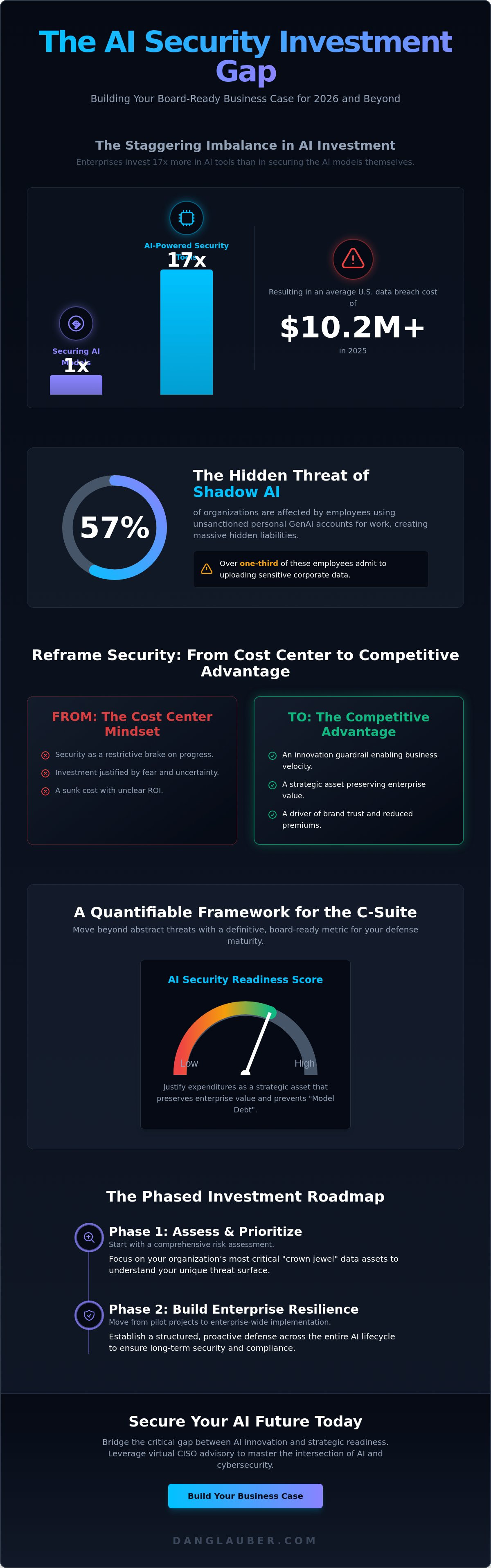
Enterprises are currently investing 17 times more in AI-powered security tools than in securing the very AI models those tools rely on. This staggering disparity creates a critical vulnerability on the digital battlefield, especially as the average cost of a U.S. data breach exceeded $10.2 million in 2025. Building a definitive business case for AI security investment is no longer a technical hurdle; it's a strategic mandate for any leader aiming to survive the EU AI Act’s phase two transparency requirements effective August 2, 2026. You're likely exhausted by stakeholder fatigue and the difficulty of quantifying the risks of shadow AI, which currently affects 57% of organizations.
I'll show you how to master the frameworks required to justify your security budget by aligning adversarial AI risks with core enterprise business value. We’ll move beyond abstract threats to provide board-ready arguments and a repeatable valuation model for your digital defense. You'll gain a comprehensive preview of how to bridge the gap between AI innovation and strategic readiness, ensuring your organization captures a share of the $2.52 trillion global AI market without compromising its foundational security principles.
Key Takeaways
- Reframe AI security as a prerequisite for business velocity rather than a restrictive cost center, establishing it as a critical innovation guardrail.
- Utilize the "AI Security Readiness Score" to provide the Board with a quantifiable and definitive measure of enterprise defense maturity.
- Learn to build a compelling business case for AI security investment by aligning technical adversarial risks with the CFO’s focus on operational resilience.
- Establish a structured, two-phase roadmap starting with a comprehensive risk assessment of your organization’s most critical "crown jewel" data assets.
- Discover how virtual CISO advisory provides the strategic expertise needed to master the intersection of AI and cybersecurity while bridging the current talent gap.
The Strategic Imperative: Why AI Security is the Foundation of 2026 Business Velocity
AI security investment isn't a brake on progress; it's the innovation guardrail that allows the enterprise to accelerate without catastrophic failure. In the 2026 market, business velocity is tethered to the integrity of your neural networks. If you can't secure the model, you can't deploy the service. This realization is the cornerstone of any modern business case for AI security investment. We've moved past the era of experimental pilots into a phase of industrial-scale deployment where the "cost of doing nothing" is measured in eight-figure data breaches. Mastery of this domain is now the prerequisite for strategic survival.
The current "Shadow AI" crisis exacerbates these risks and creates immediate financial exposure. Data gathered through November 2025 reveals that 57% of employees use personal GenAI accounts for work, with one-third admitting to uploading sensitive corporate information to unsanctioned tools. These unauthorized LLMs create hidden liabilities that bypass traditional perimeter defenses. Adversarial AI serves as the primary disruptor of traditional security ROI, as it weaponizes the very models designed to enhance productivity. While 2025's frameworks often focused on reactive patching, the 2026 landscape demands a proactive mastery of the entire AI lifecycle to maintain enterprise resilience.
The Digital Battlefield: Offensive vs. Defensive AI
Attackers have already weaponized LLMs to automate social engineering and discover zero-day vulnerabilities at a rate that human analysts cannot match. In May 2026, the collaboration known as Project Glasswing highlighted how AI-powered models like "Mythos" are identifying long-standing software flaws with surgical precision. Traditional signature-based defenses are now obsolete against these generative threats. We must position security as the strategic enabler. By securing the data pipeline, you allow the business to deploy AI-driven products faster than competitors who remain paralyzed by unmanaged risk and escalating attack vectors.
From Cost Center to Competitive Advantage
Robust security posture is now a primary driver of brand trust in an AI-saturated market. Organizations that demonstrate definitive control over their data provenance and model integrity gain a distinct edge in customer acquisition. This isn't just about optics; it's about the bottom line. Implementing a Cybersecurity in the Age of Artificial Intelligence: A Strategic Framework for 2026 significantly reduces cyber insurance premiums and mitigates regulatory friction from the EU AI Act’s phase two requirements. By treating security as a value-add, you transform it from a sunk cost into an engine for sustainable, high-velocity growth.
Quantifying the Risk: An Actionable Framework for AI Security Valuation
Securing a budget requires moving beyond fear and into the domain of measurable financial impact. To achieve this, I recommend implementing the "AI Security Readiness Score." This metric provides the Board with a definitive snapshot of maturity across critical domains like neural network integrity and data provenance. It transforms abstract technical anxiety into a structured foundation for a robust business case for AI security investment. By standardizing these metrics, leaders can justify expenditures not as insurance, but as a strategic asset that preserves enterprise value. The window for hesitation is closing.
The deployment of AI without integrated security creates "Model Debt," a compounding liability that increases the cost of future remediation and heightens the risk of model theft or data poisoning. To counter this, organizations are adopting the AI Risk-Adjusted Return (ARAR) as the new gold standard for investment. The ARAR is the net return on an AI project after subtracting the quantified financial exposure of its associated attack vectors. It's the only way to ensure that innovation doesn't inadvertently become a fiscal liability.
The AI Security ROI Formula
Calculating the return involves three primary pillars of value creation. Direct savings are now clearly documented; according to WEF data from May 2026, organizations using AI extensively in security operations shortened breach times by 80 days and reduced average costs by $1.9 million. Indirect gains are found in increased developer velocity, where secure AI-assisted coding environments eliminate the need for late-stage security refactoring. Finally, risk avoidance involves quantifying the prevention of LLM prompt injection attacks, which protects the enterprise from unauthorized data exfiltration and reputational collapse. For executives seeking to refine these variables, an Executive AI Strategy Workshop can help isolate the specific drivers unique to your industry vertical.
Assessing the "Cost of Inaction"
The speed of AI-driven attacks now far outpaces human-led response times. In April 2026, Chubb reported that the average cost of a U.S. data breach exceeded $10.2 million. Beyond the immediate financial hit, regulatory penalties for non-compliant AI deployments are reaching a critical threshold. The EU AI Act phase two requirements, effective August 2, 2026, and Colorado's AI Act, arriving June 30, 2026, mandate rigorous risk management for high-risk systems. Failure to comply leads to algorithmic discrimination claims and significant statutory fines. Understanding these stakes is essential when AI and Cybersecurity: Navigating the Strategic Frontier in 2026 becomes the focal point of your digital defense strategy.
Aligning the C-Suite: Tailoring the AI Security Business Case for Stakeholders
A successful business case for AI security investment is not a one-size-fits-all presentation. It's a strategic briefing tailored to the specific anxieties and objectives of each executive stakeholder. While the CISO sees attack vectors, the CFO sees balance sheets, and the Board sees fiduciary liability. Mastery of these diverse perspectives is what distinguishes a visionary leader from a technical manager. To win approval, you must translate technical risk into the language of enterprise value and operational resilience.
The CTO often views security as a friction point that stalls the development roadmap. You must shift this perception by positioning security as a catalyst for AI velocity. Without robust guardrails, the deployment of high-risk systems-such as those used in healthcare or lending-will be indefinitely delayed by legal and ethical reviews. Security provides the "Zero-Trust Architecture" that makes autonomous, agentic AI safe to deploy. It ensures that the innovation pipeline remains open by preventing the catastrophic model failures that lead to total project shutdowns.
The CFO Perspective: Capitalizing Security Innovation
CFOs prioritize "Operational Resilience" and the suppression of "Technical Debt." They view unsecured AI as a compounding liability that will eventually default. Shifting security from a heavy capital expenditure (CapEx) to a flexible operational expense (OpEx) through models like vCISO advisory allows for fiscal agility. This approach reduces the total cost of ownership (TCO) for enterprise data. By integrating security early, you avoid the massive remediation costs associated with model retraining or data cleaning after a poisoning event. Prudence dictates that we treat security as a foundational investment rather than a discretionary add-on.
Board-Level Governance and AI Ethics
For the Board, the focus is "Fiduciary Duty" and "AI Governance." With the EU AI Act's transparency requirements taking effect on August 2, 2026, and Colorado's AI Act following on June 30, 2026, AI oversight is now a legal mandate. Boards increasingly categorize AI security as a core component of ESG (Environmental, Social, and Governance) reporting. They must understand how Cyber Security Firms: A Strategic Guide for Board-Level Risk Management in 2026 protect the organization’s reputation and mitigate algorithmic discrimination. Addressing the Board requires a shift from technical jargon to a focus on long-term institutional stability and regulatory compliance.
Common objections often center on timing and cost. To those claiming it's "too early," point to California's AB 2013, which already requires documentation on training data as of January 1, 2026. The regulatory battlefield is already active. To those who argue it's "too expensive," contrast the investment with the $2.52 trillion global AI market. The cost of securing these assets is a fraction of the value they generate, making the investment a logical necessity for any growth-oriented enterprise.
The Phased Investment Roadmap: From Pilot to Enterprise Resilience
Transitioning from a reactive posture to a state of strategic readiness requires a methodical, four-phase execution plan. This roadmap serves as the technical backbone of your business case for AI security investment, ensuring that capital is allocated where it generates the highest defensive yield. We begin with Phase 1: The AI Risk Assessment. This intelligence-gathering stage focuses on identifying the "Crown Jewels" of enterprise data, such as proprietary training sets or customer PII, which are now prime targets for model theft and data poisoning.
Phase 2 involves securing the foundation through Zero-Trust Architecture. By May 2026, the industry has moved beyond simple firewalls to granular, identity-based access controls for every AI model interaction. Phase 3 introduces AI-Augmented Defense. Here, we deploy neural networks specifically tuned for anomaly detection to identify adversarial patterns in real-time, aligning with NIST’s May 2026 shift toward risk-based vulnerability enrichment. Finally, Phase 4 establishes Continuous Governance. This involves automated auditing of model outputs to ensure compliance with the transparency rules mandated by the EU AI Act.
Prioritizing High-Impact Use Cases
Strategic allocation of resources dictates that securing customer-facing LLMs must take precedence over internal research tools. The reputational risk of a public-facing prompt injection is far higher than a contained internal leak. We should focus on "Low-Hanging Fruit" such as automated patch management. Following Oracle’s May 2026 shift to monthly Critical Patch Updates, using AI to streamline this process is essential for maintaining a "Security First" culture among developers. It’s about building resilience into the development lifecycle from day one.
Measuring Success and Iterating
Quantifying progress is vital for maintaining Board support. We track two primary KPIs: Time to Detection (TTD) and Time to Remediation (TTR). Organizations that have mastered the intersection of AI and security typically see a significant reduction in TTR compared to traditional methods. These metrics should be the center of your quarterly business reviews to prove the ongoing value of your business case for AI security investment. If your internal team lacks the bandwidth to execute this roadmap, you should consider The Executive Guide to Hiring an AI Cybersecurity Consultant in 2026 to accelerate your deployment.
For personalized guidance on building your roadmap, I invite you to explore my Board-Level Cybersecurity Briefings to align your technical strategy with long-term enterprise goals.
Securing the Future: Leveraging Strategic Advisory to Execute Your AI Security Business Case
A finalized business case for AI security investment is merely a theoretical document until it's activated by specialized leadership. The digital battlefield of 2026 doesn't forgive execution gaps. Bridging the divide between high-level technical complexity and tangible business risk requires an expert practitioner who understands the nuances of neural network vulnerabilities and adversarial tactics. Strategic advisory serves as the definitive bridge, transforming your investment from a line item into a resilient defense strategy that commands respect in the boardroom.
Navigating the intersection of AI and cybersecurity is a journey of continuous adaptation. My frameworks, backed by over 50 real-world case studies, provide the structured guidance necessary for organizations to achieve mastery in this era. Engaging an AI cybersecurity consultant ensures that your defensive posture evolves at the same velocity as the threats. It's about moving from a state of potential vulnerability to one of strategic readiness, where every AI deployment is protected by a rigorous, foundation-to-application security architecture.
The vCISO Advantage in the Age of AI
The global talent gap in specialized AI security remains a primary hurdle for most enterprises. A virtual CISO (vCISO) offers the most cost-effective way to secure on-demand expertise for AI risk assessments and architecture reviews without the overhead of a full-time executive hire. This model provides board-level reporting that translates technical jargon into clear business value. By leveraging Virtual CISO Consulting Services: The 2026 Executive Guide to Strategic Security Leadership, you scale your security leadership in alignment with your AI adoption curve, ensuring that fiduciary duties are met while maintaining innovation speed.
Next Steps: Workshops and Keynotes
Empowering your leadership team is the final component of a successful AI security strategy. Executive AI Strategy Workshops provide a controlled environment to stress-test your assumptions and refine your governance frameworks. For larger organizations, a high-impact keynote engagement sets the tone for a "Security First" culture, aligning the entire workforce with the strategic imperative of digital defense. These engagements move the needle from awareness to action, providing the actionable insights needed to navigate the complexities of the Colorado AI Act and the EU AI Act with confidence. Your journey toward mastery starts with a single, decisive step toward expert-led advisory.
Mastering Strategic Readiness in the Age of AI
The digital battlefield of 2026 demands more than simple awareness; it requires the definitive mastery of actionable frameworks. The $10.2 million average breach cost from 2025 proves that inaction is a fiscal impossibility for the modern enterprise. By aligning your technical roadmap with the fiduciary requirements of the EU AI Act’s August 2, 2026, deadline, you transform security from a friction point into a competitive engine. Finalizing a robust business case for AI security investment is the first step toward reclaiming control of your enterprise neural networks and data provenance.
Bridging the gap between technical complexity and board-level strategy is my specialty. With 30+ years of technology and innovation experience and a track record as a vCISO advisor for global organizations, I help leaders navigate the intersection of AI and cybersecurity. As the author of "Cybersecurity in the Age of Artificial Intelligence," I provide the strategic depth your organization needs to thrive. Book a Strategic Advisory Session with Dr. Daniel Glauber to secure your innovation guardrails today. Your path to enterprise resilience is ready for execution.
Frequently Asked Questions
What is the primary driver for a business case for AI security investment?
The primary driver is the necessity to maintain business velocity while meeting stringent international compliance mandates. For example, California’s Automated Decision-Making Technology regulations, which went into effect on January 1, 2026, require businesses to provide opt-out options for significant decisions. A strong business case for AI security investment ensures that these legal hurdles don't stall your innovation pipeline. It's about transforming risk into a documented strategic advantage.
How much should an organization budget for AI-specific security?
While specific numbers vary by sector, Gartner’s March 2026 report indicates that global information security spending has reached $244.2 billion. Organizations should address the current disparity where they invest 17 times more in AI tools than in the security required to protect them. Budgeting should prioritize "crown jewel" data protection and the implementation of Zero-Trust Architecture to ensure long-term model integrity and operational resilience across all critical domains.
Can traditional cybersecurity software protect against AI-driven attacks?
Traditional signature-based defenses are largely obsolete against the generative threats seen in the 2026 digital battlefield. These legacy systems cannot identify the subtle patterns of data poisoning or prompt injection attacks that target neural networks directly. New models like "Mythos," announced in May 2026, demonstrate how AI-powered vulnerability discovery requires equally sophisticated, AI-native defensive countermeasures to maintain a state of strategic readiness and mastery.
What are the biggest risks of not investing in AI security in 2026?
The most severe risks include catastrophic data breaches, which averaged over $10.2 million in 2025, and massive statutory fines. Non-compliance with the EU AI Act’s phase two requirements, effective August 2, 2026, can lead to severe penalties for high-risk systems. Organizations also face "Model Debt," where the cost of fixing unsecured AI systems later far exceeds the initial investment in proactive, definitive security frameworks and actionable governance.
How do I explain Adversarial AI to a non-technical board member?
Explain it as "weaponized machine learning" where attackers use AI to exploit vulnerabilities in your own models. It's a digital battlefield where software doesn't just fail; it's manipulated to reveal secrets or make biased decisions. Frame it as a threat to the organization's fiduciary duty. This approach makes the technical complexity accessible to board members who prioritize risk management and long-term governance over high-level technical jargon.
Is a vCISO better than a full-time CISO for AI security strategy?
A vCISO is often the most cost-effective way to bridge the specialized AI security talent gap without the overhead of a full-time hire. This model provides on-demand strategic mastery for AI risk assessments and board-level briefings. It allows the organization to scale its security leadership in direct proportion to its AI adoption, ensuring that the business case for AI security investment remains grounded in actionable, expert-led strategy.
How does AI security investment impact cyber insurance coverage?
Cyber insurance carriers in 2026 are increasingly making specific AI security controls a mandatory condition for coverage. Organizations that cannot demonstrate robust model governance and data provenance face higher premiums or total denial of claims. Investing in AI-specific security proves to underwriters that you've mitigated the unique risks of neural networks, directly improving your insurability and reducing the total cost of risk for the enterprise.
What is the "Shadow AI" crisis and how does it affect the business case?
The Shadow AI crisis refers to the 57% of employees using unsanctioned GenAI tools for work, often uploading sensitive corporate data. This creates "hidden liabilities" that bypass traditional perimeter defenses and create immediate regulatory friction. It strengthens the business case by highlighting an existing, unmanaged risk that already threatens the enterprise. Addressing Shadow AI is the "low-hanging fruit" that demonstrates immediate ROI for any strategic security investment.