

What if the most critical vulnerability in your digital battlefield isn't a sophisticated neural network attack, but a CFO who views your department as a bottomless cost center? You've likely experienced the exhaustion of budget fatigue while attempting to justify essential spend in an era where global cybercrime costs are projected to reach $10.5 trillion by the end of 2026. It's a common struggle to articulate why the organization needs groundbreaking AI-driven countermeasures when the board only sees a growing list of expenses rather than a strategic insurance policy for the enterprise.
You can master the art of how to get executive buy-in for security budget by translating complex technical risks into definitive business outcomes. This article provides a repeatable 2026 strategic framework designed to bridge the gap between technical mastery and fiscal reality. We'll examine how to leverage the latest NIST CSF 2.0 governance standards and upcoming CIRCIA reporting mandates to secure necessary funding, build a stronger partnership with your financial leadership, and position your security infrastructure as a primary driver of organizational resilience.
Key Takeaways
- Replace fear-based tactics with Cyber Risk Quantification to translate abstract threats into definitive financial impact for the board.
- Secure a specialized budget line for AI-driven countermeasures to defend against the emerging threat of Adversarial AI and neural network exploits.
- Learn exactly how to get executive buy-in for security budget by utilizing a stakeholder pre-mortem and aligning every spend with the CEO’s top strategic priorities.
- Leverage Virtual CISO leadership to maintain consistent board-level communication and transform one-time approvals into a sustainable, long-term security strategy.
The 2026 Budget Crisis: Why Traditional Security Pitches Fail
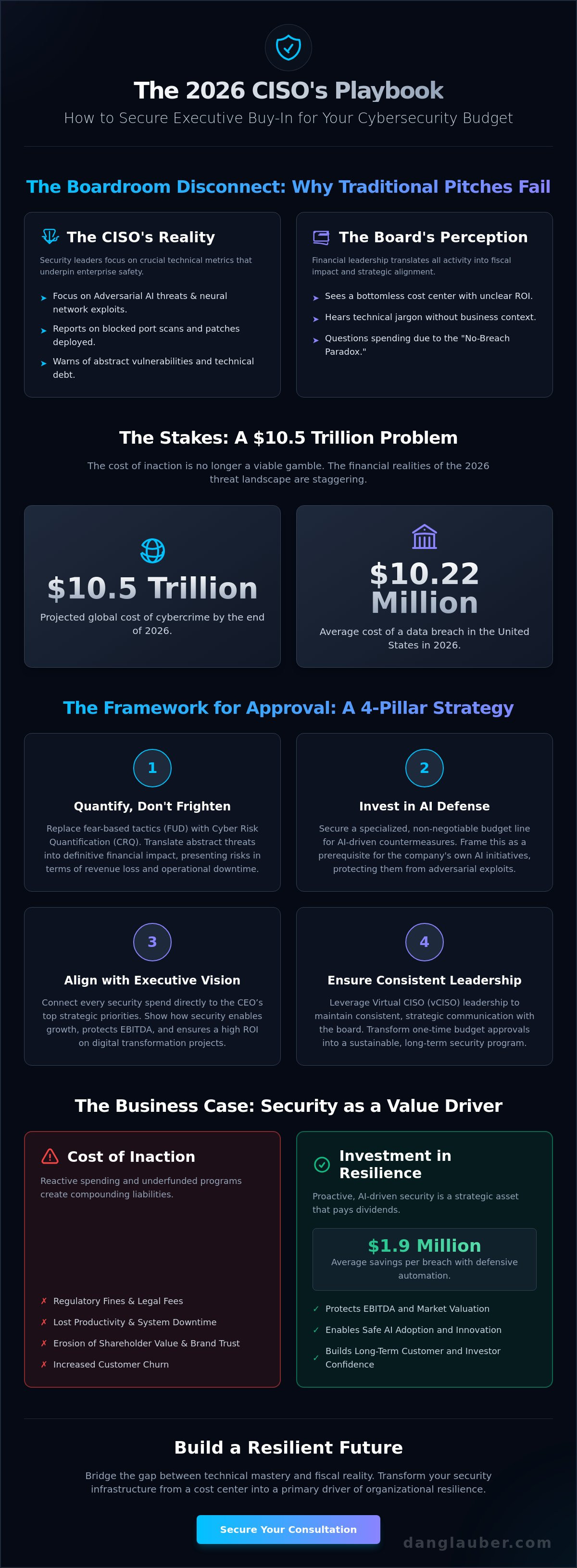
The digital battlefield of 2026 has rendered yesterday's funding strategies obsolete. Many security leaders currently face the "No-Breach Paradox," where a period of sustained safety is used by the board as justification to slash future resources. This creates a dangerous vulnerability; executives often mistake a lack of visible incidents for a lack of active threat. Relying on Fear, Uncertainty, and Doubt (FUD) no longer works. Modern boards are immune to alarmism; they demand data-driven mastery over their risk landscape rather than vague warnings of impending doom.
Success in this environment requires a definitive shift from simple perimeter defense toward an AI-resilient architecture. This transition isn't just a technical upgrade but a fundamental change in how we perceive enterprise protection. Strategic Security Alignment is the intentional bridge that connects technical defensive measures directly to the C-suite’s overarching fiscal objectives. Understanding this connection is the first step in learning how to get executive buy-in for security budget in an era where adversarial AI has become the new baseline for global threats.
The Gap Between Technical Risk and Business Value
A CFO doesn't care about the number of patches deployed or the volume of blocked port scans. To the financial leadership, these are technical metrics that lack strategic context. To bridge this gap, you've got to translate technical debt into financial liability. When you present risk, frame it through the NIST Cybersecurity Framework to provide a standardized, board-recognized structure. Engaging with elite cyber security firms can help validate these external threats, turning abstract vulnerabilities into quantified operational risks that demand immediate investment.
The Evolving Role of the Modern Security Leader
The 2026 CISO has evolved from a "No-Man" into a strategic business enabler. You're no longer just protecting data; you're protecting EBITDA and ensuring a high ROI on digital transformation initiatives. If you want to know how to get executive buy-in for security budget, you must position security as a mandatory prerequisite for AI adoption. Without robust countermeasures, the organization's AI initiatives are built on sand. By aligning security with corporate growth, you move from being a cost center to a vital component of the corporate ecosystem, ensuring your department is seen as a driver of resilience rather than a drain on capital.
Translating Technical Risk into Business Value Frameworks
The board doesn't speak in vulnerabilities; they speak in volatility. Learning how to get executive buy-in for security budget requires a definitive shift from technical reporting to Cyber Risk Quantification (CRQ). This model assigns a specific dollar value to every potential threat, allowing you to present the digital battlefield in terms of financial exposure. By translating abstract neural network attacks into potential revenue loss, you provide the CFO with the structured data necessary to make an informed investment decision.
Mastery of this translation process involves aligning your security objectives with established corporate KPIs such as system uptime, customer retention, and brand trust. By utilizing the cybersecurity in the age of artificial intelligence framework, you can project future costs and demonstrate how defensive automation leads to an average savings of $1.9 million per breach. In the modern economic landscape, a firm's cyber resilience profile directly correlates to its market valuation, serving as a definitive indicator of long-term operational viability.
Quantifying the Cost of Inaction
Modeling the total cost of a breach is essential for illustrating the gravity of the current threat landscape. While remediation is expensive, the true financial liability lies in regulatory fines, lost productivity, and the erosion of shareholder value. With the average cost of a data breach in the United States reaching an all-time high of $10.22 million in 2026, the "cost of doing nothing" is no longer a viable gamble. You'll find the logic for these calculations in NIST's Guide to Managing Information Security Risk, which provides the foundational logic for board-level risk discussions. Proactive virtual ciso consulting services offer a structured path to mastery that costs significantly less than the chaotic, unbudgeted expenses of emergency incident response.
Security as a Competitive Advantage
Robust security isn't just a defensive shield; it's a business accelerator that enables faster product launches and aggressive digital expansion. When your organization adopts Zero-Trust architectures, it reduces long-term operational friction and signals to high-value B2B partners that your enterprise is a safe harbor for their data. This positioning transforms security from a perceived bottleneck into a "trust signal" that wins contracts. For leaders seeking to refine these metrics further, attending executive AI strategy workshops can help you articulate these advantages to your board with precision and authority. Demonstrating how to get executive buy-in for security budget becomes significantly easier when you prove that a secure infrastructure is the primary engine for sustainable growth.
The AI Multiplier: Justifying the 2026 Security Spend
The 2026 fiscal year demands a radical departure from traditional line-item grouping. You can't simply bury artificial intelligence expenses within a general IT or security bucket and expect to maintain a definitive defense. Learning how to get executive buy-in for security budget in this era requires presenting a dedicated "AI Security" category that addresses the unique attack vectors of neural network exploits. The Intersection of AI and Cybersecurity stands as the primary strategic frontier; it's where the next generation of enterprise value will be won or lost.
Adversarial AI has become the new baseline for enterprise protection. With AI-powered phishing expected to account for over 42% of all global intrusions by the end of 2026, the speed of incoming threats has outpaced human-centric response capabilities. Investing in AI-driven SOC automation isn't just about modernization; it's a fiscal necessity. Statistics show that organizations deploying security AI and automation save an average of $1.9 million per breach. By reducing the Mean Time to Detect (MTTD) from the current average of 181 days, you directly mitigate the catastrophic financial bleed associated with prolonged containment cycles.
Budgeting for Generative AI Risks
The rise of "Shadow AI" creates a hidden battlefield within your own walls. When employees utilize unsanctioned LLMs, they expose sensitive corporate data to the public domain, creating a visibility gap that costs significant capital to close. You must justify the cost of specialized AI risk assessments to maintain data privacy compliance. A robust ai and cybersecurity synergy ensures that your organization doesn't just adopt innovation, but does so within a framework of strategic readiness.
Efficiency Gains Through Security Automation
The 2026 shift marks a transition from high-headcount manual labor to high-utility smart hardware and software. Instead of requesting a massive increase in personnel to manage thousands of daily alerts, focus your pitch on the scalability of automated countermeasures. These tools don't just work faster; they work with a level of precision that manual processes can't match. Engaging an ai cybersecurity consultant can help you optimize your toolset spend, ensuring you aren't overpaying for redundant features. This approach proves how to get executive buy-in for security budget by demonstrating a clear path to long-term operational efficiency and reduced human error.
Building the Business Case: A Step-by-Step Execution Plan
Securing funding in the 2026 digital battlefield requires more than a technical justification; it demands a tactical operation. You can't walk into a boardroom expecting approval based on technical merit alone. To master how to get executive buy-in for security budget, you must execute a structured pre-meeting strategy that neutralizes objections before they're even voiced. This process begins with a "Pre-Mortem" where you sit down with key stakeholders in finance and legal to ask a single, provocative question: "If we were to deny this budget today and suffer a breach tomorrow, what would be the primary reason we hesitated?" This identifies the specific friction points you need to address in your final pitch.
Your execution plan should follow these five definitive steps:
- Map initiatives to the "Big Three": Identify the CEO's top three strategic goals for 2026 and demonstrate how every security dollar protects those specific revenue streams.
- Implement a Tiered Investment Model: Present three options—Minimum (compliance only), Recommended (resilience), and Strategic (competitive advantage). This shifts the conversation from "Yes/No" to "How much protection do we want?"
- Demonstrate the Value of Time: Use tabletop exercises to show that while the average breach containment takes 60 days, AI-driven countermeasures can reduce this window significantly, preventing the $10.22 million average cost of a U.S. data breach.
- Secure a Champion: You need an ally in the finance department who understands that security is a capital investment in organizational longevity rather than a recurring expense.
The Board-Level Briefing: Less is More
Board members are often overwhelmed by technical jargon. Avoid the "Technical Deep Dive" trap and focus entirely on the Executive Summary. Your pitch should consist of exactly three slides: the current risk-to-revenue landscape, the AI capability gap, and the roadmap to mastery. When asked the inevitable trap question—"Is this 100% secure?"—don't provide a false guarantee. Instead, explain that security is a disciplined practice of risk management and resilience, ensuring the enterprise can withstand and recover from the inevitable evolution of neural network threats.
Using External Validation to Close the Deal
External data provides the professional urgency required to move a hesitant board. Leverage industry benchmarks and peer-group spending data to show where the organization stands in the global ecosystem. Third-party audits act as a definitive proof point, validating your internal assessments with an objective lens. By incorporating case studies and expert insights from Dr. Glauber’s research, you ground your request in real-world application rather than abstract theory. To refine your presentation strategy further, consider scheduling Board-Level Cybersecurity Briefings to ensure your leadership team is fully aligned with the realities of the 2026 threat landscape. This level of preparation is the definitive answer to how to get executive buy-in for security budget in a high-stakes environment.
Securing the Future: Executive Advisory and vCISO Leadership
Winning the budget battle is a significant milestone, but it's merely the first engagement in a much larger campaign. Once you've mastered how to get executive buy-in for security budget, the challenge shifts toward execution and the maintenance of board-level trust. Executives don't just want to see where the money went; they want to see how that capital has measurably hardened the enterprise against the evolving digital battlefield. This is where the transition from a one-time funding win to a sustainable security culture begins. You've got to prove that the investment is actively reducing volatility and enabling the organization's broader ambitions.
A Virtual CISO (vCISO) Advisory role is the definitive solution for maintaining this momentum. By providing consistent, high-level guidance, a vCISO ensures that the security roadmap remains aligned with shifting corporate priorities. They act as a strategic translator, keeping the CFO informed of the strategic ROI while ensuring the technical team remains focused on critical domains. This ongoing leadership prevents the "budget fatigue" that often sets in when security is treated as a series of disconnected emergencies rather than a core business discipline. It's about moving from a reactive stance to one of mastery and preparedness.
Executive AI Strategy Workshops are another powerful tool for long-term alignment. These sessions move beyond technical jargon to show skeptics how robust security is the primary engine for safe AI adoption. When leaders see the direct connection between neural network protection and their own innovation targets, they stop being obstacles and start being advocates. This cultural shift is essential for ensuring that future budget requests are met with partnership rather than resistance, as the board begins to view the security team as a vital business enabler.
Leveraging Dr. Glauber’s Strategic Frameworks
Actionable frameworks are what distinguish a visionary leader from a reactive one. By bridging the gap between high-level theory and enterprise strategy, Dr. Glauber’s methods provide a curriculum for mastery in a rapidly evolving field. A vCISO retainer offers a consistent strategic ROI by embedding this expertise directly into your leadership structure, ensuring you're always ahead of the curve. For those needing a foundational primer, the "Cybersecurity in the Age of AI" book serves as an essential guide, outlining the comprehensive chapters needed to navigate the Intersection of AI and Cybersecurity with confidence.
Conclusion: Building a Cyber-Resilient Future
In 2026, the mandate is clear: security is no longer an optional add-on; it's the foundation upon which all modern innovation is built. The frameworks we've discussed provide the roadmap for how to get executive buy-in for security budget, but the final step is yours to take. Moving your organization from a state of potential vulnerability to one of strategic readiness requires decisive action, expert mentorship, and a commitment to data-driven insights over hype. The digital battlefield doesn't wait for the unprepared; it's time to secure your organization's future with a definitive, board-aligned strategy.
Don't wait for the next incident to justify your spend. Engage Dr. Daniel Glauber for an Executive AI Strategy Workshop and start your journey toward definitive executive alignment today.
Mastering the Strategic Frontier
Transitioning from a technical cost center to a strategic business enabler is the definitive challenge for the 2026 security leader. Success lies in translating abstract attack vectors into quantified financial liabilities and aligning every countermeasure with the CEO's primary growth targets. By implementing a tiered investment model and utilizing a stakeholder pre-mortem, you provide the board with the structured logic they require to approve critical funding. Understanding how to get executive buy-in for security budget isn't just about winning a single meeting; it's about establishing a culture of resilience that supports long-term innovation.
Navigating the intersection of AI and cybersecurity requires an advisor who has spent decades on the digital battlefield. With over 30 years of technology innovation expertise and as the author of the definitive guide, Cybersecurity in the Age of AI, Dr. Daniel Glauber serves as a trusted board-level advisor for global enterprises. Don't leave your organization's defense to chance. Secure your organization’s future with an Executive AI Strategy Workshop with Dr. Daniel Glauber. You have the frameworks and the strategy; now it's time to lead your enterprise toward total mastery.
Frequently Asked Questions
How do I calculate cybersecurity ROI for a budget request?
ROI in security is calculated as the "Expected Loss Prevented" minus the "Cost of the Security Investment." You've got to use the 2026 average U.S. breach cost of $10.22 million as your baseline for these discussions. By demonstrating how a specific tool reduces the probability or financial impact of a breach, you transform a technical expense into a quantifiable financial gain for the board.
What is the best way to explain "Zero-Trust" to a non-technical CEO?
Explain Zero-Trust as a "never trust, always verify" digital ecosystem where identity is the new perimeter. Instead of a castle with a moat, it's like a high-security office where every door requires a unique badge swipe, regardless of who is walking through. This approach minimizes the lateral movement of threats and ensures that a single compromised credential doesn't lead to a total enterprise collapse.
How much of the IT budget should be dedicated to security in 2026?
Industry benchmarks for 2026 suggest that high-growth enterprises should allocate between 12% and 15% of their total IT budget specifically to cybersecurity. Organizations in highly regulated sectors, such as healthcare or finance, often see this number rise toward 20% to account for increased compliance mandates like CIRCIA. This ensures a definitive balance between operational innovation and the necessary countermeasures to protect those digital assets.
What happens if the board rejects the security budget?
If the board rejects your proposal, you must formally document the "Risk Acceptance" by the leadership team. This isn't a gesture of defiance; it's a professional necessity to ensure the board understands exactly which threats remain unmitigated. Use this as an opportunity to refine your approach on how to get executive buy-in for security budget by asking for specific feedback on their fiscal priorities and risk tolerance.
How do I justify the cost of an AI-driven security tool?
Justify AI-driven tools by highlighting the $1.9 million average savings per breach realized by organizations using security automation in 2026. Emphasize that these tools handle the massive volume of attack vectors that human teams simply can't process manually. Positioning AI as a "force multiplier" allows you to demonstrate how the tool reduces Mean Time to Containment (MTTC) and prevents the need for exponential headcount growth.
Is a vCISO more cost-effective than a full-time hire for budget planning?
A vCISO is often more cost-effective for strategic planning because they provide board-level expertise without the overhead of a full-time executive salary and benefits. They offer a definitive advantage by bringing cross-industry insights and proven frameworks to your budget process. This allows your organization to access high-level advisory services exactly when you're navigating complex intersections of AI and security, ensuring maximum strategic ROI.
How can I use tabletop exercises to get executive buy-in?
Tabletop exercises create a controlled sense of urgency by forcing executives to navigate a simulated breach in real-time. When a CEO experiences the pressure of a 72-hour CIRCIA reporting deadline during a mock ransomware attack, the need for funding becomes visceral rather than abstract. These sessions bridge the gap between technical risk and business reality, making the justification for groundbreaking countermeasures undeniable and urgent.
What are the top 3 metrics boards care about in security reports?
Boards primarily care about Cyber Risk Quantification (the dollar value of current exposure), Compliance Status (readiness for mandates like CMMC 2.0), and Operational Resilience (Mean Time to Recover). To master how to get executive buy-in for security budget, your reports must move away from technical jargon. Focus instead on how these three metrics impact the organization’s market valuation and its ability to maintain uninterrupted business operations.