

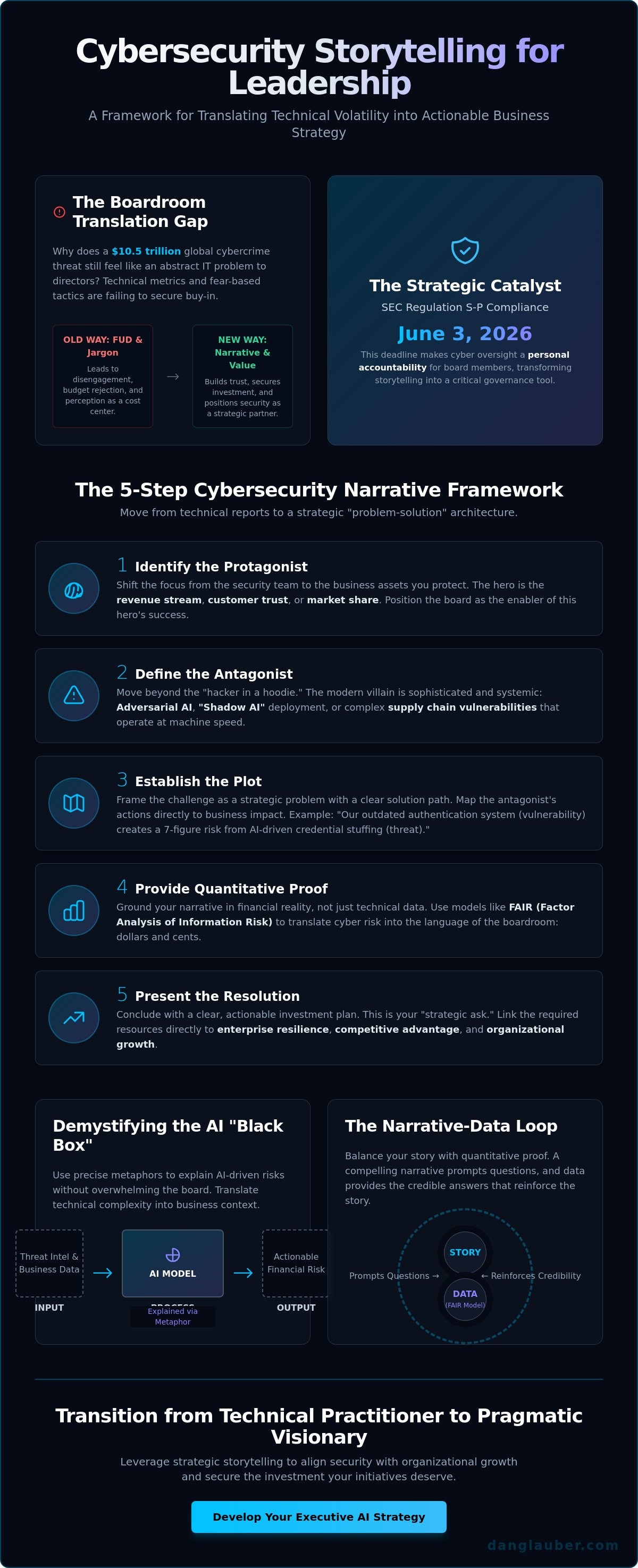
The SEC’s amended Regulation S-P compliance deadline of June 3, 2026, has fundamentally shifted the digital battlefield into the boardroom, making directors personally accountable for cyber oversight. Yet, many security leaders still watch their most critical AI initiatives die during briefings because of a persistent translation gap. Why does a $10.5 trillion global cybercrime threat feel like an abstract IT problem rather than a fiduciary crisis? Mastering cybersecurity storytelling for leadership is the definitive way to transform technical volatility into actionable business strategy that directors respect and fund.
You likely recognize the frustration of presenting a groundbreaking defense strategy only to have it met with disengagement or budget rejection. It's exhausting to be viewed as a cost center when you're actually the architect of enterprise resilience. This article provides the strategic framework you need to bridge the gap between neural networks and net profit. We'll explore how to translate the intersection of AI and cybersecurity into compelling narratives that secure board buy-in and position you as a visionary partner in the C-suite.
Key Takeaways
- Shift your strategy from fear-based reporting to a value-driven narrative by identifying business protagonists and adversarial AI antagonists.
- Demystify the "Black Box" of machine learning using precise metaphors that explain AI-driven risks without losing technical credibility.
- Implement the Narrative-Data Loop to ground your story in quantitative proof, using the FAIR model to provide a rigorous subplot for your strategic vision.
- Learn the five-step framework for cybersecurity storytelling for leadership to secure board buy-in and drive investment in high-stakes security initiatives.
- Transition from a technical practitioner to a pragmatic visionary by leveraging Executive AI Strategy Workshops to align security goals with organizational growth.
The Strategic Imperative of Cybersecurity Storytelling for Leadership
Cybersecurity is no longer a localized IT concern relegated to the basement server room. It's a definitive pillar of corporate survival. In the digital battlefield of 2026, cybersecurity storytelling for leadership is the strategic translation of technical telemetry into high-stakes business impact narratives. Traditional tactics like "Fear, Uncertainty, and Doubt" (FUD) have lost their potency in the modern boardroom. Directors are exhausted by alarmism; they demand mastery and strategic readiness. They don't want to hear that the sky is falling. They want to know how you've reinforced the foundations to withstand the storm.
The primary narrative challenge we face today exists at the Intersection of AI and Cybersecurity. With global cybercrime costs projected to hit $10.5 trillion this year, the stakes are too high for simple status updates. We're moving away from merely reporting on isolated security events. Instead, the modern leader must use story to guide strategic outcomes, transforming abstract threats into a roadmap for enterprise resilience. This shift requires a move from being a cost center to becoming a pragmatic visionary who protects the organization's most critical domains.
Why Technical Metrics Alone Fail the C-Suite
Security professionals often fall into the trap of the "Cognitive Load" problem. When you present a board with thousands of blocked attack vectors or patch latency percentages, their eyes glaze over. Raw data frequently obscures the digital battlefield rather than illuminating it. It hides the actual business risk behind a wall of jargon. Sensemaking is the strategic leader's ability to synthesize technical chaos into a shared understanding of business risk and opportunity. Without this bridge, your technical depth becomes a barrier to investment rather than a catalyst for it.
Storytelling as a Governance Tool
Effective narratives are now a requirement for regulatory compliance. With the SEC’s Regulation S-P deadline of June 3, 2026, personal accountability for board members is a legal reality. Storytelling allows you to align security initiatives with these strict governance standards. It builds a cyber-resilient culture from the top down by making the "why" as clear as the "how." Understanding The Strategic Imperative of Cybersecurity Storytelling helps bridge the gap between technical awareness and executive action.
In many organizations, the vCISO plays a pivotal role in crafting this "Master Narrative." By leveraging cybersecurity storytelling for leadership, an advisor can ensure that every security dollar spent is directly linked to a business outcome. This approach doesn't just secure a budget; it establishes a foundation of trust that allows the organization to innovate safely in the age of artificial intelligence.
How to Build a Cybersecurity Narrative Framework: 5 Actionable Steps
Creating a strategic narrative requires more than just a deck of slides. It demands a logical structure that mirrors the organized nature of a battle plan. To master cybersecurity storytelling for leadership, you must move beyond the "if/then" logic of technical alerts and adopt a "problem-solution" architecture. This framework allows you to ground abstract AI concepts in real-world applications that the Board can grasp immediately. By following a structured five-step process, you transform from a technical reporter into a strategic business partner who commands respect through depth of knowledge.
Step 1 & 2: Identifying Your Hero and Villain
In the digital battlefield, the protagonist of your story isn't the security team. It's the revenue stream or the customer trust that fuels the organization's growth. When you present your case, position the Board as the essential "Enabler" of this success rather than just the "Funder" of a cost center. The antagonist has also evolved. We've moved past the simplistic archetype of the lone hacker in a hoodie. Today's villain is often "Shadow AI" or sophisticated "Adversarial AI" that exploits systemic vulnerabilities at machine speed. In my framework, Cybersecurity in the Age of Artificial Intelligence, I identify these modern threat archetypes to help leaders visualize the invisible forces working against their fiduciary interests. Identifying the right villain ensures the Board understands the gravity of the revolutionizing cyber threats we face in 2026.
Step 3, 4 & 5: Building the Arc to a Decision
The stakes must be framed in terms the C-suite values. While operational downtime is a significant concern, the permanent erosion of brand equity is a fiduciary crisis. Balancing Story with Quantitative Proof ensures your narrative is grounded in the $10.5 trillion reality of global cybercrime. This is where you introduce your "Actionable Framework" as the resolution. Frame Zero-Trust Architecture not as a technical hurdle, but as the hero's protective shield that allows the business to innovate faster than the competition.
Finally, conclude with a clear strategic ask. This isn't just about budget; it's about policy alignment and strategic readiness. Frame the investment as a business opportunity to maintain market trust in a volatile environment. If your current narrative isn't landing, participating in Executive AI Strategy Workshops can help refine your organizational story for maximum impact. Each step of this arc must lead directly to a decision point, ensuring that your briefing results in action rather than just acknowledgement.
Translating AI Complexity into Boardroom Reality
Explaining neural networks to a board of directors is often a lesson in frustration. Traditional IT security followed a predictable "lock and key" logic, but AI introduces the "Black Box" problem. The logic within an AI model isn't always transparent, even to its creators. This opacity makes cybersecurity storytelling for leadership more critical than ever. You aren't just explaining a patch; you're explaining an evolving, autonomous system that can be turned against the organization. To succeed, you must act as a Chief Storytelling Officer, translating these opaque risks into the language of fiduciary responsibility.
Using metaphors is the most effective way to describe Adversarial AI without losing technical accuracy. Think of a prompt injection attack not as a code exploit, but as a "social engineering attack on a machine." You're tricking the system into ignoring its instructions. By grounding your narrative in these relatable concepts, you move the conversation away from the "how" of algorithms and toward the "so what" of AI governance. Based on my research involving 50+ real-world case studies, the boards that approve the largest security investments are those that view AI as a governance challenge, not a technical curiosity.
The 'Adversarial AI' Narrative
When you tell the story of a prompt injection, don't show a single line of code. Instead, describe a scenario where an external actor tricks your customer service bot into giving away proprietary data or authorizing a fraudulent refund. This frames AI risk as a next-gen cyber threat that demands strategic foresight rather than just technical countermeasures. AI-driven attacks accelerate the Cybersecurity OODA Loop by automating reconnaissance and exploitation, effectively shrinking the window for human intervention from days to mere seconds. This speed necessitates a shift toward automated, AI-driven defenses.
From 'Shadow AI' to Strategic Asset
Unmanaged AI usage across your departments creates what I call "Digital Debt." It's a high-interest liability that grows every time an employee uploads sensitive data to an unvetted large language model. You can position the Cybersecurity in the Age of Artificial Intelligence framework as your organization's roadmap to safety. Storytelling helps the Board see that security isn't a hurdle to AI adoption; it's the foundation that makes AI a strategic asset. If the complexity feels overwhelming, it may be time to use these narratives to justify the need for an AI cybersecurity consultant who can help refine your defense posture for 2026.
The Metrics of Narrative: Balancing Story with Quantitative Proof
A story without data is a fable; data without a story is noise. In the high-stakes environment of the boardroom, numbers require a narrative to become actionable. This is the essence of the Narrative-Data Loop. It's a mechanism that ensures cybersecurity storytelling for leadership remains grounded in mathematical reality. By using the Factor Analysis of Information Risk (FAIR) model as a quantitative subplot, you provide the analytical rigor that CFOs demand while maintaining the strategic resonance needed to drive organizational change. This dual-perspective approach transforms abstract cyber resilience metrics into a definitive scorecard for success.
A common objection from technical purists is whether storytelling is merely a sophisticated way to hide bad data. On the contrary, a well-constructed narrative exposes the gaps in your defense by providing the necessary business context. It transforms a "failed" metric into a "critical vulnerability" within the story arc, demanding immediate strategic resolution. Instead of masking weaknesses, the story highlights the urgency of addressing them to protect the organization's most critical domains.
Quantifying the Narrative Impact
Translating operational resilience into "Dollars at Risk" is the ultimate goal of this translation. You must show how your Actionable Frameworks are moving the needle from potential catastrophe to mastery. Regular Board-Level Cybersecurity Briefings act as chronological markers for your story. They track how the organization has moved from a state of vulnerability to one of strategic readiness. This consistency builds trust; it proves that the security strategy isn't a series of reactive patches but a disciplined, progressive curriculum of defense.
Visual Storytelling for the Board
Stop relying on static heat maps that only provide a snapshot of risk. These often fail to capture the dynamic nature of the digital battlefield. Instead, utilize "Journey Maps" to visualize the path of a potential breach across your neural networks. These maps illustrate the conflict, the specific attack vector, and the resolution, which is your set of countermeasures. Utilizing virtual ciso consulting services can help standardize these visual reports. This ensures the Board receives a consistent, professional briefing that links every data point to a strategic business outcome.
To see how these metrics function in a live environment, consider booking one of our Board-Level Cybersecurity Briefings to refine your executive communication strategy.
Leading the Strategic Narrative: Next Steps for Security Leaders
The transition from a technical manager to a pragmatic visionary is the final frontier for the modern security leader. It's a shift that requires you to stop viewing your role as a reactive defender and start seeing yourself as a strategic architect of business confidence. Mastering cybersecurity storytelling for leadership is the catalyst for this evolution. It allows you to command the room not through the volume of your data, but through the clarity of your vision. You aren't just presenting a report; you're leading a continuous campaign to build a culture of proactive resilience at the highest levels of the organization.
Establishing a cadence for this narrative is vital. Leadership storytelling shouldn't be reserved for the quarterly board meeting or an annual budget request. It's a persistent effort to educate and align stakeholders on the revolutionizing cyber threats that define our era. By maintaining narrative consistency, you ensure that security remains a core governance priority rather than a periodic distraction. This methodical approach transforms your briefings from a cost-center update into a strategic roadmap for the enterprise.
Developing Your Voice as a Security Leader
To be effective, you must cultivate an "Expert Practitioner" persona that balances technical authority with executive accessibility. This voice commands respect because it's grounded in research yet remains focused on the practical needs of the business. You can use Dr. Glauber's keynote speaking engagements as a definitive model for this type of influential communication. Start building a "Story Bank" today. Collect internal case studies of near-misses and external examples of supply chain breaches to illustrate your points. These real-world narratives provide the gravity needed to move a board from passive listening to strategic readiness.
Mastering the Intersection of AI and Cybersecurity
Compelling leadership stories require the fuel of constant education. As neural networks and adversarial AI reshape the digital battlefield, your ability to master these critical domains will determine your influence. Reading Cybersecurity in the Age of Artificial Intelligence provides the foundational data you need to ground your narratives in technical truth. However, raw knowledge is only the beginning. To truly refine your organizational story and secure the strategic investment your team requires, you must engage in hands-on leadership development. Engage Dr. Daniel Glauber for an Executive AI Strategy Workshop to transform your technical expertise into a groundbreaking strategic asset. The age of AI demands a new kind of leader; it's time to claim your place at the table.
Mastering the Strategic Narrative in the Age of AI
The evolution of the digital battlefield demands a shift from reporting on technical incidents to guiding organizational destiny. You've learned that effective cybersecurity storytelling for leadership requires a structured narrative framework, the use of precise metaphors to demystify AI complexity, and a rigorous anchor in quantitative risk models. These aren't just communication tactics; they're the foundational tools of a pragmatic visionary who understands that trust is the ultimate competitive differentiator in 2026. By bridging the gap between neural networks and net profit, you position yourself as an essential strategic partner.
Transitioning your security posture from a cost center to a strategic asset requires a definitive guide who has navigated these critical domains for decades. With over 30 years of technology and innovation experience and as the author of Cybersecurity in the Age of Artificial Intelligence, Dr. Daniel Glauber provides the expert-driven insights needed to align your board with the realities of modern threat vectors. As a featured keynote speaker for global executive audiences, he specializes in turning technical volatility into actionable readiness.
Book Dr. Daniel Glauber for a Board-Level Cybersecurity Briefing to transform your technical telemetry into a groundbreaking strategic narrative. Your journey toward mastery starts with a single, compelling story.
Frequently Asked Questions
What is cybersecurity storytelling for leadership exactly?
Cybersecurity storytelling for leadership is the sophisticated process of translating raw technical telemetry into a strategic narrative that highlights business risk and opportunity. Instead of listing firewall logs, you're explaining how a zero-trust architecture protects the organization's revenue streams. It bridges the gap between IT operations and boardroom governance. This approach ensures that every security initiative is viewed through the lens of fiduciary responsibility and long-term enterprise resilience.
How can I avoid making cybersecurity stories sound too alarmist?
You avoid alarmism by replacing "Fear, Uncertainty, and Doubt" with a focus on mastery and preparedness. Instead of saying "we will be hacked," frame the conversation around "how we are reinforcing our foundations." A controlled sense of urgency is grounded in data rather than hype. By positioning the Board as an enabler of safety, you move the audience from a state of potential vulnerability to one of strategic readiness.
What are the most important elements of a board-level security story?
A board-level security story requires four critical pillars: a business-centric protagonist, a clear antagonist, high stakes, and a definitive resolution. The protagonist is typically your revenue or customer trust. The antagonist in 2026 is often Adversarial AI or systemic vulnerability. The stakes must involve brand equity or regulatory compliance. Finally, the resolution must be an actionable framework that leads to a clear strategic decision point.
Can storytelling really help in getting a bigger cybersecurity budget?
Storytelling is a definitive tool for securing budget because it transforms security from a cost center into a strategic business enabler. When leaders understand how a specific investment prevents the erosion of brand trust, the conversation shifts from "how much does it cost" to "what is the value of our resilience." It provides the business context that CFOs require to justify large-scale AI security initiatives.
How do I balance technical accuracy with a simplified narrative?
Balancing accuracy requires focusing on the "so what" of a technology rather than the "how." Use sophisticated metaphors to describe complex concepts like neural networks or prompt injections. For example, describe an AI exploit as a social engineering attack on a machine. This maintains technical integrity while ensuring the narrative remains accessible to non-technical executives who are focused on governance and risk management.
What role does AI play in modern cybersecurity storytelling?
AI acts as both the primary change driver and the central narrative challenge in modern security briefings. It introduces the "Black Box" problem, where the logic of defense systems is no longer transparent. In the intersection of AI and cybersecurity, your story must explain how you're leveraging AI for automated defense while simultaneously countering attackers who use the same technology for sophisticated impersonation and reconnaissance.
How often should I update the 'Security Story' for my Board?
You should view your security story as an ongoing campaign rather than a one-time presentation. While a comprehensive master narrative should be established annually, it requires quarterly updates to reflect the evolving digital battlefield. Significant regulatory changes or new threat archetypes, such as the emergence of deepfake-driven fraud, necessitate immediate narrative adjustments to keep the Board informed and strategically aligned.
Where can I find real-world case studies for my security narratives?
Reliable case studies can be found in government incident reports, industry-specific threat disclosures, and peer-reviewed research. Dr. Daniel Glauber’s work includes 50+ real-world case studies that ground abstract AI concepts in practical application. Using these documented proof points signals that your authority is backed by substantial work. It moves the narrative from theoretical risk to documented business impact.