
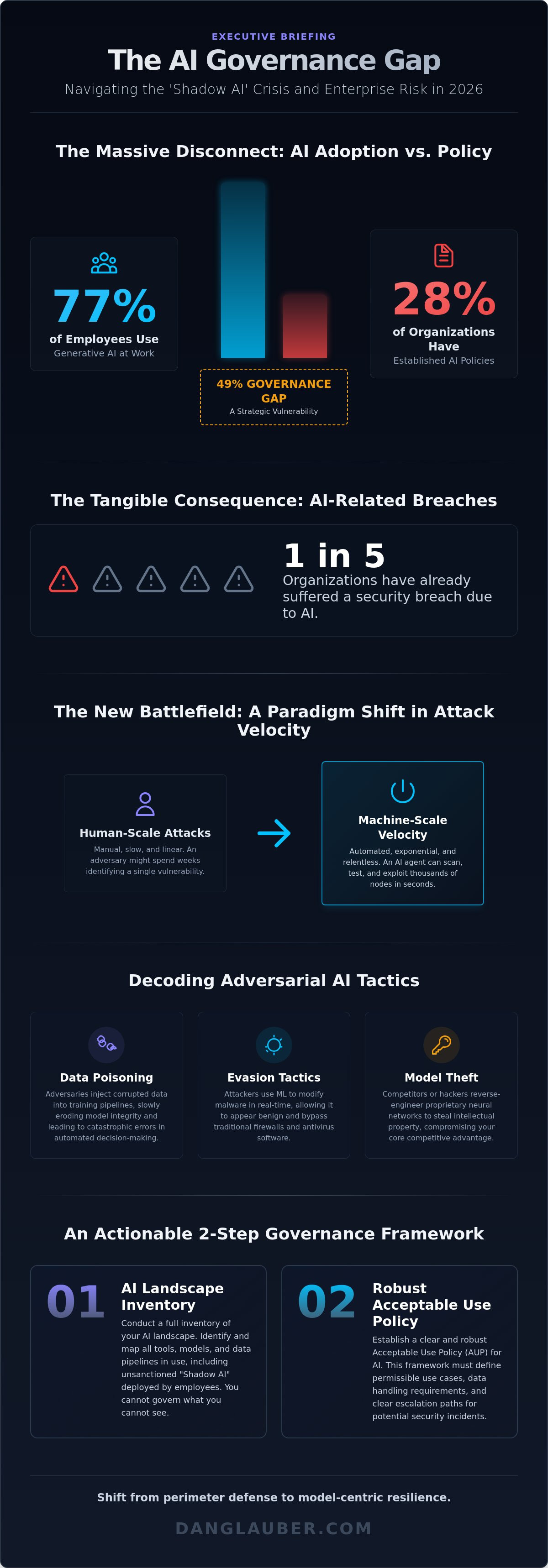
Approximately 77% of your employees are currently using Generative AI at work, yet only 28% of organizations have established clear usage policies to govern them. This massive adoption gap isn't just a technical oversight; it's a strategic vulnerability on a digital battlefield where one in five organizations has already suffered an AI related security breach. You likely feel the weight of information overload as you attempt to quantify these risks for the board without sounding like a technician. It's a common struggle for leaders who recognize the "Shadow AI" crisis within their departments but lack the tools to measure its impact.
Mastering the intersection of AI and cybersecurity requires a shift from technical defense to strategic resilience. This guide provides the definitive framework for explaining AI cyber threats to non-technical executives, ensuring you can translate adversarial AI tactics into business risk. You'll gain a clear mental model of the 2026 regulatory landscape, including the California AI Transparency Act, and walk away with the precise vocabulary needed to discuss countermeasures with your CISO. We'll explore actionable steps to secure your enterprise, moving your organization from a state of potential exposure to one of disciplined, data-driven mastery.
Key Takeaways
- Understand the transition from human-scale attacks to machine-scale velocity, requiring a fundamental shift in how your organization perceives the digital battlefield.
- Acquire a definitive vocabulary for explaining AI cyber threats to non-technical executives, focusing on how adversarial AI uses poisoning and evasion to bypass traditional security.
- Bridge the strategic gap by adopting behavior-based defenses that counter automated offensive tactics, effectively removing the human-in-the-loop bottleneck in incident response.
- Execute a two-step governance framework that starts with a full inventory of your AI landscape and concludes with a robust Acceptable Use Policy.
- Shift your leadership perspective from traditional perimeter defense to a model-centric approach, positioning yourself as a pragmatic visionary of secure innovation.
The Digital Battlefield: Why AI Cyber Threats Demand Executive Attention in 2026
AI cyber threats aren't merely "smarter" versions of old computer viruses. They represent the systematic use of machine learning to automate and optimize the entire attack lifecycle, from initial reconnaissance to final data exfiltration. In the current 2026 environment, we've witnessed a definitive shift from "human-scale" attacks to "machine-scale" velocity. A human adversary might spend weeks identifying a single vulnerability; an AI-driven agent can scan, test, and exploit that same weakness across thousands of nodes in seconds. This overwhelming speed renders traditional, human-led response times obsolete.
When explaining AI cyber threats to non-technical executives, it's vital to frame AI as a dual-use technology. It's both the weapon and the shield. This creates a high-stakes environment at the intersection of AI and cybersecurity, which has become the primary domain of modern business risk. Leaders must understand that they're no longer just protecting hardware or software; they're protecting the very logic and data that drive their competitive advantage. Failure to grasp this shift leaves the enterprise vulnerable to automated tactics that don't sleep and don't make mistakes.
The Democratization of Cybercrime
The barrier to entry for high-level cyberattacks has effectively vanished. Generative AI has democratized sophisticated exploitation, allowing low-level actors to execute state-actor level campaigns with minimal effort. LLM-powered "Cybercrime-as-a-Service" platforms have become a thriving underground economy in 2026. Today, non-technical criminals use these models to generate complex, polymorphic code that bypasses standard defenses. This isn't just a volume problem; it's a quality problem. The precision of these automated attacks often exceeds what a manual team of experts could achieve only a few years ago.
From Data Breaches to Trust Breaches
Modern threats target organizational reputation and executive decision-making rather than just raw databases. AI-driven social engineering creates a profound psychological impact, as deepfake audio and text can mimic leadership styles with enough accuracy to deceive even seasoned professionals. This forces a strategic shift in focus toward Adversarial machine learning, where the goal of the attacker is to corrupt the underlying intelligence of the firm. Adversarial AI is the intentional manipulation of machine learning models to deceive or corrupt their output. When the C-suite can't trust the integrity of their own internal analytics, the strategic damage outweighs a simple data leak.
Beyond the Hype: Decoding the Mechanics of Adversarial AI for the C-Suite
Explaining AI cyber threats to non-technical executives requires moving past the buzzwords of the "AI revolution" to examine the specific mechanics of how corporate assets are compromised. We categorize these into a strategic framework of direct and indirect risks. Direct risks involve attacks targeting the AI models themselves, such as poisoning attacks. In these scenarios, adversaries inject corrupted data into your training pipelines to subtly alter the model's behavior over time. This isn't a sudden crash; it's a slow erosion of your corporate intelligence that can lead to catastrophic errors in automated decision-making. Indirect risks, conversely, use AI as a high-velocity delivery vehicle for traditional exploits.
Evasion tactics represent a significant evolution in this space. Here, attackers use machine learning to modify malware in real-time, allowing it to bypass your existing antivirus and firewalls by appearing benign. When combined with model theft, where competitors or hackers reverse-engineer your proprietary neural networks to steal intellectual property, the stakes become existential. A Strategic Framework for AI Threats emphasizes that these aren't merely technical glitches. They're fundamental challenges to the integrity of the firm. Leaders who fail to distinguish between these attack vectors will struggle to allocate resources effectively. If you're looking to refine your organization's posture, a Board-Level Cybersecurity Briefing can help align your leadership team on these critical distinctions.
Generative Phishing and Deepfake Social Engineering
The days of spotting a phishing attempt by its poor grammar are over. In 2026, attackers use multi-modal deepfakes to create hyper-personalized "CEO Fraud" campaigns. This isn't a theoretical concern. In early 2024, a finance worker in Hong Kong was tricked into paying out $25 million after attending a video call with what appeared to be their CFO and other staff members. Every person on that call, except the victim, was a deepfake. Today's models use public executive data to mimic your voice, cadence, and even specific internal vocabulary with 99% accuracy, making social engineering the most potent weapon in the adversary's arsenal.
Automated Vulnerability Discovery
AI "scouts" now identify weaknesses in your network 1,000x faster than any human hacker could. This has birthed the era of zero-day automation, where machine learning models find and exploit software bugs before your IT team even knows they exist. Because these scouts operate at machine velocity, your traditional monthly or quarterly patching cycles are essentially obsolete. By the time a human signs off on a security update, an AI-driven agent has already identified the gap and moved to the exfiltration phase. This speed disparity creates a strategic gap that only an automated, AI-driven defense can bridge.
Traditional Defense vs. AI-Driven Offense: The Strategic Gap
The core of the current crisis lies in a fundamental mismatch between the speed of offensive AI and the rigidity of legacy defense. Traditional cybersecurity has long relied on signature-based detection, which functions like a digital "wanted poster" for known malware. This approach is powerless against the polymorphic threats of 2026. These AI-driven exploits rewrite their own code in real-time, ensuring they never present the same signature twice. To survive, organizations must shift to behavior-based AI defense that identifies anomalies in network traffic rather than waiting for a known match.
Explaining AI cyber threats to non-technical executives requires highlighting the "Asymmetry of AI." In this digital battlefield, an attacker only needs to succeed once to compromise the enterprise, while your security team must win every single time. This burden is made heavier by "human-in-the-loop" systems that have become the primary bottleneck in incident response. When an attack unfolds at machine-scale velocity, waiting for a human analyst to approve a lockout is a recipe for disaster. Bridging this gap requires a deep dive into Cybersecurity in the Age of Artificial Intelligence, which serves as the foundational text for modern executive strategy.
Why Legacy Security Fails Against Neural Networks
Rules-based firewalls operate on "if-then" logic that simply can't keep pace with the fluid nature of neural networks. We also face the "Black Box" problem; your AI defense might flag a threat based on subtle patterns it can't easily explain to a human operator. This lack of transparency can lead to hesitation at the executive level. The only viable response to this uncertainty is the implementation of a Zero-Trust Architecture. By assuming every user and device is already compromised, you mitigate the risk of a single AI-driven breach cascading through the entire infrastructure.
The Cost of Inaction: Quantifying AI Risk
The stakes have moved beyond the simple loss of data to a total loss of operational integrity. In 2026, the regulatory environment has caught up with the technology. The EU AI Act's deadline for transparency solutions, such as watermarking AI content, takes effect on December 2, 2026. Simultaneously, the Colorado AI Act becomes enforceable on June 30, 2026, targeting high-risk systems. These laws mean that ai and cybersecurity are now inseparable in board-level financial reporting. Failure to quantify these risks doesn't just invite a breach; it invites significant legal and financial penalties from global regulators.
An Actionable Framework for AI Risk Governance
Moving from the theoretical risks of adversarial AI to a state of operational readiness requires a structured, repeatable methodology. When explaining AI cyber threats to non-technical executives, the conversation must pivot from "what could happen" to "how we govern what is happening." This five-step framework provides the definitive roadmap for establishing oversight without stifling the innovation your organization needs to remain competitive in 2026. By treating AI security as a core business function, you transform a technical challenge into a strategic advantage.
- Step 1: Comprehensive AI Inventory. You can't secure what you don't track. Create a centralized registry of all AI models, including third-party SaaS integrations and internal neural networks.
- Step 2: Establish an AI Acceptable Use Policy (AUP). This document should define which data types are prohibited from public LLM inputs and set clear parameters for human-in-the-loop verification of AI outputs.
- Step 3: Implement Continuous Monitoring. Deploy automated tools to detect model drift and adversarial inputs that attempt to bypass your corporate logic.
- Step 4: Conduct AI-Specific Red Teaming. Move beyond standard penetration testing by simulating poisoning and evasion attacks to stress-test your behavioral defenses.
- Step 5: Link Security to ESG and Corporate Governance. Position AI integrity as a core component of your firm’s ethical responsibilities and long-term sustainability goals.
If your leadership team requires a tailored roadmap to implement these steps, an Executive AI Strategy Workshop can provide the necessary alignment and actionable steps for your specific industry vertical.
Managing the Shadow AI Crisis
The prevalence of unsanctioned AI usage remains a primary attack vector in 2026. Approximately 77% of employees currently use Generative AI at work, yet only 28% of organizations have established clear policies. This gap results in the silent leakage of intellectual property through public prompts. To mitigate this, organizations must implement input sanitization and egress filtering. Hiring an ai cybersecurity consultant allows for a comprehensive audit of these hidden risks, identifying where your proprietary data might be exiting the perimeter via "free" productivity tools.
Board-Level Reporting: Translating Technical Risk
Effective communication with the board depends on your ability to translate technical vulnerability scores into Business Impact Analysis. Explaining AI cyber threats to non-technical executives is most impactful when you focus on three key metrics: Model Integrity Scores, Time to Detect Adversarial Manipulation, and Shadow AI Exposure Rates. These figures provide a clear picture of resilience that directors can use for financial planning and insurance assessments. Leading cyber security firms are now prioritizing these strategic metrics over raw technical data to help the C-suite manage risk at the speed of the 2026 digital battlefield.
Mastering the Intersection: Leading Your Organization Through the AI Revolution
The transition from defending the perimeter to defending the data and the model itself represents the final stage of executive maturity in the AI era. You're no longer just protecting a network; you're safeguarding the weights, biases, and training data that constitute your firm's cognitive advantage. When explaining AI cyber threats to non-technical executives, it's vital to position this transition as an opportunity for secure innovation. You aren't a gatekeeper holding back the tide, but a pragmatic visionary who ensures that every AI deployment is resilient by design. This dual-perspective approach is the hallmark of modern leadership at the intersection of AI and cybersecurity.
My definitive guide, featuring 18 comprehensive chapters, provides a deeper dive into these strategic frameworks. It moves beyond the basics to offer actionable insights grounded in over 50 real-world case studies. By mastering these principles, you ensure your organization doesn't just survive the AI revolution but leads it with confidence and technical depth. This level of preparedness is what distinguishes a vulnerable enterprise from a market leader in the 2026 digital battlefield.
The vCISO Advantage in the AI Era
Mid-to-large organizations often find that a full-time, high-level security hire is too rigid or expensive for the fluid 2026 threat environment. Engaging virtual ciso consulting services provides the strategic oversight needed without the immense overhead of a permanent executive. A vCISO acts as a bridge between your technical teams and the board, offering the specialized knowledge required to navigate complex adversarial tactics. This on-demand leadership ensures that your security posture remains as agile as the machine-scale threats it seeks to neutralize.
Next Steps: Your 90-Day AI Security Roadmap
Securing your enterprise is a methodical process that begins with immediate, focused action. Use this roadmap to align your leadership team and move toward a state of mastery. Each phase builds upon the last to create a comprehensive shield for your intellectual property.
- Days 1-30: Audit. Identify and catalog every AI model in use, from enterprise-grade LLMs to the hidden "Shadow AI" tools used by individual employees for daily tasks.
- Days 31-60: Educate. Establish a common vocabulary for explaining AI cyber threats to non-technical executives and formalize your first draft of an AI Acceptable Use Policy.
- Days 61-90: Encapsulate. Implement behavior-based defenses and Zero-Trust protocols to protect your proprietary models from poisoning and evasion tactics.
Implementing these changes requires board-level buy-in and a unified vision across all departments. To begin this transformation and align your C-suite with the latest defensive strategies, Book Dr. Daniel Glauber for a Board-Level Briefing or Keynote to ensure your organization is prepared for the high stakes of the coming year.
Securing the Strategic Frontier of AI Innovation
The digital battlefield of 2026 demands a departure from legacy security mindsets. You've learned that machine-scale threats require machine-scale defenses; specifically behavior-based AI systems that can outpace automated adversaries. By implementing the five-step governance framework, your organization moves beyond the "Shadow AI" crisis toward a state of disciplined resilience. Mastering the art of explaining AI cyber threats to non-technical executives ensures your board moves from a state of potential vulnerability to strategic readiness, protecting both your operational integrity and your hard-earned reputation.
True mastery of the intersection of AI and cybersecurity is achieved through a combination of data-driven insights and proven strategy. With 30+ years of technology innovation experience, I have developed the definitive guide to navigating these critical domains. My actionable frameworks are backed by over 50 real-world case studies, providing you with the foresight needed to lead with confidence in an era of rapid change. Secure your organization's future with Dr. Daniel Glauber's 'Cybersecurity in the Age of Artificial Intelligence'-Get the book now. You have the tools to turn these emerging threats into a blueprint for secure, sustainable innovation.
Frequently Asked Questions
How does AI increase cyber risk for non-technical businesses?
AI automates the attack lifecycle, allowing adversaries to scale exploits at machine velocity. This shifts the digital battlefield from human-led defenses to automated offensive tactics that can overwhelm traditional IT teams. Non-technical businesses are often targeted because their detection systems lack the behavioral analysis required to spot polymorphic malware. Without these advanced countermeasures, a firm's response time remains stuck at a human pace while the threat moves at the speed of code.
What is the difference between traditional phishing and AI-driven phishing?
Traditional phishing relies on generic templates and often contains linguistic errors; AI-driven phishing uses Generative AI to create perfect, multi-modal content. Attackers leverage public data to synthesize deepfake voice and video, making social engineering nearly impossible to detect through visual cues alone. These hyper-personalized campaigns are designed to bypass the skepticism of even well-trained employees by mimicking the exact cadence and vocabulary of trusted leadership figures.
Can AI replace my existing cybersecurity team or CISO?
No, AI is a force multiplier, not a replacement for strategic leadership. While machine learning handles high-speed detection, the CISO provides the essential context for risk appetite and business alignment. The intersection of AI and cybersecurity requires human oversight to manage complex ethical and strategic trade-offs that algorithms cannot resolve. Your team's role evolves from manual monitoring to managing the sophisticated frameworks that govern automated defenses.
What is 'Shadow AI' and why should executives be worried about it?
Shadow AI refers to the unsanctioned use of artificial intelligence tools by employees within your organization. This creates massive risk because sensitive corporate data is often fed into public LLMs, leading to intellectual property leakage. Without a clear Acceptable Use Policy, your firm's proprietary logic could inadvertently become part of a public training set. Executives must address this to prevent the erosion of competitive advantage and maintain control over organizational data.
How do I explain AI risk to a board of directors without getting too technical?
Focus on Business Impact Analysis rather than technical vulnerability scores. When explaining AI cyber threats to non-technical executives, use the "weapon and shield" metaphor to illustrate how AI accelerates both attacks and defenses. Quantify the risk through the lens of operational integrity and regulatory compliance, such as the upcoming deadlines for the EU AI Act. This framing transforms a technical problem into a clear discussion about strategic resilience and capital preservation.
What are the legal implications of an AI-driven data breach in 2026?
Organizations face a complex patchwork of enforceable laws, including the California AI Transparency Act and the Colorado AI Act effective June 30, 2026. Non-compliance with these transparency and safety reporting mandates can result in significant financial penalties. Regulators now require proof of proactive risk management and incident disclosure for high-risk AI systems. A breach today carries heavier legal weight because it often implies a failure to meet these new, binding governance standards.
Is it possible to 'AI-proof' my organization completely?
Absolute security is an impossibility; the goal is strategic resilience. You must assume that adversaries will eventually find a gap, which makes a Zero-Trust Architecture essential. By focusing on rapid detection and containment through behavior-based AI, you minimize the blast radius of a breach and maintain operational continuity under pressure. Resilience is about the ability to absorb a machine-scale attack and recover without a total loss of trust or operational function.
What is the first step an executive should take to mitigate AI threats?
The primary step is conducting a comprehensive audit of all AI use cases within the enterprise. This inventory allows you to identify where data is flowing and which systems are most vulnerable to adversarial manipulation. Once you have visibility, you can begin explaining AI cyber threats to non-technical executives across other departments to build a unified defensive culture. Establishing this baseline of knowledge is the prerequisite for any successful long-term security strategy.