
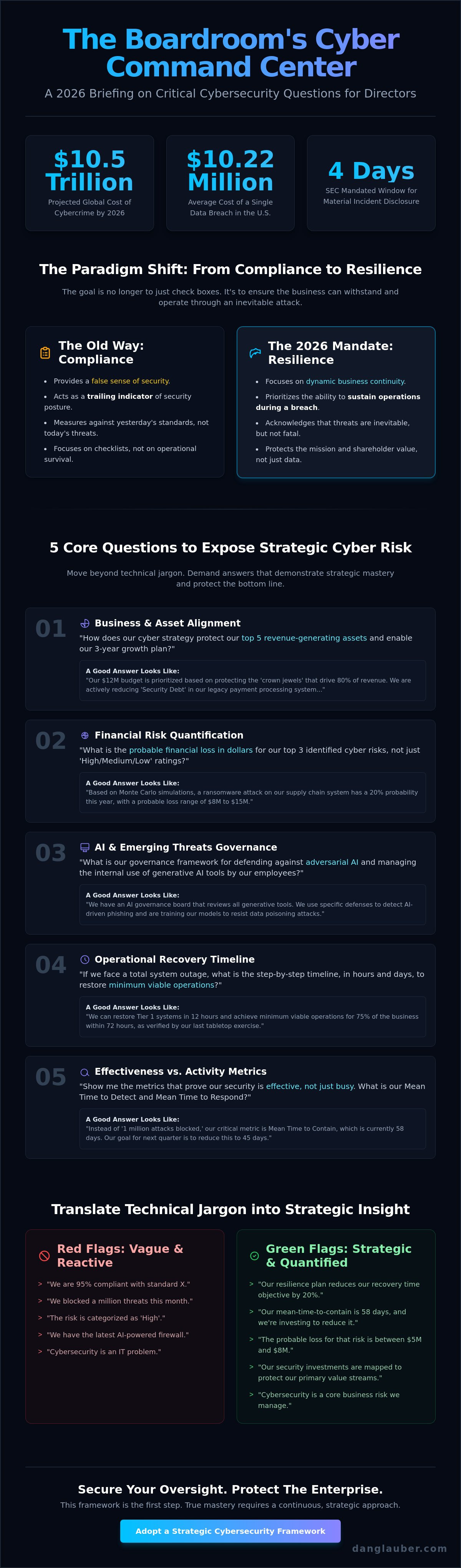
With the global cost of cybercrime projected to hit $10.5 trillion in 2026, the digital battlefield has moved from the server room to the boardroom. The specific questions board members ask about cybersecurity have shifted from technical curiosity to a demand for strategic mastery and personal liability protection. You likely feel the weight of the June 3, 2026, SEC disclosure deadline and the crushing volume of technical data that often obscures real risk. It's exhausting to oversee a landscape where a single US breach now averages $10.22 million.
I'll equip you with the actionable framework you need to cut through the noise and demand accountability from your leadership. This briefing explores the high-impact questions that reveal organizational resilience, defines what a "good" answer looks like at the intersection of AI and cybersecurity, and secures your oversight strategy against modern threats. We will move beyond the compliance checklist to build a foundation of mastery that protects both the enterprise and its directors.
Key Takeaways
- Shift your perspective from defensive compliance to dynamic business resilience by aligning cyber strategy with long-term organizational goals.
- Master the specific questions board members ask about cybersecurity to identify the top five existential risks that could compromise your operations.
- Establish a robust governance framework for the intersection of AI and cybersecurity to defend against adversarial attacks and unmanaged generative tools.
- Demand transparency on operational recovery timelines to ensure the enterprise can withstand total system outages in an increasingly volatile digital battlefield.
- Learn to detect red flags in technical reporting by distinguishing between superficial activity metrics and high-impact effectiveness data.
The Evolution of Boardroom Cybersecurity Inquiries in 2026
The boardroom has evolved into a strategic command center where digital defense is inseparable from fiscal health. In 2026, the questions board members ask about cybersecurity have matured beyond simple technical queries. We've entered an era where cyber risk is a systemic business threat that can erase 15% of market capitalization in a single afternoon. Passive observation is a relic of the past. Today's directors must adopt a foundation-to-application approach to oversee complex neural networks and zero-trust architectures effectively. This transition marks the end of the "IT problem" era. Cybersecurity is now an existential business risk that demands the same level of scrutiny as financial auditing or quarterly earnings reports.
From Compliance Checklists to Resilience Frameworks
Asking "are we compliant" provides a false sense of security that sophisticated hackers routinely exploit. Compliance is a trailing indicator; it measures yesterday's standards against today's adversarial AI and automated attack vectors. True mastery requires shifting the focus toward organizational resilience. This means moving beyond static checklists to a strategic framework for 2026 that prioritizes the ability to sustain operations during a live breach. Resilience acknowledges that threats are inevitable. The goal is to ensure they aren't fatal. In 2026, boards must evaluate if their teams can contain a breach in under 60 days, as the global average cost of a data breach has climbed toward $4.88 million. It's about protecting the mission, not just the data.
The Heightened Stakes of Director Oversight
The regulatory landscape reached a boiling point this year. With the June 3, 2026, SEC disclosure rules in full effect, the board’s role in Corporate Governance of Information Technology is no longer a matter of best practice; it's a legal mandate. Directors now face potential personal liability for failures in oversight, particularly regarding the four-day material incident disclosure requirement. This shift makes the questions board members ask about cybersecurity a matter of professional survival. Passive oversight is now interpreted as negligence by regulators and shareholders alike. You don't need to be a coder, but you must be a strategist who understands how cyber investments protect the bottom line. The cost of silence is too high when global information security spending has reached $183.9 billion. Boards must demand actionable accountability to navigate this revolution in cyber threats and maintain their mandate to protect shareholder value.
Core Questions Board Members Ask About Strategic Risk
Strategic risk management in 2026 requires a departure from the reactive posture of previous decades. Board members no longer accept vague technical updates. They demand to know how security investments safeguard the 3-year growth plan. The questions board members ask about cybersecurity today must focus on the "crown jewels"—the data assets and operational processes that generate the most value. If a cyber incident occurs, the board needs to know exactly which top five risks could halt operations immediately. This level of clarity allows for a controlled sense of urgency rather than a state of panic. It's about moving from a state of potential vulnerability to one of strategic readiness. Risk is math. Data is the target.
Aligning Security with Business Objectives
The CISO must function as a business enabler who understands that every security control should support a revenue objective. When reviewing the 2026 budget, which has seen a 15% year-over-year increase in global security spending, directors must ask if these funds are prioritized based on critical asset protection. A key area of concern is "Security Debt" within legacy systems. These outdated structures often lack Zero-Trust Architecture and become easy entry points for modern attack vectors. To ensure your leadership is on the right path, you might consider adopting a standard set of cybersecurity questions from NIST to benchmark your internal progress against established frameworks.
Quantifying Risk in Dollars and Cents
Qualitative labels like "High" or "Medium" risk are insufficient for a board tasked with fiduciary responsibility. In 2026, sophisticated boards use Monte Carlo simulations and financial modeling to translate cyber threats into probable loss ranges. This data-driven approach allows the board to set an "Acceptable Risk" threshold that aligns with the company's risk appetite. For instance, if the average cost of a US data breach has reached $10.22 million, the board must decide if a $2 million investment in immutable backups is a proportional response. Quantifying risk in currency makes cybersecurity a standard line item in the capital allocation discussion. For directors seeking deeper mastery of these financial frameworks, participating in board-level cybersecurity briefings can provide the necessary tactical edge.
Finally, maturity must be measured against industry peers. If the financial services sector is averaging a breach containment time of 60 days, your organization can't afford to lag at 181 days. Understanding your maturity level provides a definitive proof point of whether your defense strategy is keeping pace with the digital battlefield or falling behind the curve.
Modernizing Oversight: Questions About AI and Emerging Threats
The digital battlefield has been revolutionized by the emergence of neural networks and automated attack vectors. AI isn't just a productivity tool; it's a double-edged sword that has fundamentally altered the threat landscape. Traditional oversight frameworks often fail to account for the unique vulnerabilities inherent in machine learning models. The specific questions board members ask about cybersecurity must now address whether the organization is merely using AI or if it has mastered the intersection of AI and cybersecurity. Directors must ensure that as the company adopts generative tools, it also deploys AI-driven countermeasures to keep pace with adversaries who use the same technology to automate breaches.
Governing the Intersection of AI and Cybersecurity
Effective governance requires a dual-perspective approach that views AI as both a critical threat vector and a primary defense strategy. You must ask leadership how they are securing the company's own models against data poisoning and model inversion. These attacks don't just steal data; they corrupt the logic of your business intelligence. Implementing a Zero-Trust Architecture for AI-driven environments is essential to ensure that every automated process is verified. Directors should evaluate how our AI and cybersecurity strategy mitigates neural network vulnerabilities before these systems are integrated into core operations. This proactive mastery prevents the organization from becoming a test case for groundbreaking new exploits.
Shadow AI and Internal Risk Management
Internal risk has expanded beyond simple phishing to the realm of "Shadow AI." This occurs when employees feed proprietary corporate data into public Large Language Models (LLMs) to solve daily tasks, inadvertently leaking intellectual property. The board must demand a clear policy regarding corporate data usage in third-party AI tools. Integrating these concerns with broader board-level cyber risk questions helps ensure that the workforce is prepared for the "Age of Artificial Intelligence." Training programs must move beyond basic awareness to technical literacy. If your teams don't understand the risks of prompt injection or insecure API integrations, they're providing an open door for attackers. Mastery of these critical domains is the only way to transform AI from a systemic liability into a definitive competitive advantage.
Probing the Response: Questions on Resilience and Recovery
The digital battlefield demands more than just a perimeter. It requires a resilient core that can withstand a successful strike. When considering the questions board members ask about cybersecurity, the focus must shift from "if" we are hit to "how" we recover. Resilience is the ability to sustain operations under fire. If the organization faces a total system outage, leadership must provide a definitive timeline for restoration. In 2026, where ransomware multi-stage extortion damages are forecasted to reach $74 billion, a "hope for the best" strategy is a fiduciary failure. Mastery of recovery is as critical as the defense itself.
Testing the Incident Response (IR) Plan
A plan that hasn't been stress-tested is merely a document, not a defense. Live-testing incident response plans through tabletop exercises is essential; these sessions must include active board participation. Directors need to understand the "Kill Chain," the stages of a cyberattack, to evaluate where defenses failed. There's a critical distinction between "backing up data" and "business continuity." Having a copy of your data doesn't mean your business processes can resume immediately. You must ask how long the organization can survive without its primary digital infrastructure before the damage becomes irreversible. Practical readiness is the only antidote to the chaos of a live breach.
Supply Chain and Third-Party Ecosystem Risk
Your security is only as strong as the weakest link in your vendor network. Modern oversight requires probing into "Fourth-Party" risk, which involves the security postures of your vendors’ own suppliers. Contractual security requirements mean nothing if they aren't enforced through regular audits and proof of controls. To navigate these complexities, I recommend reviewing this strategic guide for board-level risk regarding vendor management. It provides a framework for demanding accountability from the entire ecosystem, ensuring that external partners don't become an unmanaged attack vector into your environment.
Communication and Stakeholder Trust
A breach is a public relations crisis as much as a technical one. Under the 2026 SEC rules, you have only four business days to disclose material incidents. Does your leadership have a pre-approved communication strategy for shareholders, regulators, and customers? Passive oversight in this area can lead to catastrophic loss of trust and plummeting stock value. Transparency is a strategic asset when managed correctly. To ensure your board is prepared for these high-stakes scenarios, you can schedule one of my Board-Level Cybersecurity Briefings to master the art of resilient governance and proactive stakeholder management.
Translating Technical Answers into Strategic Board Action
Board oversight fails when directors cannot decode technical jargon into actionable business risk. It's not enough to memorize the questions board members ask about cybersecurity; you must possess the strategic mastery to interpret the responses provided by your leadership. A primary red flag in any executive report is the "100% secure" claim. In an era defined by Adversarial AI and evolving attack vectors, any assertion of absolute security is a definitive signal of leadership complacency. Strategic action requires moving beyond raw data to structured frameworks that prioritize resilience over the illusion of perfection. You aren't there to manage the firewalls, but you are responsible for ensuring the strategy protecting the enterprise is groundbreaking and reliable.
Evaluating the CISO’s Reporting Style
Many CISOs fall into the trap of "Whack-a-Mole" reporting, where they focus on the volume of blocked attacks or the number of patches deployed. These are "Activity Metrics" that provide little insight into actual risk reduction. The board must demand "Effectiveness Metrics" that track the organization’s ability to detect and contain threats within the 241-day global average. Trend analysis is far superior to static snapshots. If your internal leadership struggles to bridge this gap, a Virtual CISO advisory can provide the specialized perspective needed to transform technical updates into high-impact strategic briefings. Executive AI Strategy workshops are also essential to ensure the leadership team understands the specific neural network vulnerabilities that threaten your 3-year business goals.
The Value of Independent Strategic Advisory
Internal security teams often suffer from confirmation bias or operational myopia. An AI cybersecurity consultant acts as an objective lens, validating internal claims against real-world attack vectors and quantitative proof points. This external validation is critical for meeting the SEC’s annual governance disclosure requirements due by June 3, 2026. Independent advisors bridge the gap between the technical basement and the boardroom, ensuring the questions board members ask about cybersecurity yield answers grounded in data rather than optimism. Mastery of the digital battlefield is achieved through this disciplined approach to preparedness. By demanding actionable accountability and leveraging external expertise, you move the organization from a state of potential vulnerability to one of strategic readiness.
Mastering the Strategic Frontier of Cyber Governance
Navigating the 2026 regulatory landscape requires more than just awareness; it demands a definitive shift toward organizational mastery. You've seen how the questions board members ask about cybersecurity must bridge the gap between technical defense and fiscal resilience. By focusing on financial risk quantification and the unique vulnerabilities of neural networks, you move your organization from a state of potential vulnerability to strategic readiness. True oversight in this age involves distinguishing between superficial activity and real effectiveness.
As the author of "Cybersecurity in the Age of Artificial Intelligence" with 30 years of technology innovation experience, I've served as a vCISO advisor to global organizations facing these exact challenges. The digital battlefield is evolving rapidly, but your governance framework can remain ahead of the curve through disciplined preparation and expert-led strategy.
Download Dr. Glauber’s Boardroom Cyber-Resilience Framework or book a briefing to equip your directors with the actionable insights needed to navigate the intersection of AI and cybersecurity. You possess the authority to transform cyber risk into a managed pillar of enterprise strength.
Frequently Asked Questions
What is the single most important question a board member can ask about cybersecurity?
The most critical inquiry is: "How does our current resilience framework protect our top three revenue-generating assets during a total system outage?" This question forces leadership to move beyond technical jargon and focus on the intersection of AI and cybersecurity as it relates to business survival. It shifts the conversation from theoretical prevention to the practical mastery of recovery timelines and operational continuity.
How often should the board receive a formal cybersecurity briefing?
Boards should receive a formal strategic briefing at least once per quarter. However, in high-risk sectors like healthcare or financial services, monthly updates are becoming the 2026 standard to keep pace with rapid developments in Adversarial AI. These sessions shouldn't just be data dumps; they must be structured as actionable briefings that align with the organization's 3-year growth objectives.
Is the board personally liable for a cyber breach in 2026?
Yes, the legal landscape has shifted toward individual director accountability. Under the SEC's June 3, 2026, disclosure requirements, boards are held responsible for the oversight of material cyber risks. Passive oversight is now viewed as a breach of fiduciary duty. Directors must demonstrate they've asked the right questions board members ask about cybersecurity to ensure the organization is prepared for the digital battlefield.
What is the difference between IT oversight and cybersecurity oversight?
IT oversight focuses on operational efficiency, system uptime, and technological utility. In contrast, cybersecurity oversight is a risk management discipline focused on defending against attack vectors and ensuring data integrity. While IT builds the infrastructure, cybersecurity protects it from sophisticated threats like model inversion and data poisoning. Boards must treat them as distinct but overlapping critical domains.
How should a board member react if the CISO cannot answer a strategic question?
A CISO's inability to answer strategic questions is a significant red flag indicating a lack of business alignment. It often suggests that the security team is trapped in a technical silo rather than functioning as a business enabler. In such cases, the board should consider an Executive AI Strategy Workshop or engaging a vCISO to bridge the communication gap between technical teams and leadership.
Can AI completely automate the board’s cybersecurity reporting?
AI can synthesize massive datasets into trend analysis, but it cannot replace human accountability. While neural networks are excellent for identifying patterns in global threat data, they lack the "Pragmatic Visionary" perspective required for fiduciary oversight. The board's role is to interpret AI-generated insights through a strategic lens to make definitive decisions about resource allocation and risk appetite.
What are the red flags in a company’s cyber risk disclosure?
The most dangerous red flag is the use of vague, qualitative labels like "High" or "Low" risk without financial quantification. Another warning sign is an over-reliance on "100% secure" claims or the absence of a clear strategy for managing fourth-party vendor risks. If a disclosure doesn't mention specific recovery time objectives (RTOs), it's likely the organization hasn't mastered its incident response plan.
How much should a board know about the technical details of a breach?
Directors don't need to understand lines of code, but they must understand the "Kill Chain" impact on operations. You should focus on how the breach occurred, what data was compromised, and the definitive timeline for full restoration. Mastery in the boardroom means knowing enough technical detail to validate that the organization's countermeasures are sufficient for the modern threat landscape.