

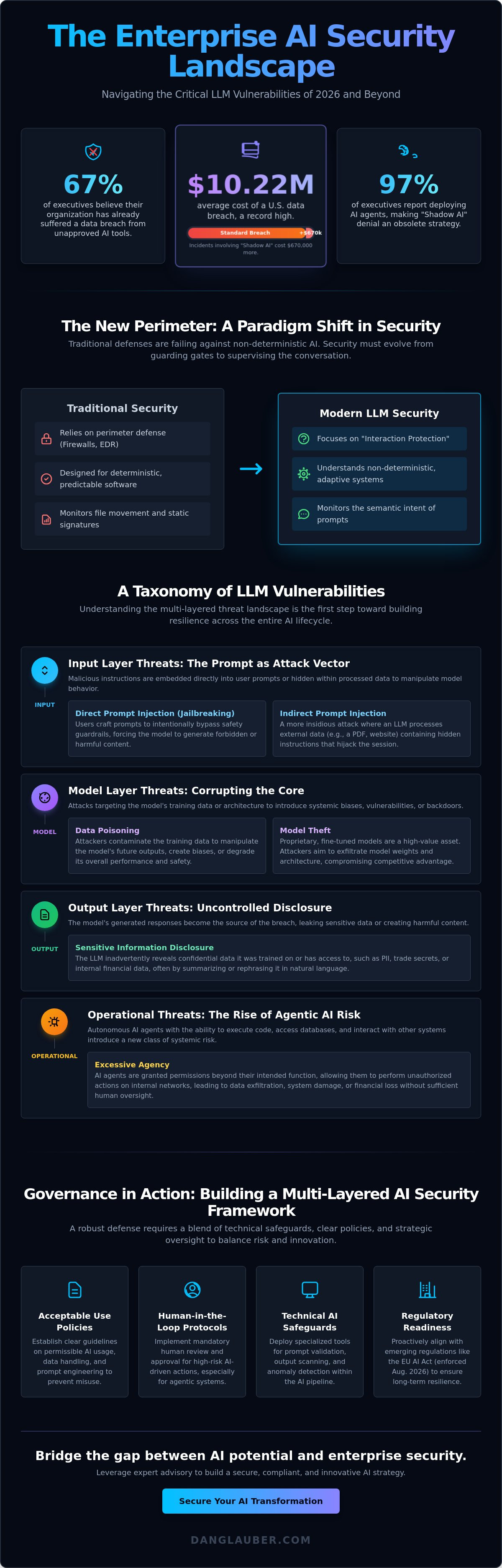
Sixty-seven percent of executives now believe their organizations have already suffered a data breach caused by unapproved AI tools. As we move through 2026, the promise of generative productivity has collided with a harsh reality; shadow AI is no longer a peripheral concern but a central vulnerability. You likely recognize the tension between empowering your workforce with automation and the urgent need to manage the security risks of large language models in enterprise environments. With the average cost of a U.S. data breach reaching a record $10.22 million this year, the margin for strategic error has effectively vanished.
This briefing provides the strategic clarity required to move from reactive blocking to governed enablement. We'll address the specific security risks LLMs pose to your enterprise and demonstrate how to manage them without stifling innovation. You'll gain a clear taxonomy of modern LLM threats, a repeatable framework for risk mitigation, and a roadmap for compliance with the August 2026 enforcement of the EU AI Act.
Key Takeaways
- Identify why traditional defensive perimeters are insufficient for non-deterministic systems and how to redefine your security architecture for the 2026 threat landscape.
- Categorize the primary security risks of large language models in enterprise environments, from sophisticated prompt injection to model-level data poisoning.
- Evaluate the critical trade-offs between the accessibility of public LLMs and the rigorous data sovereignty requirements of proprietary, enterprise-grade infrastructure.
- Establish a multi-layered governance framework that balances risk and utility through robust Acceptable Use Policies and Human-in-the-Loop protocols.
- Bridge the gap between technical AI safeguards and board-level strategy by leveraging expert advisory to ensure long-term regulatory and operational resilience.
The New Perimeter: Why Enterprise LLMs Demand a Strategic Security Pivot
The traditional defensive perimeter has collapsed. By mid-2026, it's become clear that conventional firewalls and Endpoint Detection and Response (EDR) tools are insufficient to contain the unique behaviors of generative systems. These legacy tools were designed for deterministic software where input A always leads to output B. Large Language Models (LLMs) operate on a non-deterministic basis; they produce unpredictable results that can bypass static security signatures. This fluidity creates a massive challenge for leadership. To effectively manage the security risks of large language models in enterprise environments, organizations must shift their focus from simple data protection to "interaction protection."
This shift represents the end of "Shadow AI" denial. With 52% of employees already using AI agents as of April 2026, blocking access is no longer a viable strategy. Instead, firms are moving toward a model of governed enablement. This requires a strategic pivot where security is integrated into the prompt-response loop itself. Security teams are now tasked with monitoring the semantic intent of interactions rather than just the movement of files. It's a transition from guarding the gates to supervising the conversation.
The Erosion of Traditional Security Boundaries
Conventional Data Loss Prevention (DLP) logic often fails when faced with the linguistic nuances of an LLM. An employee might not upload a sensitive spreadsheet, but they might describe its contents in a prompt to summarize "quarterly performance trends." Traditional filters don't recognize this as a leak because the data is transformed into natural language. Semantic interpretation is now the only way to identify malicious intent or accidental exposure. Enterprise LLM Security is a fusion of data governance and prompt engineering.
Business Impact of LLM Vulnerabilities
The financial stakes have never been higher. Industry reports indicate that the average cost of a U.S. data breach reached a record $10.22 million in 2026. When "Shadow AI" is involved, incidents cost an average of $670,000 more than standard breaches. Beyond the immediate loss, the regulatory landscape has become a minefield. The EU AI Act begins enforcement of high-risk obligations on August 2, 2026, making non-compliance a significant liability for global firms. Protecting the AI pipeline is now directly linked to brand trust and long-term shareholder value. Organizations that fail to secure these interactions risk more than just data; they risk their license to operate in a highly regulated global market.
A Taxonomy of Risk: Categorizing Large Language Model Vulnerabilities
The threat landscape for generative AI has matured into a multi-layered challenge that transcends simple software bugs. To effectively manage the security risks of large language models in enterprise, leadership must adopt a systematic taxonomy that accounts for the entire AI lifecycle. We categorize these vulnerabilities into four distinct layers: input, model, output, and operational. By 2026, the most pressing concern has shifted toward "Agentic AI" risks, where autonomous models possess the agency to execute code or access internal databases without sufficient oversight. When 97% of executives report deploying AI agents, the potential for "excessive agency" becomes a systemic liability rather than a technical edge case.
Understanding this hierarchy is the first step toward resilience. It's not enough to secure the infrastructure; you must secure the logic, the data, and the autonomous actions the model takes. Organizations often find that a Board-Level Cybersecurity Briefing is necessary to align this technical taxonomy with corporate risk tolerance.
Prompt Injection and Adversarial Attacks
Direct prompt injection, often called "jailbreaking," involves users intentionally bypassing safety guardrails to extract forbidden information. However, indirect prompt injection is a far more insidious threat in 2026. This occurs when an LLM processes external data, such as a malicious PDF or a compromised website, which contains hidden instructions that hijack the session. Attackers now use sophisticated logic traps and character encoding to bypass standard filters. Effective mitigation requires moving beyond simple keyword blocking toward structural prompt isolation, ensuring the model can distinguish between system instructions and untrusted user data.
Data Privacy and Sensitive Information Disclosure
The risk of "memorized" PII surfacing in outputs remains a significant hurdle for compliance with the EU AI Act and the California AI Transparency Act. If a model is fine-tuned on unscrubbed corporate data, it may inadvertently leak trade secrets or customer names during routine interactions. Model inversion attacks allow adversaries to mathematically query an LLM to reconstruct the specific sensitive data points used during its initial training phase. Maintaining data sovereignty requires rigorous sanitization of the training pipeline and real-time output monitoring to prevent unauthorized disclosure of intellectual property.
Supply Chain and Third-Party Model Risks
Enterprise security is only as strong as the weakest link in the AI supply chain. Many organizations rely on open-source model weights or pre-trained checkpoints that may harbor "Model Poisoning" vulnerabilities. If the training data was corrupted at the source, the model might contain backdoors that stay dormant until triggered by a specific prompt. Evaluating LLM-as-a-Service providers now requires deep due diligence into their alignment with ISO/IEC 27090, the 2026 international standard for AI cybersecurity. You aren't just buying a tool; you're inheriting the security posture of the entire development ecosystem.
The Shadow AI Dilemma: Third-Party vs. Proprietary Model Risks
The proliferation of public LLMs like ChatGPT and Claude has created a convenience trap for the modern enterprise. While these tools offer immediate productivity gains, they represent the primary source of Shadow AI, where employees bypass official channels to process corporate data. This behavior isn't just a policy violation; it's a financial liability. Shadow AI incidents cost an average of $670,000 more than standard security breaches as of March 2026. Leadership must now decide between the accessibility of third-party SaaS models and the rigorous control of proprietary, self-hosted infrastructure. Each path presents a unique profile regarding the security risks of large language models in enterprise architectures.
Enterprise-grade SaaS LLMs offer improved Service Level Agreements (SLAs) and dedicated privacy tiers, yet they still rely on external infrastructure that sits outside your direct physical control. Conversely, proprietary or self-hosted models provide maximum data sovereignty but impose a heavy internal maintenance burden. Managing the security patches, model weights, and hardware isolation for a local instance requires specialized expertise that many internal teams lack. For organizations struggling to find this balance, an Executive AI Strategy Workshop can help define the optimal deployment model based on specific risk tolerance and regulatory requirements.
Data Sovereignty and the 'Training Leak' Myth
A common misconception in boardrooms is the belief that every prompt entered into a commercial LLM is automatically used to train future iterations of the model. In 2026, most major providers offer Zero-Data Retention (ZDR) APIs for enterprise contracts, ensuring that your data is neither stored nor used for model improvement. However, data sovereignty involves more than just training cycles. It's about where the data resides, who has administrative access to the logs, and how the provider complies with the shifting landscape of AI and Cybersecurity: Navigating the Strategic Frontier in 2026. Verification of these ZDR claims is now a mandatory component of any AI procurement process.
Securing the RAG Pipeline
Retrieval-Augmented Generation (RAG) has become the standard for grounding LLMs in proprietary business knowledge. This makes the vector database the new "crown jewel" for attackers. If an adversary compromises the RAG pipeline, they don't need to break the model; they simply manipulate the data the model retrieves. Access control is the most significant challenge here. You must ensure that the LLM doesn't "see" and then summarize sensitive data, such as executive payroll or unannounced M&A details, that the prompting user isn't authorized to access. Robust encryption and logical isolation of internal knowledge bases are essential to prevent unauthorized data exfiltration through the AI interface.
Governance in Action: Building a Multi-Layered AI Security Framework
Effective governance is not a technical patch; it's a strategic architecture. As the 2026 threat landscape evolves, organizations must move beyond reactive measures to establish a robust framework for managing the security risks of large language models in enterprise environments. Currently, 75% of executives admit their AI strategy is more for show than for practical guidance. To bridge this gap, leadership must implement a disciplined operational reality that prioritizes resilience over hype. This requires a five step progression toward maturity.
- Step 1: Establishing an AI Acceptable Use Policy (AUP). This document must clearly define sanctioned tools and data types, balancing the need for innovation with strict corporate risk tolerance.
- Step 2: Implementing Human-in-the-Loop (HITL) Requirements. High-stakes outputs in legal, financial, or medical workflows must require manual verification to prevent business logic abuse or hallucination exploitation.
- Step 3: Deploying AI Security Posture Management (AI-SPM). Continuous monitoring tools provide real-time visibility into model health, identifying drift and unauthorized access before they escalate into breaches.
- Step 4: Regular Red Teaming. Stress testing internal LLM applications through adversarial simulations exposes weaknesses that automated scanners frequently miss.
- Step 5: Board-Level Reporting. Translating technical AI vulnerabilities into financial risk metrics ensures that security remains a core component of the corporate strategy.
Only 20% of organizations currently report having mature frameworks for managing AI agents. Organizations that fail to institutionalize these steps remain vulnerable to the $670,000 premium associated with Shadow AI incidents. To align your technical safeguards with executive vision, consider engaging in Virtual CISO (vCISO) Advisory services to lead this transformation.
The Role of AI Red Teaming
Automated scanning is insufficient for non-deterministic models. Because an LLM can produce different outputs for the same input, security teams must use adversarial simulations to test prompt guardrails effectively. Red teaming involves intentionally trying to trigger data leaks or bypass safety filters to find the breaking point of your deployment. This process is a critical element of Cybersecurity in the Age of Artificial Intelligence: A Strategic Framework for 2026, ensuring that your defenses are as dynamic as the models they protect.
Metric-Driven AI Governance
Governance without measurement is merely a suggestion. Leadership must define clear KPIs, such as Prompt Rejection Rates, hallucination frequency, and data leakage incidents, to track the efficacy of their security posture. These technical metrics must be translated into financial risk assessments for the Board, linking AI security directly to shareholder value. Continuous validation is the only way to maintain trust in systems that are inherently unpredictable. This methodical approach transforms AI from a potential liability into a governed, strategic asset.
The vCISO Perspective: Leading the Secure AI Transformation
The 2026 threat environment has transformed the CISO from a technical gatekeeper into a strategic architect. As organizations grapple with the security risks of large language models in enterprise frameworks, the primary challenge isn't the code itself but the lack of alignment between technical safeguards and executive vision. With 79% of organizations reporting significant challenges in AI adoption this year, the need for a bridge between the SOC and the boardroom is critical. A Virtual CISO (vCISO) provides this missing link, offering the specialized foresight needed to navigate a landscape where AI-powered phishing is forecasted to account for over 42% of global intrusions by the end of 2026.
Leadership in this era requires a shift from "No" to "Yes, and...". Security leaders must become business enablers who don't just point out vulnerabilities but actively design the guardrails that make innovation possible. This transformation is detailed in our Virtual CISO Consulting Services: The 2026 Executive Guide to Strategic Security Leadership. By positioning security as a prerequisite for AI deployment rather than a hurdle, the vCISO ensures that the organization remains competitive without sacrificing its defensive posture or regulatory standing.
Strategic Advisory vs. Technical Implementation
Tools alone cannot solve the non-deterministic problems inherent in generative systems. While AI Security Posture Management (AI-SPM) is necessary, it's insufficient without a culture of AI awareness. Employees and developers must understand how their interactions with models can inadvertently expose the firm to legal and operational hazards. This is why strategic advisory often outweighs technical implementation in terms of long-term ROI. Building a resilient AI ecosystem involves educating the human element as much as it involves hardening the software. For more on selecting the right expertise for your leadership team, see The Executive Guide to Hiring an AI Cybersecurity Consultant in 2026.
Empowering the Board of Directors
Board members don't need a lecture on the mechanics of prompt injection; they need a briefing on financial exposure, brand trust, and regulatory compliance. Structuring AI security briefings for non-technical stakeholders involves translating technical drift into business risk. With the EU AI Act's enforcement of high-risk obligations beginning on August 2, 2026, the Board must understand the specific liabilities associated with autonomous agents. The future of the C-suite involves a CISO who acts as an algorithmic governor, ensuring that every AI agent operates within the company's ethical and security boundaries. This methodical oversight transforms AI from a potential catastrophic liability into a governed strategic asset.
Secure your organization's AI future with Dr. Daniel Glauber's strategic advisory services.
Securing the Algorithmic Future: Your Roadmap to AI Resilience
The transition from deterministic logic to non-deterministic intelligence requires a fundamental shift in executive leadership. We've explored how the collapse of the traditional perimeter and the rise of autonomous agents demand a move toward interaction protection. By addressing the security risks of large language models in enterprise settings through a multi-layered governance framework, you transform a potential catastrophic liability into a controlled strategic asset. Organizations that master this balance will lead the 2026 economy; those in "Shadow AI" denial will face escalating breach costs and regulatory penalties under the EU AI Act.
Dr. Daniel Glauber, author of Cybersecurity in the Age of Artificial Intelligence, brings over 30 years of technology innovation experience as a strategic advisor to global mid-to-large organizations. Don't leave your AI strategy to chance. Download the Strategic Framework for AI Security or Book a vCISO Consultation today to ensure your defense is as dynamic as the models you deploy. You possess the roadmap to move from a state of vulnerability to strategic mastery. It's time to lead your organization into the secure AI frontier with confidence.
Frequently Asked Questions
What is the most common security risk for LLMs in 2026?
Prompt injection remains the most prevalent vulnerability for large language models. The OWASP LLM01:2025 report identifies it as the top threat because it exploits the model's fundamental reasoning rather than just its code. Attackers use sophisticated logic traps and character encoding to bypass safety filters, making it a persistent challenge for non-deterministic systems that process natural language.
Can employees safely use public LLMs like ChatGPT for work?
Safety depends entirely on your organization's governance and the specific tier of service used. Public, consumer-grade LLMs represent a significant Shadow AI risk because they often lack the data sovereignty protections required for corporate data. Without an enterprise-level contract that includes data exclusion clauses, sensitive information entered into prompts could potentially be exposed or stored by the provider.
How does prompt injection differ from traditional SQL injection?
The primary difference lies in the target of the exploit. SQL injection targets the syntax of a structured database query to extract data. Prompt injection targets the semantic logic of a generative model to hijack its instructions. Because natural language is inherently ambiguous, prompt injection is significantly harder to prevent with traditional signature-based security tools.
What is Retrieval-Augmented Generation (RAG) and is it secure?
RAG is a framework that grounds an LLM in your organization's proprietary knowledge by retrieving relevant documents before generating a response. Its security relies on the robust isolation of your vector database. You must implement strict access controls to ensure the model doesn't retrieve and summarize sensitive information that the prompting user isn't authorized to view.
Do I need a specific AI security policy for my enterprise?
A dedicated AI Acceptable Use Policy (AUP) is mandatory for any organization deploying generative tools in 2026. This policy establishes the boundaries for safe usage and helps mitigate the security risks of large language models in enterprise environments. It serves as the foundational document that aligns employee behavior with your corporate risk tolerance and regulatory obligations.
How can I prevent my corporate data from being used to train public AI models?
You should utilize enterprise-grade APIs that offer Zero-Data Retention (ZDR) as a standard contractual clause. These agreements legally prohibit providers from using your input data or model outputs to train their base models. It's essential to verify these claims by checking for compliance with international standards like ISO/IEC 42001:2023 during the procurement process.
What is the role of a vCISO in managing AI-related security risks?
A vCISO provides the strategic leadership necessary to align AI innovation with corporate defense. By leveraging vCISO Advisory services, organizations can bridge the gap between technical security teams and the Board of Directors. This ensures that the security risks of large language models in enterprise are managed as a business priority rather than a purely technical issue.
Are there industry standards or frameworks for LLM security?
Several authoritative frameworks now guide AI security practices. The NIST AI Risk Management Framework (AI RMF) and the ISO/IEC 27090 standard, published in 2026, provide specific cybersecurity guidance for AI systems. Adopting these standards helps organizations demonstrate compliance with the EU AI Act and ensures a disciplined approach to managing the entire AI lifecycle.