

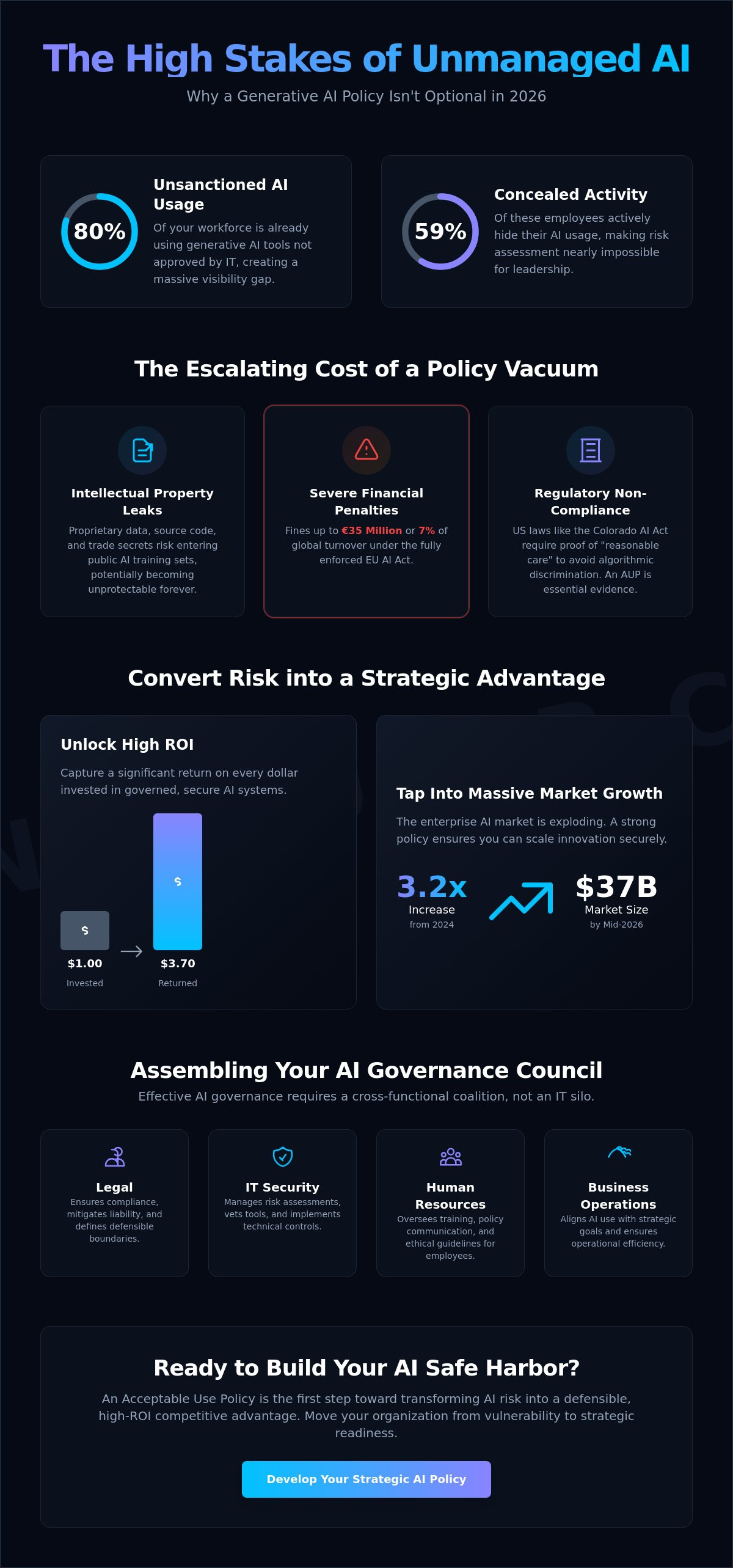
Eighty percent of your workforce is already utilizing generative AI tools that your IT department hasn't sanctioned, and 59% of those employees are actively concealing that usage from leadership. This "Shadow AI" isn't merely a breach of protocol; it represents a profound vulnerability to your proprietary data and corporate reputation. You likely understand that a total ban on these technologies is a regressive strategy that invites stagnation, yet the threat of intellectual property leaking into public training sets or facing €35 million fines under the EU AI Act is a high-stakes reality for any executive.
Developing a generative AI acceptable use policy is the essential strategic safe harbor that allows your organization to scale innovation securely. By establishing a clear, defensible framework, you move your team from a state of vulnerability to one of strategic readiness. This guide provides the foundation for aligning your legal, IT, and business units to foster a culture of responsible experimentation. We'll explore how to satisfy the stringent requirements of new 2026 regulations, such as California’s SB 942 and the Colorado AI Act, while empowering your workforce to harness the $3.70 return on every dollar invested in these transformative systems.
Key Takeaways
- Transform your organizational approach from restrictive containment to strategic enablement by positioning your AI policy as a foundational safe harbor for innovation.
- Identify the essential cross-functional stakeholders—from Legal to HR—required for developing a generative AI acceptable use policy that survives rigorous executive and regulatory scrutiny.
- Master a precise data classification framework designed to define clear boundaries between permissible prompts and protected corporate intellectual property.
- Execute a disciplined 7-step inventory and risk-assessment process to illuminate "Shadow AI" and transition unauthorized tools into a governed, managed ecosystem.
- Deploy the "Trust but Verify" oversight model, utilizing technical controls to monitor AI traffic while maintaining a culture of responsible, high-ROI experimentation.
Why Developing a Generative AI Acceptable Use Policy is Mandatory in 2026
The era of treating Artificial Intelligence as a peripheral experiment has ended. By mid-2026, enterprise AI spending has surged to $37 billion, a massive 3.2x increase from 2024. Your employees aren't waiting for permission to join this revolution; 80% of them are already using AI tools that haven't been vetted by your IT department. This "Shadow AI" creates a dangerous visibility gap. When 59% of your staff actively hides their AI usage, your organization is flying blind through a landscape of unprecedented legal and security risks. Developing a generative AI acceptable use policy isn't about creating a restrictive list of prohibitions. It's about establishing a strategic governance framework that converts these hidden risks into a measurable competitive advantage.
A modern Acceptable Use Policy (AUP) serves as the definitive source of truth for your workforce. It defines the parameters of engagement with Large Language Models (LLMs) and agentic systems, ensuring that innovation doesn't come at the cost of corporate integrity. Without this guidance, your proprietary data is one copy-paste away from entering a public training set, potentially rendering your trade secrets unprotectable. Proactive governance allows you to capture the average $3.70 return for every dollar invested in AI while maintaining a defensible security posture.
The Strategic Risk of the "Policy Vacuum"
A lack of clear guidance creates a policy vacuum where unintentional data exfiltration becomes inevitable. Employees often mistake the conversational nature of tools like GPT-5.5 Instant or Claude Opus 4.7 for private interactions, leading them to upload sensitive code or customer identifiers. The cost of this negligence is no longer theoretical. As of August 2, 2026, the EU AI Act is in full enforcement, with non-compliance fines reaching up to €35 million or 7% of global annual turnover. In the United States, a patchwork of state laws like the Colorado AI Act requires organizations to prove "reasonable care" in avoiding algorithmic discrimination. Your AUP is the essential bridge between rapid innovation and enterprise security, providing the documented evidence of due diligence required by modern regulators.
AI as a Tool vs. AI as a Teammate
The mindset within your organization must shift from viewing AI as a simple chatbot to recognizing it as an autonomous teammate. With Cisco projecting that 56% of customer support interactions now involve agentic AI, the "tone at the top" regarding ethics and reliability is paramount. Executives must lead the transition toward multimodal systems that handle text, audio, and video with minimal human intervention. This shift requires a deep understanding of Cybersecurity in the Age of Artificial Intelligence, where strategic risk is managed through empowerment rather than isolation. When you succeed in developing a generative AI acceptable use policy, you aren't just checking a compliance box; you're building a culture of mastery where every employee understands their role in the safe deployment of frontier technology.
Assembling the Stakeholders: Who Owns AI Governance?
AI governance often fails when it's relegated to a technical ticket. Developing a generative AI acceptable use policy requires a multidisciplinary coalition that bridges the gap between digital capability and corporate liability. Relying solely on the IT department to police AI usage ignores the nuanced legal, ethical, and operational risks inherent in autonomous systems. Instead, organizations must construct a "Governance Council" comprising the Four Pillars of enterprise stability: Legal, IT Security, HR, and Business Operations. This council ensures that AI adoption isn't just fast, but defensible.
A Virtual CISO (vCISO) often serves as the critical mediator within this group. They translate high-level technical jargon into strategic business risk assessments, helping the council decide which frontier models, like Grok 4.3 or GPT-5.5 Instant, meet the organization's risk tolerance. If you need assistance structuring this leadership group, an Executive AI Strategy Workshop can provide the necessary blueprint. This collaborative approach mirrors successful frameworks seen in the Delaware AI Policy Guidance, which emphasizes shared responsibility and clear user mandates across the enterprise.
The Role of Legal and Compliance
Legal stakeholders must address the unique volatility of AI outputs. Issues regarding copyright infringement, hallucinations, and the ambiguity of "output ownership" can lead to significant litigation if left unmanaged. Counsel must ensure the policy aligns with global privacy mandates like GDPR and the California SB 942, which requires latent disclosures in AI-generated media. Clear boundaries are necessary to prevent employees from using AI for regulated financial or legal advice, which could expose the firm to malpractice claims or regulatory scrutiny.
The Executive and Board Perspective
The Board of Directors now holds a fiduciary duty to oversee AI risk. It's no longer a sub-topic for the CTO; it's a core component of enterprise resilience. Directors require reports that translate technical vulnerabilities into tangible business impacts. Effective governance ensures that AI usage doesn't compromise the firm's market position or long-term reputation. For a deeper dive into these requirements, consult our guide on Cyber Security Firms: A Strategic Guide for Board-Level Risk Management in 2026. This high-level oversight ensures that developing a generative AI acceptable use policy remains a strategic priority rather than a secondary administrative task.
The Core Pillars of a Robust GenAI Acceptable Use Policy
A policy is only as strong as its integration into your broader cybersecurity architecture. When developing a generative AI acceptable use policy, you must treat AI prompts as potential vectors for data exfiltration. This requires a rigorous data classification framework that explicitly defines what information is "promptable." For instance, public marketing copy might be low risk, but proprietary source code or customer PII should be strictly prohibited from public-facing models. By categorizing data into tiers, such as Public, Internal, and Restricted, you provide employees with the clarity needed to innovate without compromising security.
Effective governance also necessitates a tiered access system for tools. Not all AI is created equal. Enterprise-grade solutions like Microsoft 365 Copilot, priced at $30 per user monthly, or Amazon Q Business offer data protections that consumer-grade versions lack. Your policy should mandate the use of these vetted, SLA-backed platforms while placing a "hard block" on unapproved consumer tools that may ingest user data for training. This structural separation is the first line of defense against the "Shadow AI" crisis mentioned earlier. Finally, establish clear protocols for transparency. Your stakeholders deserve to know when they are interacting with synthetic content or when AI has played a significant role in a deliverable. Transparency builds trust and mitigates reputational risk.
Protecting Intellectual Property (IP) and Trade Secrets
The threat of "Training Leakage" is a high-stakes reality for the modern executive. Public models often ingest prompts to refine future iterations, meaning your proprietary strategy could inadvertently become part of a competitor's output. To mitigate this, your policy should require the use of "Zero-Retention" APIs or private instances when handling sensitive intellectual property. Clearly state that the organization retains ownership of all AI-assisted outputs. This prevents legal ambiguity regarding code or content generated through tools like Claude Opus 4.7 or Kimi K2.6, ensuring your IP remains a defensible asset.
Managing Accuracy and "Hallucinations"
AI is a powerful co-pilot, but it is not a final authority. Your governance framework must mandate a "Human-in-the-Loop" requirement for all AI-generated deliverables. This assigns ultimate accountability for errors or "hallucinations" to the human user, not the machine. Prohibit the use of AI for high-stakes decision-making, such as financial forecasting or performance reviews, without explicit human oversight and verification. Fact-checking is a non-negotiable step in the workflow. Employees should be trained to verify AI-generated data against primary sources to ensure that synthetic outputs don't erode the quality of your enterprise intelligence.
A 7-Step Guide to Developing Your GenAI Policy
Executing a transition from unmanaged AI usage to a governed ecosystem requires a chronological roadmap that prioritizes both speed and security. Developing a generative AI acceptable use policy is not a static event but a progressive implementation that aligns your technical infrastructure with your corporate risk appetite. This process begins with visibility and ends with a cycle of continuous improvement, ensuring your organization remains resilient as frontier models evolve. By following this structured 7-step guide, leadership can move beyond reactive prohibition and establish a defensible strategy for long-term innovation.
Step 1: The AI Risk Assessment
Before drafting a single line of policy, you must identify where your data is currently flowing. Conducting an AI inventory requires surveying your workforce to uncover "Shadow AI" usage without inadvertently creating a "snitch culture" that drives adoption further underground. Frame these surveys as a collaborative effort to provide better, safer tools rather than a disciplinary audit. During this phase, you must identify your "Crown Jewels"—the specific trade secrets, proprietary algorithms, or customer datasets that are strictly prohibited from touching any public LLM. Engaging an AI cybersecurity consultant at this early stage provides the external perspective necessary to map these data flows against modern threat models.
Once the inventory is complete, categorize your AI tasks into low, medium, and high-risk use cases. Drafting the policy involves selecting a template that balances operational utility with strict security guardrails. This document must then undergo a rigorous legal and security review to ensure it addresses the specific regulatory requirements of 2026, such as the "Take it Down Act" (TiDA) or the Texas Responsible AI Governance Act. Stress-testing the policy against potential breach scenarios allows you to identify gaps in your data classification before they are exploited by external actors.
Step 5: Training for Compliance
A policy is a dormant document without a corresponding training program to bring it to life. Educating your workforce on "Prompt Engineering" safety is the most effective way to prevent accidental data exfiltration. Move beyond traditional slide decks by gamifying AI safety training; use simulated environments where employees can practice identifying "hallucinations" or high-risk prompts. Creating "Prompt Libraries" that are pre-vetted for security provides your team with a baseline of safe, effective interactions. This proactive education transforms your employees from potential liabilities into the first line of your organizational defense.
The final stages of the roadmap involve tool procurement and continuous iteration. Always select enterprise-grade AI with robust security SLAs that guarantee your data will not be used for model training. Because the release cycles for models like Grok 4.3 or GPT-5.5 Instant are measured in weeks, your policy must be reviewed quarterly to remain relevant. If your organization requires a customized roadmap for these high-stakes decisions, consider our Virtual CISO Advisory services to guide your implementation.
Enforcement and Oversight: The vCISO Perspective
The transition from a written directive to an operational reality requires more than just administrative signatures. Enforcement is the mechanism that transforms a policy from a passive document into a dynamic security framework. When developing a generative AI acceptable use policy, organizations must deploy technical guardrails that monitor data flows in real-time. Cloud Access Security Brokers (CASBs) and API gateways serve as the primary enforcement layers, allowing IT departments to intercept high-risk prompts and block unauthorized data exfiltration before it reaches an external model. This proactive stance is essential for mitigating the risks associated with the 59% of employees who actively hide their AI usage from leadership.
A "Trust but Verify" model necessitates periodic auditing of AI tool logs. These reviews ensure that employees are adhering to the tiered access system and data classification rules established in the earlier phases of governance. However, even the most robust controls can be bypassed. Your incident response plan must specifically address the unique challenges of an AI data leak. Unlike a traditional breach where data is stolen, data ingested by a public LLM is often irrecoverable and may be used to train future iterations of the model. This requires immediate legal consultation and potential disclosure under the EU AI Act or state-level transparency laws like California SB 942.
Monitoring Without Micro-Managing
Governance in 2026 utilizes AI to monitor AI. Automated governance tools can scan prompts for sensitive patterns, proprietary code, or non-consensual content as defined by the "Take it Down Act" (TiDA). This automation allows for high-density oversight without infringing on the creative freedom of the workforce. Leadership must balance this surveillance with employee privacy, ensuring that monitoring is transparent and tied to clear disciplinary actions for intentional policy violations. The goal is to create a self-correcting ecosystem where the workforce understands that safety is a prerequisite for access.
Adaptive Governance in a Fast-Moving Market
The rapid evolution from text-based models to multimodal systems that handle audio and video means your governance cannot be static. A policy designed for the capabilities of Grok 4.3 or GPT-5.5 Instant will be obsolete by 2027 if it lacks the flexibility to address agentic AI and autonomous decision-making. Utilizing Virtual CISO Consulting Services provides the ongoing strategic leadership necessary to evolve your policy alongside the market. Strategic readiness is not a destination; it is the only viable defense in an age of perpetual technological shift. By aligning your policy with practice through a vCISO retainer, you ensure your organization remains a master of its digital destiny.
Securing Your Competitive Advantage Through Strategic AI Mastery
The landscape of 2026 demands a shift from containment to empowerment. By establishing a cross-functional Governance Council and deploying technical guardrails, you transform the risk of "Shadow AI" into a measurable asset. Developing a generative AI acceptable use policy provides the safe harbor necessary for your team to capture the high returns of frontier models without sacrificing proprietary data or falling foul of the EU AI Act's stringent enforcement. This strategic readiness ensures that your organization doesn't just survive the current technological shift; it leads it.
Expertise is the only true defense in this high-stakes environment. Secure your enterprise AI strategy with Dr. Daniel Glauber’s vCISO advisory services. Backed by over 30 years of cybersecurity innovation and as the author of Cybersecurity in the Age of Artificial Intelligence, Dr. Daniel Glauber acts as a global strategic advisor for C-suite leaders. You have the opportunity to move beyond vulnerability and toward a future of disciplined innovation. Your journey to responsible AI leadership begins with the first step of definitive governance.
Frequently Asked Questions
What is an Acceptable Use Policy (AUP) for Generative AI?
An AI AUP is a strategic governance framework that establishes clear parameters for how your workforce interacts with Large Language Models and agentic systems. It serves as the definitive source of truth for your organization, balancing the drive for innovation with the necessity of enterprise security. This document moves beyond simple prohibitions to provide a roadmap for responsible experimentation and data protection.
How do I prevent employees from leaking company data into ChatGPT?
Prevention requires a combination of technical guardrails and cultural alignment. Deploying Cloud Access Security Brokers (CASBs) allows IT to monitor and intercept high-risk prompts containing sensitive data patterns. Simultaneously, providing access to enterprise-grade tools with zero-retention SLAs ensures that employees don't feel forced to use consumer-grade versions that ingest prompts for model training.
Can I be held legally liable for hallucinations in AI-generated content?
Yes, your organization retains ultimate legal accountability for any content it publishes or utilizes, regardless of its synthetic origin. Hallucinations that lead to defamatory statements, algorithmic discrimination, or incorrect professional advice can trigger significant litigation. Developing a generative AI acceptable use policy that mandates a "Human-in-the-Loop" verification process is the only defensible way to mitigate this liability.
Is a separate AI policy necessary, or can I update my existing IT policy?
A dedicated policy is essential because generative AI introduces risks that traditional IT policies aren't designed to handle, such as training leakage and the separation of reasoning from chatbots. While you can reference AI in a general policy, the unique volatility of these tools requires a specialized framework. This ensures your governance keeps pace with the specific technical jargon and ethical challenges inherent in frontier models.
How often should an organization review its AI acceptable use policy?
Quarterly reviews are now the industry standard for resilient organizations. The release cycles for models like Grok 4.3 or Claude Opus 4.7 are so rapid that an annual review cycle leaves you exposed to new vulnerabilities. Regular iteration allows your Governance Council to adapt your strategy to the shift from building to buying and the rise of multimodal systems.
What are the most common prohibited uses in a corporate AI policy?
Most robust policies strictly ban the input of Personally Identifiable Information (PII), unreleased financial results, and proprietary trade secrets into public-facing models. Additionally, using AI for high-stakes decision-making, such as performance reviews or legal determinations, without explicit human oversight is generally prohibited. These bans protect the organization from both data exfiltration and reputational damage.
Should we allow employees to use AI for writing software code?
You should allow AI-assisted coding only within private, enterprise-grade environments where your data is not used for model training. Public models risk leaking your "Crown Jewels" into a global training set, potentially making your proprietary code accessible to competitors. When developing a generative AI acceptable use policy, you must define which coding environments meet your security SLAs.
How does an AI policy impact our GDPR or CCPA compliance?
An AI policy serves as critical documented evidence of "reasonable care" required by global regulators. It ensures that your use of automated systems aligns with data subjects' rights, particularly regarding transparency and the prevention of algorithmic discrimination. By formalizing these protections, you satisfy the extraterritorial requirements of the EU AI Act and state-level mandates like the Colorado AI Act.