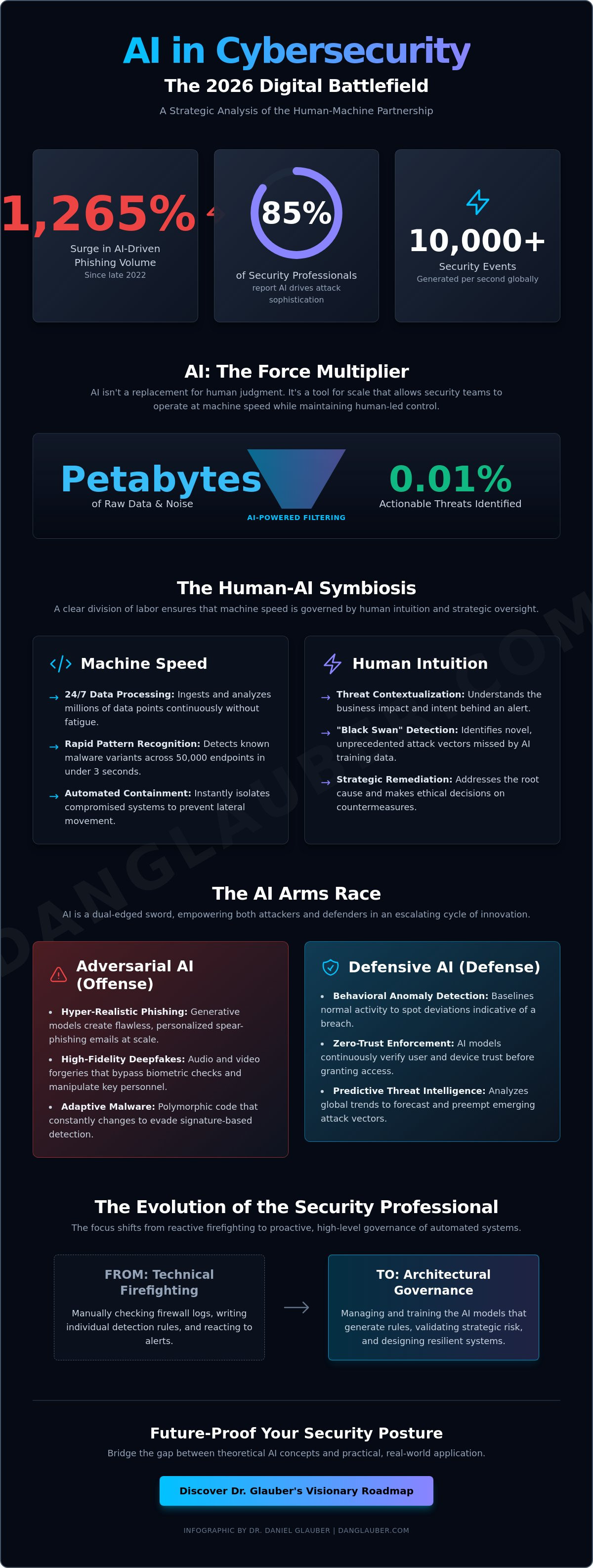
By 2026, the digital battlefield won't be won by the fastest algorithm alone, but by the leader who masters the synergy between human intuition and machine speed. You've likely felt the mounting pressure as AI-driven phishing volume surged by 1,265% since late 2022. It's natural to wonder, will ai take over cyber security, or if your current defense strategy is destined for obsolescence. You're right to be skeptical of the hype; while 85% of security professionals report that AI is already a primary driver of attack sophistication, the tool is only as effective as the framework governing it.
This expert analysis moves beyond the alarmism to show you why artificial intelligence is transforming, but not replacing, the strategic core of digital defense. You'll gain a definitive understanding of the AI-human relationship and discover actionable steps to future-proof your organization against adversarial AI. We'll explore the intersection of AI and cybersecurity through the lens of Zero-Trust Architecture and real-world case studies, providing the strategic clarity you need for your next board-level briefing.
Key Takeaways
- Define AI's role in 2026 as a sophisticated force multiplier that enhances defensive scale while maintaining the critical necessity of human-led strategic oversight.
- Analyze the evolving digital battlefield where Adversarial AI and deepfakes create an unprecedented arms race, challenging even the most robust traditional filters.
- Discover why the "Context Gap" ensures that human intuition and ethical decision-making remain the ultimate safeguards when determining if will ai take over cyber security in the coming years.
- Master the deployment of actionable frameworks and Zero-Trust Architecture to build a resilient foundation capable of neutralizing complex AI-driven attack vectors.
- Access Dr. Daniel Glauber’s visionary roadmap for future-proofing your security posture by bridging the gap between theoretical AI concepts and practical, real-world application.
The Reality Check: AI as a Force Multiplier, Not a Replacement
By 2026, the provocative question of will ai take over cyber security has shifted from speculative science fiction to a practical matter of strategic scaling. We've moved past the "Total Automation" myth. Organizations don't need a sentient agent to replace their CISO; they need a force multiplier to manage the 10,000+ security events generated every second across global cloud networks. AI is not a replacement for human judgment. It's a tool for scale that allows us to operate at machine speed while maintaining human-led control over the digital battlefield. This evolution requires a fundamental mindset shift, as cybersecurity in the age of artificial intelligence demands that we stop viewing AI as a competitor and start seeing it as a critical infrastructure component.
The "Force Multiplier" metaphor is the most accurate way to describe this relationship. AI handles the data; humans handle the intent. In a typical 2026 SOC environment, neural networks filter through petabytes of noise to identify the 0.01% of signals that represent a true threat. However, the decision to shut down a critical production server or initiate a legal countermeasure remains a human prerogative. This division of labor ensures that AI safety protocols are integrated into the workflow, preventing automated systems from making catastrophic errors based on misinterpreted context. We're building a partnership where the machine provides the reach, but the human provides the restraint.
The Speed of Machine Learning vs. The Nuance of Human Logic
Neural networks identify patterns across vast datasets faster than any human analyst could dream. By 2026, these systems can detect a polymorphic malware variant across 50,000 endpoints in under three seconds. Despite this algorithmic speed, pattern recognition has a hard limit: the "Black Swan" event. When an adversary deploys a completely novel attack vector that hasn't appeared in training data, AI often misses the signal because it doesn't fit a known pattern. Human logic excels here. We use intuition, historical context, and lateral thinking to identify anomalies that don't follow a mathematical trend. Strategic risk management requires a deliberate, slow pacing that balances algorithmic urgency with professional skepticism.
Why 'Take Over' is the Wrong Framing for 2026
The conversation around will ai take over cyber security often focuses on job replacement, but the reality is role evolution. Security professionals are moving away from technical "firefighting," such as manually checking firewall logs, and moving toward high-level architectural governance. Instead of writing individual detection rules, experts now manage the AI models that generate those rules. This shift transforms the analyst into a supervisor of automated systems. AI in security functions as an augmentation layer that accelerates threat detection while relying on human expertise to validate strategic risk and intent. The goal is mastery over the tool, not submission to the process.
- Data Processing: Handled by AI for 24/7 coverage and scale.
- Threat Contextualization: Handled by humans to understand business impact.
- Incident Response: A hybrid approach where AI contains the threat and humans remediate the root cause.
The Evolution of the Digital Battlefield: How AI Transforms Threat Landscapes
The 2026 threat landscape isn't just faster; it's fundamentally more intelligent. Attackers now leverage generative models to scale operations that previously required hundreds of human hours, creating a definitive arms race. This shift allows for AI-driven phishing campaigns and high-fidelity deepfakes that bypass the static filters common in 2023. Understanding ai and cybersecurity requires recognizing this technology as a dual-edged sword. It empowers the defender while simultaneously arming the adversary with a precision-guided arsenal.
Traditional, static defense models are effectively dead in this new era. These rule-based systems cannot adapt to the fluid tactics of Adversarial AI. When we analyze will ai take over cyber security, we must look at the speed of the current digital battlefield. Security teams no longer have the luxury of "minutes" to respond; they now operate in milliseconds. Organizations that fail to transition to a dynamic, AI-integrated posture find themselves vulnerable to automated exploitation frameworks that never sleep.
Automating the Attack Surface: The Rise of Smart Malware
Traditional malware typically left a recognizable "fingerprint" or signature that security software could block. Today, polymorphic code uses neural networks to rewrite its own structure in real-time, making it invisible to legacy antivirus tools. Automated reconnaissance tools now scan enterprise perimeters in seconds, identifying misconfigurations that human auditors might miss during a week-long assessment. Because of these advancements, "Zero-Day" attacks have increased by 42% since early 2024. AI-assisted vulnerability discovery allows hackers to find and exploit weaknesses before a vendor patch even exists, shortening the breach lifecycle to a matter of hours.
Neural Network Defenses: Fighting Fire with Fire
Modern Security Operations Centers (SOCs) must fight fire with fire to maintain operational integrity. By integrating AI's role in threat landscapes, organizations move from signature-based detection to intent-based prediction. These systems analyze behavioral patterns to spot "impossible" anomalies, such as a user account accessing a database from two different continents within a ten-minute window.
A 2025 industry benchmark study highlighted a case where an AI-driven SOC neutralized a multi-stage ransomware attempt in 14 seconds. This occurred well before a human analyst could even acknowledge the initial alert. This transition from reactive to proactive defense is the only way to achieve strategic readiness in an age of automated warfare. This level of mastery is no longer optional; it's the baseline for survival in a world where the enemy is a machine.
The Human-AI Symbiosis: Why Context and Intuition Remain Uniquely Human
While the digital battlefield evolves at breakneck speed, the central question persists: will ai take over cyber security entirely? The definitive answer is no. Machines excel at processing petabytes of data and identifying patterns across vast attack surfaces, yet they consistently stumble in the "Context Gap." An AI model can flag a suspicious lateral movement across a network, but it cannot understand if that movement is a critical, board-approved server migration or a genuine breach. It lacks the nuanced intuition to weigh security friction against business continuity.
The role of empathy and ethics becomes paramount during a crisis. When a ransomware attack hits, the response isn't just technical; it's emotional and strategic. Humans must manage stakeholder anxiety and make ethical calls that algorithms aren't programmed to handle. AI cannot "own" a risk. Accountability remains a human burden because a machine cannot be held liable for a catastrophic error. We must also address the "hallucination" risk. In 2025, reports indicated that even advanced security LLMs produced false positives or fabricated threat intelligence in 15% of complex forensic cases. Human verification is the only safeguard against these algorithmic ghosts.
The Strategic Frontier: Decisions Machines Can't Make
Security leaders face a constant trade-off between absolute protection and operational agility. Tightening Zero-Trust policies might stop an Adversarial AI attack, but it could also paralyze a $500 million production line. AI lacks the professional judgment needed for high-stakes board-level briefings where risk tolerance is debated. Humans are uniquely capable of interpreting "weak signals," those subtle anomalies that don't fit into a standard training dataset. A 2024 Gartner study highlighted that 60% of security failures stem from poor human-centric design. Machines process logic; humans manage the organizational fallout.
Governance and the Ethics of Automated Defense
The transition toward autonomous security raises a critical question of responsibility. Who is accountable when an AI-driven tool makes a tactical error? This is especially volatile in the realm of "Active Defense." The ethical implications of "Hack Back" automation are staggering. If an automated countermeasure accidentally disrupts a hospital's life-support systems while targeting a perceived threat, the algorithm doesn't stand trial. To avoid the "Black Box" security trap, organizations must prioritize transparency. We use these actionable frameworks to ensure human oversight remains the anchor of every defense strategy:
- Risk Ownership: Defining the human executive responsible for every automated response trigger.
- Model Transparency: Auditing neural networks to ensure decision-making logic is explainable to regulators.
- Crisis Empathy: Utilizing human-led communication strategies for post-incident recovery.
- Verification Protocols: Implementing mandatory human-in-the-loop (HITL) checks for high-impact security changes.
Maintaining this symbiosis is the only way to achieve mastery in the Age of Artificial Intelligence. While we leverage AI to sharpen our tactics, the strategic vision and ethical compass must remain human. For those asking if will ai take over cyber security, the reality is a shift in role, not an exit from the stage. We aren't being replaced; we're being promoted to the role of AI orchestrators.
Strategic Readiness: Adapting Your Security Framework for an AI-Driven World
Integrating artificial intelligence into your existing architecture requires more than a software update; it demands a shift toward Actionable Frameworks. These frameworks provide the necessary structure to move from reactive defense to proactive mastery. As leaders ask, "will ai take over cyber security," the focus must pivot toward how human intelligence orchestrates these automated systems. By 2026, 85% of global enterprises will require a unified AI-security roadmap to maintain a competitive edge in the digital battlefield. It's not about replacing the human element but enhancing it through structured, disciplined integration.
Zero-Trust Architecture remains the non-negotiable foundation for an AI-resilient posture. It operates on the principle that no entity, whether a human user or an autonomous agent, is inherently trustworthy. This becomes critical when conducting an AI Risk Assessment for internal tools. You must evaluate data lineage, model integrity, and the potential for adversarial prompt injection. Professional cyber security firms play a vital role here, providing the external auditing necessary to vet third-party AI vendors who often obscure their security protocols behind proprietary black boxes. Relying on unverified vendor claims is a risk no modern board can afford to take.
Building an AI-Resilient Culture
True security starts at the board level. Executive training must move past the AI hype to address specific operational risks, such as algorithmic bias and data poisoning. Your current security team shouldn't fear replacement. Instead, they must upskill into AI Orchestrators who manage the intersection of AI and cybersecurity. AI resilience is the ability to maintain operations during an automated attack. This cultural shift ensures that when an incident occurs, the response is calculated rather than chaotic. Organizations that prioritize this upskilling see a 40% improvement in incident response efficiency.
The vCISO Approach to AI Governance
A virtual CISO (vCISO) provides the strategic bridge between complex technical tools and broader business objectives. They implement iterative security roadmaps that evolve as quickly as the underlying technology. Evaluating the ROI of these tools requires a move beyond simple threat counts. By 2026, successful organizations will measure success through metrics like the reduction in Mean Time to Remediate (MTTR) and the precision of automated triage. It's about strategic readiness, not just accumulating software licenses. A vCISO ensures your AI investments align with long-term resilience goals.
Navigating the Intersection: Dr. Glauber’s Vision for Future-Proof Security
Dr. Daniel Glauber stands at the center of this transformation, serving as a strategic guide for organizations facing an uncertain digital horizon. His core thesis, detailed in his book Cybersecurity in the Age of Artificial Intelligence, posits that the question of whether or not will ai take over cyber security misses the critical point. AI is already the primary catalyst for a new era of adversarial tactics. Dr. Glauber’s work moves beyond the hype to provide a definitive roadmap for integrating AI into defensive strategies without losing human oversight. He helps boards and executives understand that AI is a force multiplier for both sides of the conflict. Success requires a shift from reactive patching to proactive, AI-driven resilience.
Mastery Through Actionable Frameworks
Dr. Glauber’s methodology is built on 18 comprehensive chapters and more than 50 real-world case studies that ground abstract concepts in operational reality. These aren't just academic exercises; they are the foundation for his executive workshops. These sessions focus on demystifying neural networks and identifying specific attack vectors that traditional systems miss. By moving from theory to application, Dr. Glauber enables leaders to implement Zero-Trust architectures that are hardened against adversarial AI. Organizations can engage Dr. Glauber for keynote speaking or long-term strategic advisory to ensure their defense remains ahead of the curve. This structured approach provides the clarity needed to master the intersection of risk and innovation.
The Future of the CISO in the AI Era
The role of the Chief Information Security Officer is undergoing a radical shift toward becoming a Chief Risk Strategist. In a world where bots can generate millions of unique threats per hour, technical management alone is insufficient. When asking will ai take over cyber security, we must recognize that human judgment is the ultimate countermeasure. Dr. Glauber emphasizes that while AI handles the scale, humans must handle the strategy and ethics. Mastery of this intersection is the only way to survive the digital battlefield of 2026. Secure your organization's future with Dr. Glauber's strategic advisory and prepare for the challenges of tomorrow, today.
Mastering the Strategic Frontier of AI-Driven Defense
As we approach 2026, the question of whether will ai take over cyber security finds its answer in the synergy between machine speed and human judgment. The evolution of the digital battlefield demands more than just automated tools; it requires a sophisticated integration of neural networks and zero-trust architectures. While AI transforms threat landscapes by processing petabytes of data in milliseconds, it cannot replicate the contextual intuition of a seasoned practitioner. Success depends on moving from a reactive stance to a state of strategic readiness. Dr. Daniel Glauber, drawing on 30+ years of technology and innovation experience, emphasizes that the intersection of AI and cybersecurity is a landscape of both unprecedented risk and revolutionary opportunity. As a global vCISO and executive advisor, he's documented 50+ real-world case studies that prove human-led strategy remains the ultimate countermeasure against adversarial AI. It's time to bridge the gap between abstract theory and actionable application.
Order 'Cybersecurity in the Age of Artificial Intelligence' and Master the Strategic Frontier
Equipping yourself with these definitive frameworks will empower you to lead your organization with confidence through the next era of digital innovation.
Frequently Asked Questions
Will AI eventually replace entry-level cybersecurity jobs?
AI won't eliminate entry level roles by 2026, but it will automate approximately 40% of tier 1 SOC analyst tasks like manual log correlation and basic alert filtering. Entry level practitioners must pivot from data collection to strategic data interpretation within our actionable frameworks. This shift enables humans to focus on complex threat hunting while AI manages the baseline noise of the digital battlefield.
Can AI fully automate incident response without human intervention?
AI cannot fully automate incident response because it lacks the contextual judgment required for high stakes business continuity decisions. While automated playbooks can isolate a compromised host in milliseconds, the decision to shut down a core production server remains a human responsibility. Mastering the intersection of AI and cybersecurity means using machine speed for containment while humans lead the strategic recovery tactics.
How does AI handle completely new types of cyberattacks (Zero-Days)?
AI identifies zero day vulnerabilities by using neural networks to detect behavioral anomalies rather than relying on outdated signature databases. By 2026, predictive models can flag suspicious patterns that deviate from established baselines with 95% accuracy. These countermeasures allow security teams to neutralize unknown attack vectors before they manifest into a full scale breach of the corporate perimeter.
Is it safe to integrate Generative AI into my company's security operations?
Integrating Generative AI is safe only when governed by a strict Zero-Trust Architecture and localized data processing. Organizations that fail to implement these guardrails risk exposing proprietary code or sensitive telemetry to public models. We recommend using private LLM instances to ensure your tactical data remains within the corporate environment while still benefiting from accelerated report generation.
What are the biggest risks of relying too heavily on AI for cyber defense?
The primary risk of over reliance is adversarial AI, where attackers poison training sets to create blind spots in your defense models. A 2024 industry survey indicated that 60% of security leaders worry about model drift and false positives causing operational fatigue. If your team stops questioning the machine's output, you've already lost the tactical advantage on the digital battlefield.
What skills should cybersecurity professionals learn to stay relevant in 2026?
Professionals must master AI model auditing, data science fundamentals, and advanced prompt engineering for security orchestration to remain competitive. Understanding how to validate AI generated code and audit neural networks will be more valuable than traditional manual configuration skills. This evolution is central to our analysis of whether will ai take over cyber security or simply augment human capability.
How much should a company invest in AI security tools vs. human talent?
Organizations should target a 60/40 investment split between human talent and AI driven toolsets to maintain a resilient defense posture. While industry data suggests that AI spending in security will grow by 24% annually through 2026, technology without skilled operators is a liability. Investing in human mastery ensures that your actionable frameworks are executed with precision and strategic foresight.
Does AI make traditional security frameworks like NIST or ISO obsolete?
Traditional frameworks like NIST and ISO aren't obsolete; they're evolving to include specific controls for machine learning and algorithmic integrity. The NIST AI Risk Management Framework 1.0, released in 2023, provides the necessary structure to integrate these technologies into existing compliance models. These standards remain the definitive foundation for any organization navigating the intersection of AI and cybersecurity.