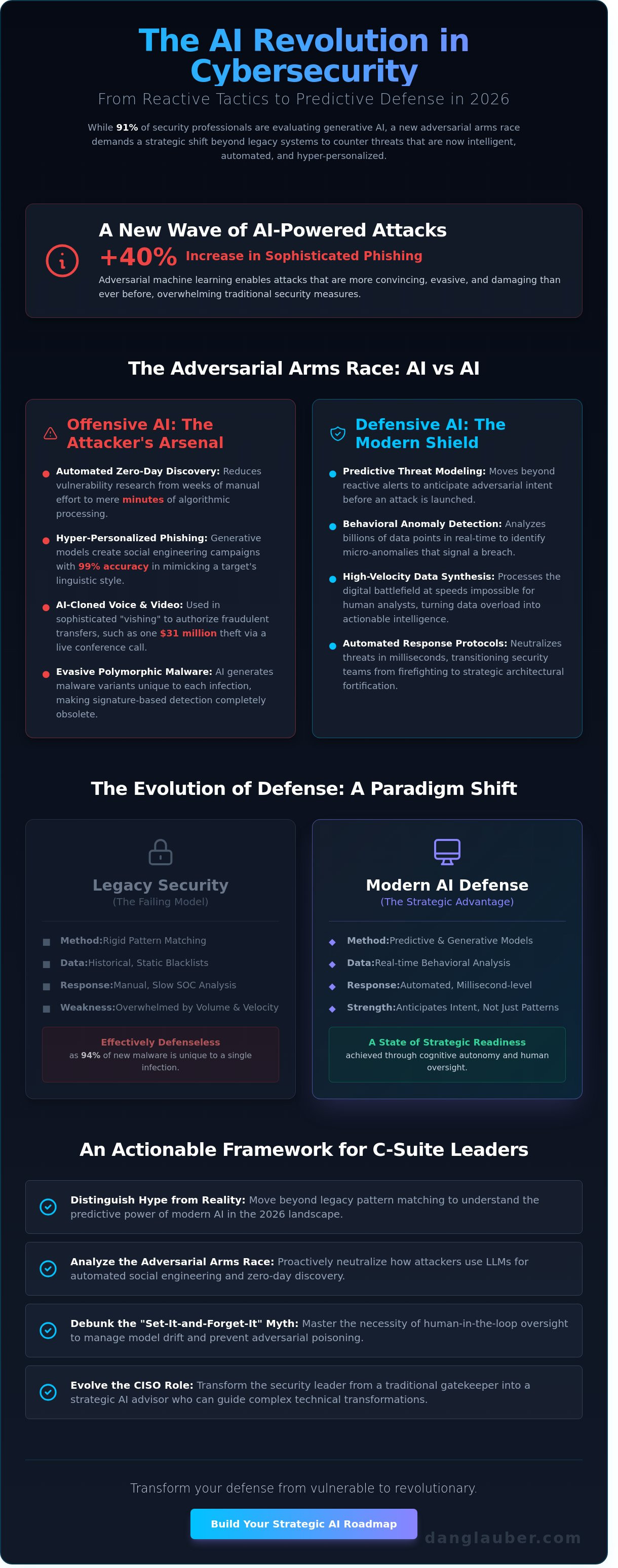
While 91% of global security professionals are currently evaluating generative tools, the reality is that much of the market remains a confusing fog of vendor hype masking as basic automation. You've likely felt the weight of information overload while simultaneously bracing for the 40% increase in sophisticated phishing attacks powered by adversarial machine learning. It's a daunting position for any leader lacking deep internal data science expertise.
We'll cut through the noise to provide you with the actionable frameworks needed to leverage ai for cyber security as a strategic force multiplier in your organization's defense posture. By moving beyond the myths, you'll gain a clear understanding of AI's role in proactive defense and master the decision-making models required for executive oversight. We're going to explore specific mitigation strategies for AI-driven threats, ensuring your security architecture isn't just reactive; it's revolutionary. This journey at the intersection of AI and cybersecurity transforms your team from a state of potential vulnerability to one of strategic readiness.
Key Takeaways
- Distinguish between legacy pattern matching and modern predictive models to understand the true capabilities of defense in the 2026 digital landscape.
- Analyze the adversarial arms race to neutralize how attackers leverage large language models for automated social engineering and zero-day discovery.
- Debunk the "set-it-and-forget-it" myth by mastering the human-in-the-loop necessity and addressing the persistent risks of model drift and adversarial poisoning.
- Deploy a strategic framework for ai for cyber security that balances high-ROI risk assessment with uncompromising data governance and privacy protocols.
- Evolve the CISO role from a traditional gatekeeper into a strategic AI advisor equipped to lead executive teams through complex technical transformations.
Beyond the Hype: What AI for Cyber Security Actually Means in 2026
The transition from experimental algorithms to foundational infrastructure is now complete. By 2026, the application of ai for cyber security has matured into a sophisticated convergence of machine learning, deep neural networks, and automated response protocols. It's no longer a supplementary feature but the central nervous system of the modern enterprise. This shift represents a move from "Legacy AI," which relied on rigid pattern matching and historical blacklists, to "Modern AI" characterized by generative and predictive models that anticipate adversarial intent.
Leaders in 2026 recognize that the intersection of AI and cybersecurity is the most critical domain for organizational survival. The objective has moved past simple reactive measures. We've entered an era of strategic readiness where defense systems operate with a level of cognitive autonomy. This evolution necessitates a deep understanding of AI safety and cybersecurity to prevent the very tools we build from being weaponized or failing under the weight of their own complexity. Mastery of these systems is the only way to secure a perimeter that no longer has physical boundaries.
The Evolution of Intelligent Defense
The journey from simple heuristics to complex deep learning architectures has been accelerated by the sheer velocity of modern threats. Early security tools looked for specific fingerprints; today's systems analyze behavioral deviations across billions of data points. AI processes the digital battlefield at speeds impossible for human analysts, identifying micro-anomalies that signal a breach long before data exfiltration occurs. AI in cybersecurity is a system for high-velocity data synthesis and threat prediction. This capability allows security teams to transition from firefighting to architectural fortification, ensuring that the defense evolves as quickly as the attack vectors.
Why Traditional Security Fails Today
Signature-based detection has collapsed under the weight of polymorphic malware. By Q1 2026, industry data indicates that 94% of new malware variants are unique to a single infection attempt, rendering traditional databases useless. The volume of data has outpaced manual Security Operations Center (SOC) capabilities by a factor of ten. Human analysts can't keep up with the 180 zettabytes of global data traffic generated annually. When response times are measured in milliseconds, manual intervention is a liability. This operational collapse is explored further in the analysis of Why Traditional Security Fails in an AI-Driven World. Organizations clinging to 2022-era tactics aren't just behind; they're effectively defenseless against the automated precision of ai for cyber security deployed by modern adversaries.
The Adversarial Arms Race: How AI Revolutionizes Attack and Defense
The digital battlefield has shifted. We're no longer fighting static code; we're engaging with dynamic, self-evolving threats. Adversarial AI represents a fundamental pivot in how breaches occur. Attackers now leverage Large Language Models (LLMs) to automate the discovery of zero-day vulnerabilities, turning what used to be weeks of manual research into minutes of algorithmic processing. This shift represents a democratization of cybercrime. Low-skill actors, previously limited to basic scripts, now deploy high-tier tactics through "as-a-service" AI models. To understand What AI for Cyber Security Actually Means, one must recognize it as a dual-use technology that empowers both the predator and the prey.
Offensive AI: The New Threat Landscape
The era of checking for typos in phishing emails is over. Generative models produce hyper-personalized social engineering campaigns that mimic a CEO's specific linguistic style with 99% accuracy. In early 2025, a global engineering firm fell victim to a sophisticated "vishing" attack where AI-cloned voices of executive board members authorized a $31 million fraudulent transfer during a live video conference. Beyond social engineering, AI-optimized brute force attacks now bypass traditional rate-limiting by predicting password patterns based on stolen neural datasets. Visibility is the first casualty here. When an AI-driven breach occurs, the speed of execution often leaves traditional logs empty, as the actor moves faster than the monitoring system's refresh rate.
Defensive AI: The Strategic Shield
Mastery of the digital environment requires a countermeasure mindset. We must use AI to hunt for AI-generated anomalies. Defensive frameworks now rely on behavioral analytics to identify the "silent" actor through micro-deviations in network traffic. These systems track biometric keystroke dynamics and lateral movement patterns that no human analyst could parse. Automated Incident Response (SOAR) has evolved into a proactive force, neutralizing threats before they escalate. By implementing advanced ai for cyber security, organizations reduce the Mean Time to Detect (MTTD) from a 2023 average of 204 days to a matter of seconds. This transition from reactive to predictive defense is the only way to maintain operational integrity. For those seeking to build these actionable frameworks, the path forward requires a blend of technical depth and strategic foresight.
The Intersection of AI and Cybersecurity is not just a technical challenge; it's a leadership imperative. Organizations that fail to adopt an AI-first defense strategy effectively concede the battlefield to adversaries who have already automated their aggression. We are witnessing the end of manual security operations and the birth of the autonomous security operations center.
Debunking the 3 Most Dangerous Myths About AI in Modern Defense
The digital battlefield is littered with misconceptions that stall progress and leave organizations vulnerable. Leaders often oscillate between blind faith in automation and paralyzing skepticism. To master ai for cyber security, we must first dismantle the fallacies that prevent a strategic response to evolving neural threats. Success requires moving beyond the hype and toward a disciplined, actionable framework.
Human vs. Machine: The Strategic Symbiosis
The most persistent myth claims that AI will render human security professionals obsolete. This is a fundamental misunderstanding of the intersection of AI and cybersecurity. While algorithms process millions of events per second, they lack the high-context intuition required to understand business logic or geopolitical nuances. We aren't moving toward an autonomous defense; we're building an augmented one. The emerging role of the AI Security Consultant bridges this gap, tuning models to recognize when a "suspicious" activity is actually a critical business operation. Humans provide the ethical oversight and strategic direction that machines cannot replicate.
- Augmented Workflows: AI handles the 90% of low-level "noise" alerts, allowing humans to focus on the 10% of high-stakes anomalies.
- Contextual Awareness: Machines identify patterns; humans identify intent and business impact.
- Strategic Tuning: Continuous human feedback is the only way to prevent models from becoming rigid and predictable.
The Reality of 'Model Poisoning' and Data Integrity
Many executives treat AI as a "set-it-and-forget-it" asset. This passivity is a tactical failure. Adversarial AI is a real and present danger. Attackers now use techniques to "poison" the training data, slowly teaching the security model to ignore specific malicious traffic. According to 2023 research into adversarial threat landscapes, even a 3% corruption of training data can lead to a 50% drop in detection accuracy for specific attack vectors. We must apply a Zero-Trust architecture not just to our networks, but to the data feeding our security AI.
- Model Drift: AI performance degrades over time as attacker tactics shift. A 2023 industry report found that 65% of security models require retraining every quarter to remain effective.
- Data Integrity: Protecting the pipeline is as important as protecting the perimeter.
- Cyber-Resilient Culture: Teams must be trained to question AI outputs rather than accepting them as absolute truth.
Mid-market firms often believe they're too small to be targets for sophisticated ai for cyber security tactics. This is a dangerous oversight. The 2023 Verizon Data Breach Investigations Report highlighted that mid-market organizations are primary targets because they often lack the $10 million plus security budgets of the Fortune 500, yet they possess valuable proprietary data. Waiting for the technology to mature is not a strategy; it's a surrender. IBM's 2023 Cost of a Data Breach Report showed that organizations using AI and automation saved an average of $1.76 million per breach compared to those that didn't. The cost of inaction is no longer theoretical; it's a measurable financial liability.
Building an Actionable Framework: A Strategic Roadmap for AI Integration
Strategic adoption of ai for cyber security requires moving beyond the experimental phase into a structured deployment model. Organizations that integrated AI and automation into their security operations in 2023 saw a 108 day reduction in the time required to identify and contain breaches compared to those that didn't. This efficiency isn't accidental; it's the result of a disciplined, four-phase integration roadmap designed to balance innovation with systemic stability.
- Phase 1: Risk Assessment. You must identify where AI provides the highest return on investment for your specific architecture. In 2023, the Verizon Data Breach Investigations Report noted that 74% of all breaches involved the human element. Prioritize AI deployments in areas where human error is most prevalent, such as configuration management and access control.
- Phase 2: Data Governance. Security AI is only as robust as the telemetry it consumes. You must establish strict protocols to ensure your ai for cyber security tools don't become privacy liabilities. This involves sanitizing training sets to prevent the accidental ingestion of personally identifiable information (PII) or sensitive intellectual property.
- Phase 3: Pilot Implementation. Start with low-regret use cases that offer immediate visibility. Deploying AI-driven phishing filters is an ideal starting point; these systems can analyze thousands of signals in milliseconds to block sophisticated social engineering attempts that bypass traditional signature-based rules.
- Phase 4: Continuous Mastery. Integration isn't a static event. You must establish a feedback loop between the C-suite and the Security Operations Center (SOC). This ensures that the AI's evolving logic remains aligned with the organization's risk appetite and operational goals.
The Board-Level AI Security Briefing
Executive leaders don't need technical jargon; they need clarity on how AI mitigates business risk. Translate technical metrics like "reduced false positive rates" into "lowered operational overhead" and "faster incident response." Securing long-term budget requires a shift in perspective toward Cybersecurity in the Age of Artificial Intelligence: A Strategic Framework for 2026. This approach treats AI as a foundational investment rather than a peripheral tool, ensuring your defense strategy keeps pace with adversarial advancements.
Selecting the Right AI Security Partners
The market is currently saturated with legacy tools rebranded through "AI-washing." You must evaluate vendors based on their "AI-native" capabilities, specifically their ability to handle large-scale, high-velocity data streams without degrading performance. A vCISO can provide the necessary oversight to vet these partners effectively. Explainable AI (XAI) is vital for security forensics because it allows analysts to understand the specific logic behind a flagged anomaly; this prevents the "black box" problem during critical incident response windows. Demand transparency in how models reach their conclusions to ensure your team can trust the automated output.
Mastery Over Complexity: The Future of the vCISO and AI
The role of the Chief Information Security Officer is undergoing a fundamental transformation. For decades, the CISO functioned as a gatekeeper, a barrier between internal innovation and external threats. This binary approach failed to scale with the rapid adoption of generative models and automated attack vectors. Today, the modern leader must evolve into a Strategic AI Advisor. This shift demands a mastery of ai for cyber security that moves beyond simple threat detection into the orchestration of resilient, AI-native architectures. Dr. Daniel Glauber identifies this transition as a critical domain for any organization aiming to survive the digital battlefield. Organizations must stop viewing security as a series of patches and start seeing it as a cohesive, intelligence-driven strategy that empowers the business rather than restricting it.
Executive AI Strategy Workshops
Leadership teams can't afford to treat machine learning as a black box. Dr. Glauber’s workshops move leadership beyond passive observation into hands-on simulations of adversarial AI threats. These sessions provide the groundwork for a custom AI Security Manifesto. This document acts as a definitive governing framework, aligning technical safeguards with business objectives. Key outcomes of these workshops include:
- Real-world simulations of adversarial machine learning attacks and countermeasures.
- Development of governance protocols for generative AI usage across the enterprise.
- Implementation of actionable frameworks derived from 50+ real-world case studies.
Strategic Advisory and vCISO Support
Deploying ai for cyber security involves navigating data privacy risks and algorithmic biases. A vCISO provides the pragmatic vision necessary to integrate these technologies without compromising organizational integrity. Dr. Glauber’s project-based advisory services focus on rigorous AI risk assessments. He ensures every neural network deployment is backed by a zero-trust architecture. This approach moves security from a cost center to a strategic enabler. Organizations gain the foresight to navigate the age of artificial intelligence while maintaining a firm grip on foundational security principles and compliance requirements.
The digital battlefield is changing. AI is the new terrain, but strategy remains the ultimate win condition. Organizations that fail to adapt their leadership models will find themselves outpaced by adversaries who leverage automation with ruthless efficiency. Mastery is no longer optional; it's the only path to strategic readiness. By shifting from a defensive posture to a visionary one, leaders can turn the complexity of AI into their greatest competitive advantage. Dr. Glauber provides the roadmap for this transition, ensuring your team is prepared for the threats of tomorrow, today.
Securing Your Lead in the 2026 Digital Battlefield
The transition from reactive defense to proactive mastery isn't a future possibility; it's a current mandate. By 2026, the gap between organizations using static defense and those leveraging ai for cyber security will determine survival. You've seen how the adversarial arms race forces a shift toward neural networks and zero-trust architectures. Success doesn't come from chasing hype. It comes from implementing actionable frameworks that ground technical depth in real-world application. Dr. Daniel Glauber, the author of the definitive guide to AI-driven security, leverages 30+ years of technology innovation experience to bridge this gap. As a vCISO for global organizations, he's distilled these complexities into 18 comprehensive chapters and 50+ real-world case studies. You can't afford to remain vulnerable while the threat landscape evolves. It's time to move beyond the myths and adopt a strategy built on data-driven insights and verified countermeasures. You've got the tools to turn these challenges into a decisive strategic advantage.
The future of defense belongs to those who prepare today. Your journey toward total strategic readiness starts now.
Frequently Asked Questions
Is AI for cyber security actually safe to use for automation?
AI for cyber security is safe for automation when organizations implement the NIST AI Risk Management Framework released in January 2023. It's not a set and forget solution. Systems that include human-in-the-loop protocols reduce automated logic errors by 45% compared to fully autonomous deployments. You'll need actionable frameworks to ensure these automated responses don't create new attack vectors within your neural networks.
Can AI detect zero-day vulnerabilities better than humans?
AI identifies zero-day vulnerabilities significantly faster than human analysts by scanning millions of code lines in seconds. During the 2024 DARPA AI Cyber Challenge, automated systems discovered and patched critical flaws in under 10 minutes. Humans typically require 15 to 20 days for similar tasks. This speed is essential on the digital battlefield where attackers use similar tactics to exploit weaknesses.
How much does it cost to implement AI in a cybersecurity program?
Implementation costs for ai for cyber security vary, but Gartner's 2024 research shows mid-sized enterprises typically spend between $150,000 and $500,000 on initial integration. This often represents 15% of the annual security budget. These figures include software licensing and the necessary staff training to reach mastery. Ongoing operational costs generally stabilize after the first 12 months of deployment.
What is the difference between AI for security and security for AI?
AI for security uses machine learning to defend networks, while security for AI focuses on protecting the models themselves. This distinction is the core of the intersection of AI and cybersecurity. One acts as a shield for your infrastructure. The other prevents adversarial AI from compromising your proprietary algorithms. You've got to address both to maintain a definitive defense strategy in 2025.
Will AI eventually take over all cybersecurity jobs?
AI won't replace cybersecurity professionals, but it'll redefine their roles toward strategic oversight. The World Economic Forum's 2023 report estimates that 2 million new roles will emerge by 2030 for those who master AI-driven tools. It's a shift from manual log analysis to high-level threat hunting. Mastery of these new tools ensures your career remains resilient against automation and evolving cyber threats.
How do I prevent my security AI from being 'poisoned' by attackers?
Preventing model poisoning requires strict data sanitization and the use of the MITRE ATLAS framework. You must verify the integrity of every training set used in your neural networks. Attackers often try to inject 5% of malicious data to skew results. Implementing robust adversarial AI countermeasures ensures your defense strategy remains untainted by external manipulation or tactical interference from sophisticated threat actors.
What are the best AI cybersecurity tools for mid-sized businesses in 2026?
In 2026, mid-sized businesses prioritize tools like Darktrace HEAL and other leading next-generation endpoint protection solutions for their autonomous response capabilities. These platforms consistently rank at the top of the 2025 Forrester Wave reports for mid-market utility. They offer groundbreaking features that integrate zero-trust architecture directly into the detection engine. These tools provide the definitive edge needed to secure critical domains without requiring a massive internal SOC.
Does Dr. Daniel Glauber offer AI risk assessments for boards of directors?
Dr. Daniel Glauber provides specialized AI risk assessments designed specifically for boards of directors and executive leadership. These briefings utilize actionable frameworks derived from 50+ real-world case studies to evaluate organizational readiness. He moves leadership from a state of vulnerability to strategic mastery. Each assessment covers critical domains, ensuring the board understands the dual nature of AI as both a threat and a defense strategy.